Category Archives: Culture

For Election Day: Malcolm X on blind party allegiance [AUDIO]

Before you start down that path, understand I am not defending, promoting or worshiping Malcolm X. From his bio on Wikipedia:

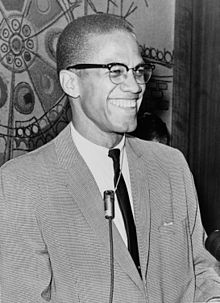
Malcolm X ( /ˈmælkəm ˈɛks/; May 19, 1925 – February 21, 1965), born Malcolm Little and also known as El-Hajj Malik El-Shabazz[1] (Arabic: الحاجّ مالك الشباز‎), was an African-American Muslim minister and human rights activist. To his admirers, he was a courageous advocate for the rights of blacks, a man who indicted white America in the harshest terms for its crimes against black Americans. Detractors accused him of preaching racism, black supremacy, and violence. He has been called one of the greatest and most influential African Americans in history.

Malcom X in 1964


Malcolm X’s father died—killed by white supremacists, it was rumored—when he was young, and at least one of his uncles was lynched. When he was thirteen, his mother was placed in a mental hospital, and he was placed in a series of foster homes. In 1946, at age 20, he went to prison for breaking and entering.

In prison Malcolm X became a member of the Nation of Islam and after his parole in 1952 he quickly rose to become one of its leaders. For a dozen years Malcolm X was the public face of the controversial group, but disillusionment with Nation of Islam head Elijah Muhammad led him to leave the Nation in March 1964. After a period of travel in Africa and the Middle East, he returned to the United States, where he founded Muslim Mosque, Inc. and the Organization of Afro-American Unity. In February 1965, less than a year after leaving the Nation of Islam, he was assassinated by three members of the group.

Malcolm X’s expressed beliefs changed substantially over time. As a spokesman for the Nation of Islam he taught black supremacy and advocated separation of black and white Americans—in contrast to the civil rights movement’s emphasis on integration. After breaking with the Nation of Islam in 1964—saying of his association with it, “I was a zombie then … pointed in a certain direction and told to march”—and becoming a Sunni Muslim, he disavowed racism and expressed willingness to work with civil rights leaders, though still emphasizing black self-determination and self-defense.

Below is the audio from a speech to a group of African Americans. Though Malcolm X is deriding them unceasingly for their support of the Democratic party, his observations about party loyalty are true across the board. The last build-up and closing sentence are the stuff of a speaker’s dreams.

If you are heading to the polls today, I encourage you to give a listen to this four minutes and think about how these words apply to what we as a nation continue to experience as a result of blind party loyalty.

Six reasons to consider voting third party

Throughout this election season, as in the last one, I have written and discussed here and on Facebook about the need to break the two party, Democrat-Republican dominated political system in the United States. The adversarial aspect of this system has led to a stymied congress, lies, deceit, and an ongoing “lesser of two evils” approach to voting.

voting boothThe election tomorrow seems to be potentially as close as any since Bush-Gore in 2000. Some have even speculated of an Electoral College tie between president Barack Obama and Republican challenger Mitt Romney. Some of my friends have made the informed decision not to vote–and have been castigated for it.

The objection I normally face has been that a vote for a third party candidate is a vote for Barack Obama (if the objection is coming from a conservative) or a vote for Mitt Romney (if coming from a liberal). I reject this reductionistic approach as inaccurate and illogical. Others say a vote for a third party candidate is akin to throwing away one’s vote. On the contrary, I say voting for someone who does not best represent your principles and philosophy of government is throwing away your vote.

Considering such dominance from the Democratic and Republican parties when should you vote for a national candidate not among the two major parties?

1. When you would have to violate your conscience to do so. If an issues or issues important to you are ignored by the most well known candidates do not cast a vote for them.

2. If neither candidate has earned your vote. I do not look at my vote as something I give to a candidate. It is something they must earn. If he or she does not earn it, they do not get it.

3. If your state is polling overwhelmingly toward one candidate or the other. My state, Tennessee, has been Republican since before Obama was elected. It is not about to change; polling is not close to the margin of error. Because of the Electoral College, every single vote truly does not matter; only the total number of votes matter. For that reason you can confidently vote for the candidate your prefer with no concern you might rip the space time election continuum.

4. If you consider the lesser of two evils argument to be abhorrent. Some Christians will make the argument that we will never have a perfect candidate, so every choice is a lesser of two evils. I find this to be thoroughly unpersuasive. First because the “two evils” necessarily eliminates other, better choices. Second because the lack of perfection does not equate to evil. (Try that on your wife: “No, she’s not perfect. In fact, you might as well say she’s evil.” Good luck with that one.)

5. If you are more concerned about being the cure than spreading the cancer. Our political system, while functional, spews a dangerous toxicity. Abuses of power, mindless spending and selfish gain seem to be the norm on The Hill.

6. If neither major party candidate even begins to address issues of vital importance to justice. Most on the Right have reduced the idea of justice to abortion, while most on the Left have similarly reduced it to taking care of the poor. Where, in three presidential debates and one vice-presidential debates, were discussions about our unjust justice system, the unjust “War” on Drugs, concerns to address human trafficking, the NDAA, the unjust drone war? They were nowhere to be found. A candidate who thinks these major issues not worth a mention does not even qualify for the office.

Can you think of any other reasons to consider voting for a third (or “minor”) party candidate?

The real issue with abortion and the DNC

The closer the presidential election draws the more attentions return to the issue of abortion. Those on the left cry “women’s rights” while those on the right plead “right to life.” Both sides are passionate, and often enflamed in their attempts to solidify or overturn–respectively–Roe v Wade.

In early September 2012 the Democratic National Convention met in North Carolina. Amidst the debacle over “God” and “Jerusalem” the Democratic Party passed as strong a pro-abortion plank as has been ever hammered into a platform.

In the days following the DNC meeting ABC’s Cokie Roberts said

I think this Democratic Convention was really over-the-top in terms of abortion. Every single speaker talked about abortion. At some point, you start to alienate people. Thirty percent of Democrats are pro-life.

On the same program Roberts challenged Newark, New Jersey mayor Cory Booker

on why the platform committee removed the phrase saying that abortion should be “safe, legal and rare,” which had been in the platform since Bill Clinton ran on that platform in 1992.

Below is the abortion plank from the 2012 Democratic National Platform called Moving America Forward. Read it carefully.

Protecting A

Woman’s Right to Choose. The Democratic Party strongly and unequivocally supports Roe v. Wade and a woman’s right to make decisions regarding her pregnancy, including a safe and legal abortion, regardless of ability to pay. We oppose any and all efforts to weaken or undermine that right. Abortion is an intensely personal decision between a woman, her family, her doctor, and her clergy; there is no place for politicians or government to get in the way. We also recognize that health care and education help reduce the number of unintended pregnancies and thereby also reduce the need for abortions. We strongly and unequivocally support a woman’s decision to have a child by providing affordable health care and ensuring the availability of and access to programs that help women during pregnancy and after the birth of a child, including caring adoption programs. (2012 DNC Platform, pg. 18)

Here is the thing implicit in the DNC platform: abortion and adoption are moral equivalents. This is the real issue with abortion and the Democratic National Convention.

That Democrats affirm the legality of abortion from conception to birth for any reason or no reason is self-evident and has been for decades. But it is startling they cannot even bring themselves to recommend adoption over abortion. This is slavish adherence to ideology at the expense of civilized thinking.

Perhaps pro-life Democrats should be added to the endangered species list.

The moral and ethical position of the DNC is abortion = birth = adoption. Whether a woman aborts a child, keeps a child, or gives the child to adoptive parents it is a morally equivalent decision. No recommendation is made for a preferred end. They “strongly and unequivocally support” all options. Dismembering a child in the womb is given no moral difference from one delivered healthy into the arms of its mother.

Author Steven Waldman noticed this very thing,

[T]he 2004 platform said abortion “should be safe, legal and rare” – language that’s [sic] casts abortion reduction as morally preferable, something this platform does not. [Emphasis added.]

Unfortunately, the DNC does seem to have a moral preference in the matter though unstated. This can be derived from the statistics of the DNC’s preferred provider of abortion, pre-natal care and adoption referrals, Planned Parenthood. In 2010 Planned Parenthood (who, as seen above in the Booker link, was a prominent player at the 2012 DNC) reported the following:

Planned Parenthood did 329,445 abortions while it provided prenatal care to 31,098 women (90% less) and referred only 841 women to adoption agencies.

The number of women receiving prenatal care dropped significantly from 2009 to 2010, as the abortion business helped 40,489 women in 2009 — meaning almost 10,000 fewer women received prenatal support from Planned Parenthood last year than the year prior, or a drop of almost 25 percent.

The number of women getting adoption referrals also declined — from a low 977 in 2009 to 841 last year, or a decline of 14 percent.

Examined another way Planned Parenthood does 391 abortions for every adoption referral it makes and almost 11 abortions for every woman it helps with prenatal care.

The direction the DNC has taken this year is indeed tragic. They have increased their strident support for Roe v Wade to a philosophical landfill in which good and evil are comparable. To quote Javert, “The world is inside out. The world is upside down.”

[dropcap]L[/dropcap]orem ipsum dolor sit amet, consectetur adipisicing elit, sed do eiusmod tempor incididunt ut labore et dolore magna aliqua. Ut enim ad minim veniam, quis nostrud exercitation ullamco laboris nisi ut aliquip ex ea commodo consequat. Duis aute irure dolor in reprehenderit in voluptate velit esse cillum dolore eu fugiat nulla pariatur. Excepteur sint occaecat cupidatat non proident, sunt in culpa qui officia deserunt mollit anim id est laborum.

Sed ut perspiciatis unde omnis iste natus error sit voluptatem accusantium doloremque laudantium, totam rem aperiam, eaque ipsa quae ab illo inventore veritatis et quasi architecto beatae vitae dicta sunt explicabo. Nemo enim ipsam voluptatem quia voluptas sit aspernatur aut odit aut fugit, sed quia consequuntur magni dolores eos qui ratione voluptatem sequi nesciunt.

[pullquote align=”right”]”Dolores eos qui ratione voluptatem sequi nesciunt. Lorem ipsum dolor.”[/pullquote]Neque porro quisquam est, qui dolorem ipsum quia dolor sit amet, consectetur, adipisci velit, sed quia non numquam eius modi tempora incidunt ut labore et dolore magnam aliquam quaerat voluptatem. Ut enim ad minima veniam, quis nostrum exercitationem ullam corporis suscipit laboriosam, nisi ut aliquid ex ea commodi consequatur? Quis autem vel eum iure reprehenderit qui in ea voluptate velit esse quam nihil molestiae consequatur, vel illum qui dolorem eum fugiat quo voluptas nulla pariatur?

At vero eos et accusamus et iusto odio dignissimos ducimus qui blanditiis praesentium voluptatum deleniti atque corrupti quos dolores et quas molestias excepturi sint occaecati cupiditate non provident, similique sunt in culpa qui officia deserunt mollitia animi, id est laborum et dolorum fuga. Et harum quidem rerum facilis est et expedita distinctio.

It’s like a language. You learn the alphabet, which are the scales. You learn sentences, which are the chords. And then you talk extemporaneously with the horn. It’s a wonderful thing to speak extemporaneously, which is something I’ve never gotten the hang of. But musically I love to talk just off the top of my head. And that’s what jazz music is all about.

Stan Getz

Nam libero tempore, cum soluta nobis est eligendi optio cumque nihil impedit quo minus id quod maxime placeat facere possimus, omnis voluptas assumenda est, omnis dolor repellendus. Temporibus autem quibusdam et aut officiis debitis aut rerum necessitatibus saepe eveniet ut et voluptates repudiandae sint et molestiae non recusandae. [highlight]Itaque earum rerum hic tenetur[/highlight] a sapiente delectus, ut aut reiciendis voluptatibus maiores alias consequatur aut perferendis doloribus asperiores repellat.

Eaque ipsa quae ab illo inventore veritatis et quasi architecto beatae vitae dicta sunt explicabo. Nemo enim ipsam voluptatem quia voluptas sit aspernatur aut odit aut fugit, sed quia consequuntur magni dolores eos qui ratione voluptatem sequi nesciunt.

Neque porro quisquam est, qui dolorem ipsum quia dolor sit amet, consectetur, adipisci velit, sed quia non numquam eius modi tempora incidunt ut labore et dolore magnam aliquam quaerat voluptatem. Ut enim ad minima veniam, quis nostrum exercitationem ullam corporis suscipit laboriosam, nisi ut aliquid ex ea commodi consequatur? Quis autem vel eum iure reprehenderit qui in ea voluptate velit esse quam nihil molestiae consequatur, vel illum qui dolorem eum fugiat quo voluptas nulla pariatur?

Nemo enim ipsam voluptatem quia voluptas sit aspernatur aut odit aut fugit, sed quia consequuntur magni.

When your top defender is a coward: Richard Dawkins [VIDEO]

Remember Richard Dawkins? One of the “Four Horsemen of the Atheist Apocalypse”? Author of The God Delusion, The Selfish Gene and other anti-theistic tomes?

richard dawkins

Professor, author, anti-theist Richard Dawkins [Image credit]

Several years ago Dawkins was one of the most prominent (though never ablest) defenders of atheism. More accurately, he was a prominent proponent of “anti-theism.” That is, he did not simply not believe in God he says the idea of God is negative and harmful. He believes “pitiless indifference” lies at the bottom of every single thing that exists, ever has existed or ever will exist. All design is apparent; no intelligence needed.

Lately, though, Dawkins has shown himself to be little more than a philosophical and intellectual coward. Repeated declinations for debating well known philosopher William Lane Craig–considered by many the best in the field–are broadly publicized and now oft repeated. According to Craig, Dawkins has also turned down at least one invitation to debate Alvin Plantinga. Dawkins, for his part, says he does not need such on his CV and refuses to share the stage with one who defends the Old Testament. Perhaps it is more because the Dawkster had his head handed to him in a cardboard box by another Christian philosopher (of mathematics), the inimitable John Lennox.

A counter-piece in the UK Guardian frames the issue well:

[T]he tactics deployed by [Dawkins] and the other New Atheists, it seems to me, are fundamentally ignoble and potentially harmful to public intellectual life. For there is something cynical, ominously patronising, and anti-intellectualist in their modus operandi, with its implicit assumption that hurling insults is an effective way to influence people’s beliefs about religion.

And this from a skeptic who likely agrees with Dawkins’ conclusions.

Possibly one reason for all of these “no’s” is that Dawkins claims to operate from the field of biology, while Craig, Plantinga and others are philosophers. Perhaps the Dawkster feels inadequate for the cross-disciplinary exchange. That would be all well and good save this fact: Dawkins routinely engages in philosophy in his books. He just rarely calls it such, and rarely does it well.

In a recent appearance at Oxford University, yet another “Can’t make it” from the Dawkster, Craig took a page from Clint Eastwood’s RNC book and debated an empty chair. Unlike Eastwood’s famous razzing of President Obama, Dawkins’ statements and responses as played by Craig were not invented.

The statements ascribed to Richard Dawkins in this presentation are statements actually made by Prof. Dawkins. The following is a list of the sources of such statements.

So reads the video beginning around 42:10.

The following video is pretty thick philosophically, but valuable if you can hang with it. I would encourage giving it two or three listens. Rather than turning it off early be taught by it. I was.


‘Religiously unaffiliated’ on the rise says Pew Research

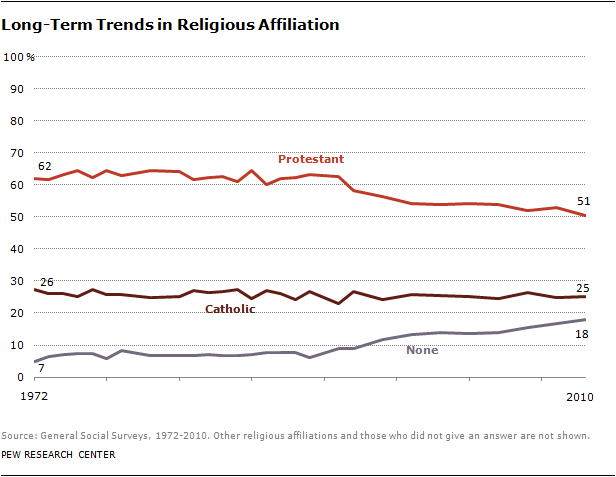
The number of Americans who do not identify with any particular religion continues to increase rapidly according to newly released data from Pew Research. One-fifth of the U.S. public–and about a third of adults under 30–are religiously unaffiliated today, the highest percentages ever in Pew Research Center polling.

In the last five years the unaffiliated have increased from just over 15% to just under 20% of all U.S. adults. Among them are more than 13 million self-described atheists and agnostics (nearly 6% of the U.S. public), as well as nearly 33 million people who claim to have no particular religious affiliation. That number represents 14% of the population.

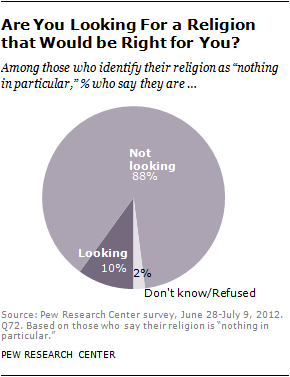
What makes this even more troubling for followers or Christ is that 88% of the “nones” are not looking for any kind of religious system.
religious preference from pew research“Overwhelmingly, they think that religious organizations are too concerned with money and power, too focused on rules and too involved in politics,” says Pew.

The report continues:

While the ranks of the unaffiliated have grown significantly over the past five years, the Protestant share of the population has shrunk. In 2007, 53% of adults in Pew Research Center surveys described themselves as Protestants. In surveys conducted in the first half of 2012, fewer than half of American adults say they are Protestant (48%). This marks the first time in Pew Research Center surveys that the Protestant share of the population has dipped significantly below 50%.

The decline is concentrated among white Protestants, both evangelical and mainline. Currently, 19% of U.S. adults identify themselves as white, born-again or evangelical Protestants, down slightly from 21% in 2007. And 15% of adults describe themselves as white Protestants but say they are not born-again or evangelical Christians, down from 18% in 2007. There has been no change in minority Protestants’ share of the population over the past five years.

religious affiliation trend chart

Thinking about the religiously unaffiliated people you know, what are their reasons for not seeking God? Or, is it God they seek outside of a religious connection?

Failed prophecies from ‘Focus’

In October of 2008 the Focus on the Family organization published the “Letter from 2012 in Obama’s America.” As you might imagine it was not friendly to the then-candidate for the presidency.

Sixteen pages long with 34 separate prediction points Focus laid out in deep, horrifying detail how the U.S would look in 2012. How did they do?

Look at it this way: the oft cited Old Testament standard for prophetic accuracy was 100%. A single errant prophecy would sound the end-of-life bell for the so-called prophet. If we were still under the Mosaic law it would be time to load up the rocks and descend on Colorado Springs.

A few of the predictions are still up in the air. One of them was half-right. Still others could possibly happen. One or two of Focus’ guesses would likely have happened no matter who was elected. Most, however, were just plain, old-fashioned fear mongering. They are so wrong as to be laughable in retrospect. These have been edited for length, but the original can be read at WND.com.

1. The Boy Scouts no longer exist as an organization. They chose to disband rather than be forced to obey the Supreme Court decision that they would have to hire homosexual scoutmasters and allow them to sleep in tents with young boys.

2. Elementary schools now include compulsory training in varieties of gender identity in Grade 1, including the goodness of homosexuality as one possible personal choice. Many parents tried to “opt out” their children from such sessions, but the courts have ruled they cannot do this, noting that education experts in the government have decided that such training is essential to children’s psychological health.

Many Christian teachers objected to teaching first-graders that homosexual behavior was morally neutral and equal to heterosexuality. They said it violated their consciences to have to teach something the Bible viewed as morally wrong. But state after state ruled that their refusal to teach positively about homosexuality was the equivalent of hate speech, and they had to teach it or be fired. Tens of thousands of Christian teachers either quit or were fired, and there are hardly any evangelical teachers in public schools any more.

focus on the family headquarters

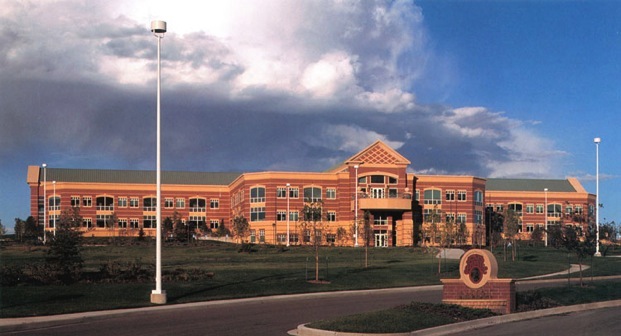
Focus on the Family headquarters [Image credit]


3. There are no more Roman Catholic or evangelical Protestant adoption agencies in the United States. Following earlier rulings in New York and Massachusetts, the U.S. Supreme Court in 2011 ruled that these agencies had to agree to place children with homosexual couples or lose their licenses.

4. All businesses that have government contracts at the national, state or local level now have to provide documentation of equal benefits for same-sex couples.

5. The Bible can no longer be freely preached over radio or television stations when the subject matter includes such “offensive” doctrines as criticizing homosexual behavior. The Supreme Court agreed that these could be kept off the air as prohibited “hate speech” that is likely to incite violence and discrimination.

6. Physicians who refuse to provide artificial insemination for lesbian couples now face significant fines or loss of their license to practice medicine

7. All other professionals who are licensed by individual states are also prohibited from discriminating against homosexuals. Social workers and counselors, even counselors in church staff positions, who refuse to provide “professional, appropriately nurturing marriage counseling” for homosexual couples lose their counseling licenses. Thousands of Christians have left these professions as a result.

8. Church buildings are now considered a “public accommodation” by the Supreme Court, and churches have no freedom to refuse to allow their buildings to be used for wedding ceremonies for homosexual couples. If they refuse, they lose their tax-exempt status, and they are increasingly becoming subject to fines and antidiscrimination lawsuits.

9. While churches are still free to turn down homosexual applicants for the job of senior pastor, churches and parachurch organizations are no longer free to reject homosexual applicants for staff positions such as parttime youth pastor or director of counseling.

10. In the first week after his inauguration, President Obama invited homosexual rights leaders from around the United States to join him at the White House as he signed an executive order directing all branches of the military to abandon their “don’t ask, don’t tell” policy and to start actively recruiting homosexuals. [Partially true, but….] As a result, homosexuals are now given special bonuses for enlisting in military service (to attempt to compensate for past discrimination) [Sorry, no sexual orientation signing bonuses.]

11. High schools are no longer free to allow “See You at the Pole” meetings where students pray together, or any student Bible studies even before or after school.

12. Tens of thousands of young churches suddenly had no place to meet when the Supreme Court ruled that public schools in all 50 states had to stop allowing churches to rent their facilities — even on Sundays, when school was not in session.

13. Campus organizations such as Campus Crusade for Christ, InterVarsity, Navigators, Baptist Campus Ministry, and Reformed University Fellowship have shrunk to skeleton organizations, and in many states they have ceased to exist.

14. Public school teachers are no longer free to lead students in the Pledge of Allegiance to the flag of the United States.

15. [F]ederal law immediately nullified hundreds of state laws that had created even the slightest barrier to abortion. States can no longer require parental involvement for minors who wish to have an abortion, waiting period, informed consent rules, restrictions on tax-payer funding or restrictions on late-term abortions. The act reversed the Hyde Amendment, so the government now funds Medicaid abortions for any reason. As a result, the number of abortions has increased dramatically.

16. Nurses are no longer free to refuse to participate in abortions for reasons of conscience.

17. Doctors who refuse to perform abortions can no longer be licensed to deliver babies at hospitals in any state. As a result, many Christian doctors have left family medicine and obstetrics, and many have retired.

18. It’s almost impossible to keep children from seeing pornography. The Supreme Court in 2011 nullified all Federal Communications Commission restrictions on obscene speech or visual content in radio and television broadcasts. As a result, television programs at all hours of the day contain explicit portrayals of sexual acts.

19. It is illegal for private citizens to own guns for selfdefense in eight states, and the number is growing with increasing Democratic control of state legislatures and governorships. This was the result of a 6-3 Supreme Court decision in which the court reversed its 5-4 decision that had upheld private gun ownership.

20. Parents’ freedom to teach their children at home has been severely restricted…the Supreme Court declared that home schooling was a violation of state educational requirements except in cases where the parents (a) had an education certificate from an accredited state program., (b) agreed to use state-approved textbooks in all courses, and (c) agreed not to teach their children that homosexual conduct is wrong, or that Jesus is the only way to God, since these ideas have been found to hinder students’ social adjustment and acceptance of other lifestyles and beliefs, and to run counter to the state’s interest in educating its children to be good citizens.

21. President Obama fulfilled his campaign promise and began regular withdrawal of U.S. troops from Iraq, completing it in the promised 16 months, by April 2010. All was peaceful during those months, but then in May 2010, Al-Qaida operatives from Syria and Iran poured into Iraq and completely overwhelmed the Iraqi security forces. A Taliban-like oppression has taken over in Iraq, and hundreds of thousands of “American sympathizers” have been labeled as traitors, imprisoned, tortured, and killed. The number put to death may soon reach the millions.

22. President Obama directed U.S. intelligence services to cease all wiretapping of alleged terrorist phone calls unless they first obtained a warrant for each case.

23. In early 2009, [Russia] followed the pattern they had begun in Georgia in 2008 and sent troops to occupy and re-take several Eastern European countries, starting with the Ukraine, Estonia, Latvia and Lithuania.

24. President Obama has also moved to deepen U.S. ties and U.S. trade with communist regimes in Cuba, Venezuela and Bolivia, regimes that had long enjoyed the favor of far-Left factions in the Democratic Party. Several other Latin American countries seem ready to succumb to insurgent communist revolutionary factions funded and armed by millions of petrodollars from Hugo Chavez in Venezuela.

25. In mid-2010, Iran launched a nuclear bomb that exploded in the middle of Tel Aviv, destroying much of that city. They then demanded that Israel cede huge amounts of territory to the Palestinians, and after an anguished all-night Cabinet meeting, Israel’s prime minister agreed. Israel is reduced to a much smaller country, hardly able to defend itself, and its future remains uncertain.

26. The new Congress under President Obama passed a nationalized “single provider” health care system, in which the U.S. government is the provider of all health care in the United States, following the pattern of nationalized medicine in the United Kingdom and Canada. The great benefit is that medical care is now free for everyone — if you can get it. Now that health care is free, it seems everybody wants more of it. The waiting list for prostate cancer surgery is 3 years. The waiting list for ovarian cancer is 2 years.

27. Because medical resources must be rationed carefully by the government, people older than 80 have essentially no access to hospitals or surgical procedures. Their “duty” is increasingly thought to be to go home to die, so they don’t drain scarce resources from the medical system. Euthanasia is becoming more and more common.

28. Tax rates have gone up on personal income, dividends, capital gains, corporations, and inheritance transfers. The amount of income subject to Social Security tax has nearly doubled. The effect on the economy has been devastating. We have experienced a prolonged recession. Everyone has been hurt by this, but the poor have been hurt most. In dozens of cities, there are no jobs to be found. [Do these folks know nothing at all of wider economic issues?]

29. The federal budget deficit has increased dramatically under President Obama, in spite of higher tax rates.

30. In 2009, Congress passed and President Obama quickly signed a “card check” program that nullified the requirement for secret ballots when voting on whether workers wanted a union shop.

31. World demand for oil continues to climb, and prices keep going up, but President Obama for four years has refused to allow additional drilling for oil in the United States or offshore. Gas costs more than $7 per gallon.

32. The FCC quickly implemented the “Fairness Doctrine,” which requires that radio stations provide “equal time” for alternative views on political or policy issues.

As a result, all radio stations have to provide equal time to contrasting views for every political or policy-related program they broadcast by talk show hosts like Rush Limbaugh, Laura Ingraham, Sean Hannity, Dennis Prager, Janet Parshall, Michael Medved and Hugh Hewitt, and broadcasters like Dr. James Dobson. Every conservative talk show is followed by an instant rebuttal to the program by a liberal “watchdog” group. Many listeners gave up in frustration, advertising (and donation) revenues dropped dramatically, and nearly all conservative stations have gone out of business or switched to alternative formats such as country or gospel or other music. Conservative talk radio, for all intents and purposes, was shut down by the end of 2010. [*COUGH *COUGH]

33. After the Supreme Court legalized same “sex marriage,” homosexual-activist groups targeted three large Christian book publishers that had publications arguing that homosexual conduct was wrong based on the teachings of the Bible…As a result, several Christian publishers have gone out of business.

34. In his first week in office, Obama followed President Clinton’s precedent and fired all 93 U.S. attorneys, replacing them with his own appointments, including the most active members of the American Civil Liberties Union (ACLU). President Obama argued this was not a selective political action like what President Bush had done, because Obama had fired all of them, conservatives and liberals alike. The Justice Department soon began to file criminal and civil charges against nearly every Bush administration official who had any involvement with the Iraq war. During his campaign, Senator Obama said, “What I would want to do is to have my Justice Department and my Attorney General immediately review the information that’s already there and to find out are there inquiries that need to be pursued.” In order to facilitate these proceedings, President Obama rescinded President Bush’s executive order that had prevented presidential papers from being released, and millions of pages of previously secret White House papers were posted on the Internet. ACLU attorneys have spent four years poring over these papers looking for possible violations of law. Dozens of Bush officials, from the Cabinet level on down, are in jail, and most of them are also bankrupt from legal costs. [What have these people been smoking??]

The issue at hand–besides the fact that they really, really need to avoid the prophecy business–is why this letter was published in October 2008. There was one and only one reason: to scare evangelical voters into voting for the Republican candidate, John McCain. (Okay, maybe also to raise money but let’s stick with the most obvious one for now…)

Of all voters Christians should be the least ones motivated by fear for any reason. We are encouraged, commanded, cajoled, challenged (pick your verb) to have not fear, fear not, to let the peace of God rule in our hearts. We are promised a peace that passes understanding. Why, then, when election time rolls around do Christ’s followers allow the fear of what might happen control how they vote? It has, it does, and it is again during this election cycle.

Regardless the candidate for whom you vote, if fear dictates it you are not approaching the election how God would have it. He is sovereign. He is in control. There is no reason to fear, so do not vote like there is.
[HT: Libby Anne]

Learning from Turkish Muslims

My friend Joel Rainey recently returned from a trip to Turkey. Joel has been a pastor and church planter, is an author, blogger, husband and father. He currently is the Director of Missions for the Mid Maryland Baptist Association.

This week he blogged about his trip to the nation of Turkey; a trip he took with several pastors from his area. It is an illuminating story with truths that benefitted me, and I hope will benefit you, too. He has given me to publish, “What Turkish Muslims Taught Me About our Changing World” in its entirety. The original post is at his blog, themelios.

My job sometimes requires pretty extensive travel, and through my service to our churches, I’ve had the opportunity to, literally, see the world. But I’ve just returned from a trip that I think has had a greater impact on me than any other trip I’ve taken.

Turkey trip

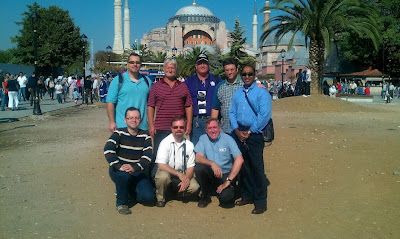
Joel Rainey (back left) and team in Turkey

From September 21-30, six area pastors and myself traveled throughout the Republic of Turkey with members of the Muslim community. This journey actually started more than a year ago with a call from one of our state legislators who is a member of one of our churches. The Governor of Maryland had included her in a trip to Turkey as part of an eventual “sister-state” agreement that was signed between my state and a province in that country, but once the leader of the Turkish organization discovered that this representative was an evangelical Christian, he expressed hesitation, because, as he put it, “I always thought evangelical Christians hated Muslims.”

Seeking to put this false rumor to rest, I reached out to the members of this community, and got a warm embrace in response that has lasted more than a year. I’ve been in the company of people from nearly every tribe and tongue, but when it comes to hospitality, no one does it better than the Turkish people! They are some of the finest and most gracious people I’ve ever met! Eventually, this new relationship resulted in their invitation for us to join them in their home country last week.

Let me say that again. Muslims openly invited more than a half dozen Baptist preachers to the middle east, and even covered a significant portion of the cost of the trip!

During our time abroad with our new friends, I have never experienced such hospitality! We toured sites together that were important to both Christians and Muslims. We visited schools, newspapers, and hospitals built by this group in the hopes of improving the lives of others in their home country. We visited the homes of influential Turkish business leaders and learned of their own involvement in trying to improve conditions, not only in Turkey, but throughout the middle east. One young pharmacist we met near the border with Syria told me “I want to take what we have done in this city, and spread that peace across the border and throughout this part of the world. I want my city to be the starting gate for peace.” I love that guy’s heart!

It is unfortunate that nearly everything about this part of the world that is broadcast on American news media focuses on extremist elements. To be sure, those elements are very present (as was demonstrated after our departure with the Syrian violence crossing the border into Turkey), but the so-called “Muslim world” is full of good people who are trying to make a positive difference, and its working!

All of this probably sounds very strange coming from the mouth of an evangelical Christian, and to be sure, my convictions have not changed. I still believe the Bible is the Word of God. I still believe Jesus is God, that He was crucified as a substitute for sinners, that he rose bodily from the dead, and that nothing short of repentance and total faith in His death and resurrection will save. But these convictions don’t hold me back from the relationship I now have with my Muslim friends. On the contrary, they propel me more deeply into relationship with these precious people!

This experience is but one example of how the way we engage the world as followers of Jesus needs to change, and I’ve addressed that issue in more depth here. But as we explore further ways to walk together with the Muslim community here, I’m taking several things away from our recent trip that will continue to inform our ongoing relationship.

1. The sincerety of their faith is motivating them to change the world, starting with the region where they live. Our Turkish-American guide for this trip told me that years ago he asked the question, “why is it that when it comes to science and technology, education, and health care, that the Muslim world seems to lag behind everyone else?” According to his own testimony, he found mentors within his own faith who believed that Islam should actively engage all these areas, and contribute to the global community. In short, he and others like him who live in Turkey have found meaning and purpose that they believe is anchored in their faith.

2. The Movement we witnessed in Turkey is cross-generational. While many young people are “out in front” seeming to make positive waves, older generations are seeing their passion and responding with financial support and other things necessary to accomplish their goals. Inspired by Imams of centuries past who encouraged Muslims to invite “outsiders” in, they have taken one step further and are taking the initiative to introduce themselves to the non-Muslim world. They are disheartened by the way the media have focused almost exclusively on the radical elements of their faith, are weary of being automatically identified with those radical elements, and are eager to share the good that is happening throughout the middle east and among Muslims worldwide which is so under-reported. It was not uncommon for us to visit a home where three or four generations of Turkish Muslims spoke of their commitment to these goals.

3. They speak boldly and loudly to the violent elements in their faith, and so should we! Though the media pay them little attention (honest appraisal of the positive elements of a movement or religion rarely sells a lot of newspapers or increases viewer ratings), they are quick to condemn violence committed in the name of Islam. We had barely landed when our guests openly and forcefully condemned the recent attack on our embassy in Libya in response to the “Innocence of Muslims” film made in the U.S., and apologized to us for the way their faith was represented in that violence. (We responded by condemning the film itself. The language and sexual content alone should make that film as offensive to Christians as it is to Muslims. We also acknowledged that idiots are entitled to their 1st amendment rights also!)

Call it propaganda if you want, but the truth is that Muslim critics of violence abound, we just don’t listen for their voices. (Harris Zafar is but one example in our own country.) Instead, we tend to suppress our awareness of the violent tendencies present in ourselves. Sure, we Christians don’t have anyone flying airplanes into skyscrapers. But when was the last time you heard a Christian openly condemning a violent attack on an abortion clinic, or the bullying of a homosexual? Our new Muslim friends agree with us that ALL people are created in God’s image and likeness, and when violence is done to any of them, the reason doesn’t matter. Such violence should be condemned.

4. This new relationship is a new platform for the very kind of “public square” evangelism in which Paul participated. You could spend years as a “traditional” missionary in a Muslim country and never achieve the level of access we achieved in a single week! From the beginning, we have been up front with our Muslim friends regarding what we believe, and told them our greatest desire is for them to come to know Jesus as we know Him. But we have also stressed that our continued friendship is not contingent on whether they become Christian. After all, “forced conversion,” is not conversion. It is conquest, and both Christians and Muslims have already given each other too much of that in our history together.

At the same time, I can’t help but think that if Paul were alive today, this is precisely the platform he would leverage in order to spread the Gospel. On several occasions, our group had this opportunity, and we seized it with the blessing of our hosts, most of whom were and are curious about Jesus. In general, Muslims have great respect for Jesus. They just don’t know much about him, and recognize that Christians spend much more time focusing on Him. So when they encounter Christians, they are often anxious to hear a story about him. Though most seminary textbooks on the subject claim that Muslims reject the doctrine of penal substitution, the truth is that many Muslims have never even been offered the opportunity to consider the concept. In one of my conversations this past week, one man asked “tell me again what you mean by ‘Jesus paid the price.’ I’ve never heard that before!”

5. In our current North American context, walking in close relationship with Muslims is the epitome of being “counter-cultural.” Let’s face it. Most Americans, even Christians, are afraid of Muslims. We are conditioned by our media, and even most of our political leadership to keep our distance. So what could possibly be more counter-cultural than our willingness to to walk together with these precious people, and do it publicly?

6. If the Gospel is truly “the power of God unto salvation,” then what on earth are we afraid of? I still believe Romans 1:16-17 is true. And because I believe this, I want to walk closely with those who have yet to accept its claim. Our new friends are anxious to talk about faith, and there is much that we hold in common! But in the midst of discussing those commonalities, I have, and will continue to challenge them concerning the basis for forgiveness, and a sure hope of eternal life. And I’ll do it because they are my friends.

Our group learned much while traveling with our friends, and we look forward to learning more, to engaging them in matters of common interest, and to consistently present the Gospel of Jesus to them at every opportunity. God is at work in places we too quickly brush off as “lost.” I saw it for myself, and I look forward to experiencing all that He has in store in the future for us, and for our new friends.

I will just add that Joel’s strategy for meeting and learning from members of the Islamic religion is also needed for any area where you and I differ from others. We cannot claim to “know” about Islam if we do not know any Muslims. We cannot claim to know the needs of the homeless unless we talk to them and ask. Those in the racial majority cannot claim to know how racial minorities are affected by government policy unless those in the majority are friends with minorities. Wisdom requires nothing less of us.

African-American responses to Propaganda’s ‘Precious Puritans’

For no particular reason I have never been a fan of rap or hip-hop, but last week I was drawn into that genre. The fellow responsible for the drawing is an artist known as Propaganda, a self-described “fire baptized, battle rapper, who’s heavily influenced by boat music and bound creative freedom in poetry.” At least I think that’s what he says. The song by which I was drawn is called “Precious Puritans.”

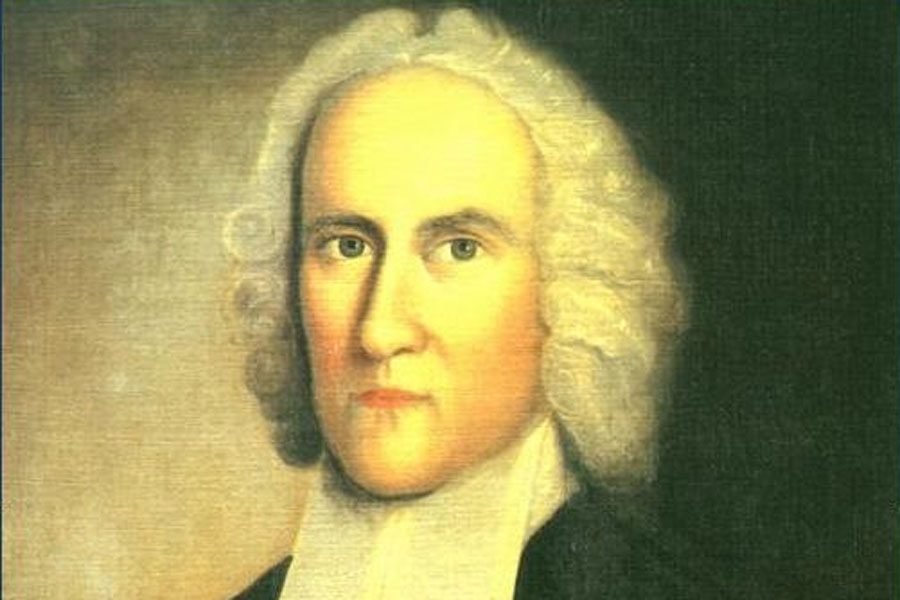
The song, from Propaganda’s new project, Excellence, takes pastors to task for uncritically quoting the theology of many Puritan pastors. These would be the same Puritans who owned and abused slaves, while excusing it as the order of things. The lyrics to the song (below) are blistering, insightful, and revealing.

jonathan edwards

Puritan pastor Jonathan Edwards [Image credit]


Chicago area pastor Joe Thorn brought the song into my field of view with two posts on his blog. The first is an interview with historian and author Dr. Richard Bailey, professor of early American history at Canisius College, and author of Race and Redemption in Puritan New England, (OUP, 2011).

The second is an interview with Propaganda, with a lengthy discussion about the song.

In short order a twitter exchange broke out with Owen Strachan taking the position the song went too far and would possibly cause avoidance of Puritans altogether. Like not enough fiber in ones diet, I suppose. Last week Strachan took to his blog with the same assertions. It was a weak attempt at a critique. If anything Strachan demonstrated with sterling clarity the very mindset challenged by Propaganda.

Next, influential blogger Steve McCoy weighed-in. McCoy is well known for his breadth of musical knowledge and affirmation of the arts. He correctly notes too many people have missed the point of “Precious Puritans.” I could not agree more. Today Steve asks, “Where are the voices of our white, Puritan-loving Southern Baptist leaders, and seminary presidents, and deans, and entity leaders, and prominent pastors? We need your voices on this.” It is a needed, important question.

I do not fit into any of those categories, but I do have a few thoughts.

One, mainly.

Where are the white believers who are seeking responses from African-Americans? Why, when issues of race propel themselves to the fore, do so many white folks think a white opinion is all that is needed? Worse, why do we so readily believe that we automatically provide a correct analysis on any racial issue?

Today, Dr. Anthony Bradley, associate professor of theology and ethics at The King’s College in New York City and research fellow at the Acton Institute for the Study of Religion and Liberty, tackled the issue on the Urban Faith blog. Addressing this crucial item he writes:

Propaganda’s point is that if white evangelicals do not talk about the bones of their heroes they run the risk of doing great harm to people of color. Many of us are beginning to wonder why white evangelicals do not seem to care much about this and seem willing to trade off “honoring” their forefathers for their own comfort over doing what is necessary to build racial solidarity. Some of my liberation theology friends, in the end, would see Strachan’s critique as a dismissal of acknowledging the importance of caring about how the Puritans are presented to African Americans and would constitute a racial microaggression or a micro-invalidation.

There is an ongoing disconnect between most white evangelicals and anything to do with minority culture, especially as it relates to African-American culture. We are so blind and insular that we do not even attempt bridging divides. This is not typically out of hate, but because we know of no such divide.

Were the slaves not freed? Was the Voting Rights Act not passed? Was the Civil Rights Act not passed? Do we not have a president who is African-American? Then, what is the fuss? Such is a typical white line of thinking.

Two of my African-American pastor friends took the time to respond with their thoughts on “Precious Puritans.” James Roberson III is the Missional Communities Pastor at Blueprint Church in Atlanta, GA. Dr. Dwight McKissic is the Senior Pastor of Cornerstone Baptist Church in Arlington, TX.

From James Roberson:

Here are some historical facts that aren’t talked about:
George Whitfield campaigned to have slaves at his orphanage.
Jonathan Edwards owned slaves as well.
The Southern Baptist Convention made negro inferiority a theological conviction amongst its convention.

Did these negative attributes define who these people were? Not in my opinion. But I wonder if the issue was abortion?

What if George Whitfield campaigned for the rights of women to have abortions.
Jonathan Edwards owned abortion clinics.
The Southern Baptist Bonvention made a woman’s right to choose a theological conviction amongst its convention.

I have heard abortion and slavery compared on more than one silly occasion so I figured I would use it here. I think abortion would make us think of these folks very differently. It shows how we value certain issues more than others.

I love what Propaganda said in his album and I’m surprised that he hasn’t received more flack than he has. Prop was right. I think the entirety of the poem speaks to the flaws of all leaders, which is a healthy reminder. But what I think we are unwilling to embrace is that white people are far too often tired of the slavery conversation and want to move on.

I understand that many white people feel like they shouldn’t have to discuss something they weren’t apart of. Yet what we should embrace is that humans were once used like a rake or luggage; nothing but tools. Black people were considered three-fifths of a human and made white people a fortune. A fortune that many whites have gained a considerable amount of privilege from. It would only be healthy to consistently take a look at how we actually thought God was ok with that. It would also be a benefit to our missiology within cities to understand how slavery and Jim Crow have effected the black population to day.

Sin is never easy to talk about. Yet my prayer is that we grow more comfortable with examining, confessing, and praying over the sins of our fathers. It will as James 5:16 promises, bring healing to our nation.

From Dwight McKissic:

(1) It is alright for the pastor to quote Puritans, because anyone quoted could probably be disqualified in someones eyes for various reasons, including Propaganda who is bothered by the pastor quoting Puritans. (2) I applaud and appreciate Propaganda for voicing his viewpoint. Whenever I quote someone that may be objectionable to a large segment of my audience (for whatever reasons), I usually make some kind of disclaimer or qualifying remark to make that person more palatable to my audience. Similar to the song I’ve said, “God sometimes hit straight licks with crooked sticks,” or “The Great Puritan, Jonathan Edwards was a slavemaster–we’ll forgive him for that without him asking. He preached a great sermon, “Sinners in the Hands….”. You get the point.

So, the preacher needs to qualify or “ask permission” to quote the slaveholder, and the rapper must accept the fact that one never receives ministry from a person totally without fault or sin. He alludes to this in his song.

And certainly, I recognize that slaveholding was a sin on par with abortion, murder, and even more egregious than same-sex marriage. But to the slave-holder, it was a blind spot. That is no excuse, but the reason we call it a blind spot is because–they were blind. Both parties need to seek to understand the other on this issue and meet somewhere in the middle.

Below are the lyrics to “Precious Puritans,” and the song itself from YouTube.

If you would allow me second to deal with some in-house issues here…

Pastor, you know it’s hard for me when you quote puritans.
Oh the precious puritans.
Have you not noticed our facial expressions?
One of bewilderment and heart break.
Like, not you too pastor.
You know they were the chaplains on slaves ships, right?
Would you quote Columbus to Cherokees?
Would you quote Cortez to Aztecs?
Even If they theology was good?
It just sings of your blind privilege wouldn’t you agree?
Your precious puritans.

They looked my onyx and bronze skinned forefathers in they face,
Their polytheistic, god-hating face.
Shackled, diseased, imprisoned face.
And taught a gospel that says God had multiple images in mind when he created us in it.
Their fore-destined salvation contains a contentment in the stage for which they were given which is to be owned by your forefathers’ superior image-bearing face.
Says your precious puritans.

And my anger towards this teaching screams of an immature doctrine and a misunderstanding of the gospel.
I should be content in this stage, right? Isn’t that Paul taught?
According to your precious puritans.

Oh, you get it but you don’t get it.
Oh, that we can go back to an America that once were, founded on Christian values.
They don’t build preachers like they used to. Oh, the richness of their revelations.
It must be nice to not have to consider race.
It must be nice to have time to contemplate the stars.
Pastor, Your colorless rhetoric is a cop-out.
You see my skin, and I see yours. And they are beautiful.
Fearfully and wonderfully divinely designed uniqueness.
Shouldn’t we celebrate that rather that act like it ain’t there?
I get it. Your puritans got it. But,

How come the things the Holy Spirit showed them in the valley of vision didn’t compel them to knock on they neighbors door and say, “You can’t own people!”?
Your precious puritans were not perfect.
You romanticize them as if they were inerrant. As if the skeletons in they closet was pardoned due to the they hard work and tobacco growth.
As if abolitionists weren’t racist and just pro-union.
As if God only spoke to white boys with epic beards.
You know Jesus didn’t really look like them paintings. That was just Michaelangelo’s boyfriend.
Your precious puritans.

They got it but they didn’t get it.
There’s not one generation of believers that figured out the marriage between proper doctrine and action.
Don’t pedestal these people, your precious puritans partners purchased people.
Why would you quote them?
Step away.

Think of the congregation that quotes you. Are you inerrant?
Trust me I know the feeling.
It’s the same feeling I get when people quote me.
Like, if you only knew!
I get it. But I don’t get it.
Ask my wife.
And, it bothers me when you quote puritans, if I’m honest, for the same reason it bothers me when people quote me–they precious propaganda.
So, I guess it’s true.
God really does use crooked sticks to make straight lines.
Just like your precious puritans.