Category Archives: Religion

What is Maundy Thursday?

Many people not in Catholicism or familiar with may ask today, “What is Maundy Thursday?” Maundy Thursday is the day before Good Friday. That is the short answer.

The longer answer to “What is Maundy Thursday” is:

Maundy Thursday (also known as Holy Thursday, Covenant Thursday, Great and Holy Thursday, Sheer Thursday and Thursday of Mysteries) is the Christian feast, or holy day, falling on the Thursday before Easter. It commemorates the Maundy and Last Supper of Jesus Christ with the Apostles as described in the Canonical gospels. It is the fifth day of Holy Week, and is preceded by Spy Wednesday and followed by Good Friday.

Another explanation of Maundy Thursday:

This day, Maundy Thursday (also “Holy Thursday” or “Shire Thursday”) commemorates Christ’s Last Supper and the initiation of the Eucharist [Lord’s Supper or Communion]. Its name of “Maundy” comes from the Latin word mandatum, meaning “command.” This stems from Christ’s words in John 13:34, “A new commandment I give unto you.” It is the first of the three days known as the “Triduum,” and after the Vigil tonight, and until the Vigil of Easter, a more profoundly somber attitude prevails (most especially during the hours between Noon and 3:00 PM on Good Friday). Raucous amusements should be set aside.

What struck me from this last paragraph was the sentence “Raucous amusements should be set aside.”


Passion Week is a week overlooked by many in favor of Easter. While there is no doubt the resurrection trumps the last supper for eternal value, that supper, if it teaches us anything, teaches us the power of remembrance.

Today is Maundy Thursday, a day of remembrance. Perhaps we should set aside frivolity for a time, reflect on what the last supper meant to Christ, to His disciples and to us. This weekend again brings to our attention the victory of Christ over the grave. He secured the possibility of forgiveness at the cross and the reality of eternal life at the resurrection.

We also do well to reflect on John 13:34, “A new commandment I give to you, that you love another. Just as I have loved you, you should love one another.” How well is that going for us? Good Friday is tomorrow, the grave is Saturday, and Easter is Sunday. Remember. And love.

Blessings.

Did Starbucks’ Howard Schultz really say, “We don’t want your business”?

In response to a question at the recent Starbucks corporation shareholders meeting, CEO Howard Schultz reiterated his and the company’s support for workplace diversity. This includes support for same-sex marriage.

As sure as night follows day a blatantly false meme began circulating on Facebook. The primary one is from Joe Miller’s Liberty Watch. His opening sentence reads:

At the Starbucks annual shareholders meeting on Wednesday, CEO Howard Schultz sent a clear message to anyone who supports traditional marriage over gay marriage: we don’t want your business.

Not to put too fine a point on it, that information is a complete fabrication.

Miller sourced his story through Examiner.com’s also deceptively entitled article, Starbucks CEO: No tolerance for traditional marriage supporters. The author, Victor Medina, opens with this:

At the Starbucks annual shareholders meeting on Wednesday, CEO Howard Schultz sent a clear message to anyone who supports traditional marriage over gay marriage: we don’t want your business.

Look familiar?

What did Howard Schultz say about traditional marriage

Starbucks CEO, Howard Schultz [Image credit]

Medina’s article points to yet another article, this one from Forbes. Finally arriving at the truth, we see Schultz was never speaking to customers of Starbucks, but in response to a shareholder’s question. The article, Howard Schultz to Anti-Gay-Marriage Starbucks Shareholder: ‘You Can Sell Your Shares'” accurately reflects the context and statement.

In response to a shareholder’s question, Starbucks’ CEO responded:

If you feel, respectfully, that you can get a higher return than the 38% you got last year, it’s a free country. You can sell your shares in Starbucks and buy shares in another company. Thank you very much.

This was the statement, and the only statement. Schultz never said or implied people who support traditional marriage should take their business elsewhere.

The fact is Starbucks and Schultz are, unsurprisingly, supporting of same-sex marriage. It is also a fact that you can boycott, or get your caffeine fix elsewhere as many have chosen to do. You can also oppose same-sex marriage and continue to buy coffee from Starbucks…I do.

To be fair, each of the first two articles includes the shareholder further into the story, but the erroneous early statements are more than enough to mislead the average reader.

What Christians should avoid, however, is sloppiness. Disagreement is fine. Strong disagreement is fine. But, at least, let us strive for accuracy.

C’mon, followers of Jesus. We can do better.

(Less than HD video of Howard Schultz responding to shareholder question on gay marriage.)

Don’t throw “The Bible” under the bus

Jesus walks on water The Bible

Jesus walks on water.


Tonight begins the showing of the highly anticipated mini-series The Bible. Produced by Mark Burnett (“Survivor,” “The Voice”) and Roma Downey (“Touched by an Angel”) I’m already seeing a tremendous amount of buzz on Facebook. Twitter also is seeing a lot of activity.

In fact, while I was looking at tweets more than 35 more dropped into the stream.

A few naysayers have popped up, primarily because they disapprove of some participants. This is to be expected, sad as it is, because there are always those who shoot first, aim second, and then determine whether they in fact had a reason to be firing at all.

Because this is an adaptation, I would expect some “storyteller’s license” though how much remains to be seen. Even if this is the case, it is still not a reason for concern. Here’s why:

There have been numerous adaptations of the Christmas Story, the Easter Story, indeed the entire Bible, over the years. None of them have halted the message of Christ. Even the scandalous Last Temptation of Christ did nothing to slow the spread, or diminish the power of the gospel.

If there are discrepancies in The Bible on HISTORY use those as further opportunities to point out the truth of the Bible. The Word has power and the Holy Spirit can use it to communicate the truth and convict of sin, righteousness and judgment.

So, even if there are a few minor issues, don’t throw The Bible under the bus.

To get a copy of the book A Story of God and All of Us, based on the mini-series, click here.

The Senior Adult Dilemma, Part 2

In my last post I explored a few issues involved with what I termed “The Senior Adult Dilemma.” I encourage you to read it first for context.

This response came from a friend via Facebook:

Consider that the Boomer generation was perhaps the first to see that government leaders often lied to them. The Sixties were radically different than anything this country had faced. Authority figures, music, sexual revolution, etc., etc. EVERYTHING changed rapidly.

I’ve read stats saying 1 out of 4 were sexually abused and we know that kind of abuse is often by someone in a place of authority in that person’s life. They were drafted into the first war (Vietnam) that was so unpopular that when coming home they were often met at airports and pelted with tomatoes. Even today one can walk in a VFW event and immediately tell the Vietnam vets. This generation was among the first to come out of college with massive student loans.

These folk (Boomers) have been told that they have spent the nation into oblivion, are guilted over abortion (the Supreme Court chief justices who wrote majority opinions were appt. by Republican Presidents Eisenhower and Nixon. Check out Republican Supreme Court appointees and their decisions. Not good. In fact, Ike said his appointment of Earl Warren was the “damnedest fool thing I ever did”.), and many are reduced to working two or three part time jobs to support themselves. One outlives early retirement. They have only know SBC live to be in turmoil their entire ministry life.

My point is that there is a lot of latent anger in almost every congregation among the seniors.

This friend spent more than a decade as a traveling evangelist, and has been nearly two decades in denominational work.

Two other friends, one via Twitter and another offline, also mentioned existing or potential issues with Baby Boomers in the Senior Adult Dilemma. As the oldest Boomers are just hitting retirement age, I think it remains to be seen. I hope, rather, to see Boomers go into their senior years pressing forward without looking back. In point of fact, I have been eyewitness to the Dilemma since before the oldest of the Boomers were out of their 40s.

While Boomers may fall to the same temptations current and past seniors have faced, this seems to be beyond a mere Boomer issue. Unless these issues are addressed, Boomers, Busters, Millennials and future generations may fall as well.

I should note I’m hardly an expert. I have been blessed with some fantastic relationships with senior adults. We loved, honored and respected each other, often in the midst of disagreements about “worship styles” or church direction. Then there were those who did not fit in that group ;^)

What I offer are thoughts as my old age grows larger in the windshield. Now let us consider a few possible solutions:

1. Seniors often feel left out, but need more than Branson, Missouri trips to help them continue to grow in Christ.
Which came first the chicken or the egg? Do churches lower discipleship expectations on seniors to little more than a travel club, or do seniors fail to respond to discipleship efforts requiring more than a travel club?

Another friend who has been in ministry for many years wrote this:

A friend of mine, a pastor and missionary of many decades reached his 70’s and told me this, “I have more time to give, more knowledge to share and a hearts desire to minister but no one wants and old man. If you are over 50-55 try and to get a position in a church, very difficult. I know there are older people who are like those in your article but there are many more who love God, love their church and desire to be in ministry but many times the church has turned them away or formed a “senior saints” group that basically takes trips for pleasure. The older generation needs to be challenged to press on just as every other generation in the church.

2. Aging entrenches routine as a form of comfort and certainty, but church leaders often miss this.
A former co-laborer on a staff once made this observation about his widowed, senior adult mother-in-law: “If a light bulb goes out at my mother-in-law’s house, she will call us every day until I can get over to replace it. Even if it is in a room or closet she rarely uses. She seems fixated on it until I can get it done.”

As we get older and more physically restricted from “adventures,” routines become places of comfort. If this is true of young people–and to some degree it is true of us all–with some it gets much worse with aging. Predictability becomes the groove through which life is comfortably lived. Like residents of The Shire many eschew the unknown and enjoy the serenity of sameness.

But, like nostalgia, routine is not a spiritual gift. Arguably, the desire for a “whole life routine” can work against spiritual growth: it is hard to invite God to break into your routine if you do not want God to break into your routine. Or fail to believe it is something He would even do.

When church leaders misunderstand the routine they multiply problems for themselves. You may not be able to change it; but you do well to take it into consideration in decision making.

3. Most people who come to Christ do so in their younger years and seniors should participate in their church’s efforts to reach them.
Every study I have ever known indicates most people who come to Christ do so while young. Youth pastors used to say the majority are saved before the age of 18. Barna says it is a “substantial majority” (2004) who do so.

If this is the case why would churches in their evangelistic attempts not focus a lot of energy in reaching those under 18? Further, why would senior adults not rejoice to be a part of leading young people to Christ?

One of the great blessings of my ministry was Mrs. Jessie Lancaster. Mrs. Jessie died several years ago. She was single for many, many years. Having no children or relatives in the community, she depended, more than most, on her church family. She was active in an intergenerational small group at our church, and prayed for me relentlessly. She once told me when I had a conflict between leaving for a youth camp and seeing her in the hospital, “Preacher, don’t you ever come see me if you have a chance to lead some young person to Jesus. That’s way more important.”

That is the outlook I want to have at 80.

4. Churches should view aging as a unique discipleship opportunity.
It is a little too easy to say, “You didn’t hear the Apostle Paul complaining while he was chained up in that dark Roman jail!!” I kind of doubt he is in your church. I kind of doubt he is in the pastor’s office, either. But, if we want to produce a different kind of senior adult believer, we might need to develop a different discipleship strategy for senior adults.

Esteemed professor, Howard Hendricks, who died February 20, 2013, described aging as a:

quiet, ill-defined blur that steals up on one with little advance warning. My body refuses to cooperate with my mind, as if it were a stranger. Mysterious little aches and odd moments of forgetfulness pop up. Birthdays become irrelevant. The surprise is that I no longer seem to be quite the ‘me’ I have always known.

It also rings true that you do not see in the mirror what everyone else sees when looking at you.

Perhaps one solution is for churches to implement “aging out” of age-graded small groups. For illustrative purposes let us say age fifty-nine. When reaching 60 members should join younger groups. That would be the only option since no senior adult groups would exist. This combats the feelings of isolation, opens the eyes of all involved to the needs of each age, and helps facilitate organic mentoring. It also helps disconnect the problem of complaints feeding on themselves.

I have heard people talk about “cradle to grave” ministry, but I have seen few ministries last that long.

One thing seems certain: if we want to reduce the amount of stress and heartache experienced both by church leaders and seniors a modified approach to discipleship is needed.

Despite all the challenges in the senior adult dilemma I have been blessed to know many seniors like Jessie Lancaster. Among them:

My Mom and Dad
My Mother began a writing ministry to women in prison after she was 65 years old. She continued ministry to them after they exited prison. For months she drove to Atlanta each Sunday to pick-up a lady and bring her to church. My Dad, in addition to never missing a work day at church, picks up a blind man for church every Sunday and takes him home after Sunday School and church are over. My Dad often takes this man to the doctor.

Their pastor, Chris, has told me on more than one occasion, “Your Mom and Dad are truly missional people.”

Frances and Waymon Lamb
The Lambs were longtime members at a church where I served on staff. They were members when the church was small enough that Frances sent get-well cards to every member who went into the hospital. The first time I ever met her she was hospitalized. When I entered her room, I noticed her leg standing in the corner of the room while she was occupying the bed. Over the course of several months I visited her so many times we joked about her trying out every room in the hospital. At the end of each visit, she had a list a names for which I was to pray…but never for her. God was taking care of her.

After she died, Waymon became a de facto chaplain for the hospital. He had spent so much time there it was like a home away from home. He had already begun visiting sick people when Frances was hospitalized, and continued returning to visit sick people after she passed away. This he did until he was too old to continue.

Waymon outlived almost all his friends, and died after I was no longer on staff at his church. His graveside service was so small, the pastor conducting the service and I had to serve as impromptu pallbearers.

Mr. and Mrs. Benson
Raynor and Lois Benson, with their adult son, Drew, volunteered in the office at my last pastorate. They were amazingly sweet, showing up every Sunday morning to do paperwork, answer the phones and the like while our secretary was completing the extra records from Sunday. They never asked for a thing, never expected a thing, and always were gracious and cheerful.

One week I got a phone call they had been in a car accident and Mrs. Benson had broken a bone; her arm, I think. They insisted that I not visit. I did anyway, for just a few minutes. As I was leaving, Mrs. Benson said, “I’m not going to tell anyone you came by. You didn’t have to come, and if I do tell people all the old people will expect you to come see them every time they get sick.” I could not believe what I was hearing, but was I ever thankful for her wisdom.

Oh, and those “old people” were her peers.

Myrl Kitchens
The “Adult Ladies” teacher in my very first church. She was a great encouragement, and faithful to teach those ladies for many, many ears. She was the first person to teach me what Genesis means by the sun and moon being given for signs.

Far from “callous disregard” for seniors’ concerns, those entrusted with spiritual leadership should help seniors see their true needs, learn to trust God instead of routines, and continue to press on toward the goal of the high calling of God in Christ Jesus.


“180” Movie [VIDEO]

I have never been much of a Ray Comfort fan. Perhaps it has to do with that sad, sad “disproving evolution with a banana” video, or perhaps it was a sad, sad debate performance I witnessed a few years back. Either way there was not much of a compelling reason to keep up with his stuff.

180 video ray comfort

A screen grab from “180.”


A couple of weeks ago, my youngest daughter told me about a short documentary she had just seen, titled “180.” As I had just written on the Holocaust (here and here) she thought I would be interested. The movie, she said, featured this guy just talking to people on the street about the Holocaust and abortion. It was very persuasive, she said. I should watch it, she said.

Then she sent the link.

When I saw Ray Comfort at the very beginning I winced. But, since I promised to watch it and she was so adamant it was good, I let it roll.

And I was pleasantly surprised.

Filling the full breadth of his person-on-the-street interview style, Comfort takes his microphone to an area resembling Venice Beach. The subject is the Holocaust. Questions focus on personal responsibility and reasoning. Would you have followed orders? How far? Where would you draw the line? Why?

He then turns to abortion as the person-on-the-street realizes, slowly at times, the distinct and unarguable parallels.

A couple of times I thought Comfort was veering into politics, but he did not. He does during a section squeeze in his “Way of the Master” style of street evangelism. Like that part or loathe it, I will say the man is bold.

This is about half-an-hour. It is worth the time if for no other reason to be reminded of the inconsistencies we all face if we think incompletely about issues.

Have Megan Phelps-Roper and her sister Grace left the Westboro cult?

It appears two granddaughters of Westboro patriarch Fred Phelps have left the fold. Megan and Grace Phelps-Roper, daughters of Shirley Phelps-Roper, have reportedly posted the following on Medium.com under a title borrowed from The Avett Brothers, Head Full of Doubt / Road Full of Promise:

“There’s no fresh start in today’s world. Any twelve-year-old with a cell phone could find out what you did. Everything we do is collated and quantified. Everything sticks.”

Don’t act surprised that I’m quoting Batman. At WBC, reciting lines from pop culture is par for the course. And why not? The sentiments they express are readily identifiable by the masses – and shifting their meaning is as easy as giving them new context. So put Selina Kyle’s words in a different framework:

Megan Phelps [Image Credit]

Megan Phelps [Image Credit]

In a city in a state in the center of a country lives a group of people who believe they are the center of the universe; they know Right and Wrong, and they are Right. They work hard and go to school and get married and have kids who they take to church and teach that continually protesting the lives, deaths, and daily activities of The World is the only genuine statement of compassion that a God-loving human can sincerely make. As parents, they are attentive and engaged, and the children learn their lessons well.

This is my framework.

Until very recently, this is what I lived, breathed, studied, believed, preached – loudly, daily, and for nearly 27 years.

I never thought it would change. I never wanted it to.

Then suddenly: it did.

And I left.

Where do you go from there?

I don’t know, exactly. My sister Grace is with me, though. We’re trying to figure it out together.

There are some things we do know.

We know that we’ve done and said things that hurt people. Inflicting pain on others wasn’t the goal, but it was one of the outcomes. We wish it weren’t so, and regret that hurt.

We know that we dearly love our family. They now consider us betrayers, and we are cut off from their lives, but we know they are well-intentioned. We will never not love them.

We know that we can’t undo our whole lives. We can’t even say we’d want to if we could; we are who we are because of all the experiences that brought us to this point. What we can do is try to find a better way to live from here on. That’s our focus.

Up until now, our names have been synonymous with “God Hates Fags.” Any twelve-year-old with a cell phone could find out what we did. We hope Ms. Kyle was right about the other part, too, though – that everything sticks – and that the changes we make in our lives will speak for themselves.

Megan and Grace

Sometimes these types of reports are little more than hopeful urban legends, but the link to this story came from Megan’s well known Twitter account:


The next day, Grace tweeted simply:


I hope this report is true. We should pray both of these young ladies come to know God in a way they never before have, but into a relationship into which He invites them.

Previous Westboro articles:
A plea to all media outlets re: the Westboro cult

Is Westboro Baptist Church a cult? Yes, it is

‘The most hated family in America,’ documentary on the Westboro Cult [VIDEO]

Click below to order (pre-order before March 5, 2013) Banished, by former Westboro member Lauren Drain.


An open letter to a fired waitress: I’m sorry we are so stingy

Chelsea Welch is a former Applebee’s waitress, recently fired for uploading a picture of a receipt from her work. Said receipt had been issued to a party served by one of her co-workers. The paying customer, Alois Bell, a St. Louis area pastor, went well out of her way to avoid a tip.

The large party had triggered the 18% auto-tip on the meal. Rather than paying the tip, pastor Bell marked out the auto-tip and added “$0” to the bill. Making matters worse, the “pastor” wrote “I give God 10% why should I give you 18?” across the receipt. She made sure to add the word “Pastor” above her signature.

After the story went viral The Smoking Gun heard from Bell,

“My heart is really broken,” Bell added. “I’ve brought embarrassment to my church and ministry.”

A spokesman for Applebee’s said it apologized to Bell for violating her “right to privacy” and confirmed that Welch “is no longer employed by the franchise.”

Look closely at the receipt and you will see the party of 8 people spent only $34.93 on the meal. That is an average of $4.37 each. Have you ever eaten at Applebee’s? Spending that little means

sharing meals or eating only appetizers. Typical menu entrees can exceed $11 each. The current special is 2 for $20. A party of three people eating a normal entree with tea or soft drinks can easily spend–before tip–as much as Bell’s entire party. [A friend suggested the $34.93 was only Bell’s portion, not the entire party. This seems to be the case. 2nd Update: A CNN interview claims the 18% was included in the total and charged to Bell’s credit card. The image does not seem to support the report. -MD]

Sad as it is that one server was chastised and stiffed by a customer, and Welch fired by her employer, I am incredibly thankful they brought this nonsense to light, and I’m compelled to write this open letter to Chelsea:

Dear Chelsea,
On behalf of some followers of Jesus Christ, I apologize. One dirty little secret of Americanized Christianity is how badly some of our tribe tip at restaurants. This is a terrible reality, but I am thankful you have brought it to light. Whether you realize it or not you have done us a great service.

Even though pastor Bell is embarrassed now, we should have been embarrassed for years. We have known about this attitude for a long time. Even though our Savior was generous, too many of us are stingy.

In fact, the excuse given–“I give God 10%”–is something I have heard in the past. After reading your story a friend of mine posted to Facebook about family members, both of whom are restaurant servers. They know servers must split tips with staff who do not work the floor. They know Sundays are the worst days to work, since many Christians do not order expensive drinks or tip well on what they do order.

Before the annual meeting of my own tribe social media becomes a flurry of reminders to tip well. I often wonder why the stinginess of many followers of Jesus is so well known it creates this cause for concern, but it remains so common.

I know it’s likely you made less than $3.00 an hour from the restaurant. If your former employer is like most restaurants your tips are part of your salary. Our chintziness is certainly no blessing to you.

It is obvious such poor character on our part is evidence that every negative thing you have heard about followers of Jesus might be true. Believe me that it is not a universal problem, but it is far too widespread. According to Yahoo you said, “I’ve been stiffed on tips before, but this is the first time I’ve seen the Big Man used as reasoning.” The “Big Man” is not the reason; He’s a convenient excuse for our own lack of generosity.

For many years my wife and myself have tipped 15, 20% or more on almost every meal. We have given gift card balances to our server far exceeding a regular tip. Only utterly awful servers do not receive good treatment. I dined with one pastor who left a $100 tip, well exceeding the cost of the entire meal. Many of us “get it.” I am so sorry you had to deal with one who does not.

Believe it or not, the God we (and pastor Bell) claim to serve is not chintzy, cheap or stingy. He is, in fact, extravagant. That we do not follow His lead when dealing with hardworking people in your field is to our shame.

I have no idea whether you will see this. The Internet can be a strange beast, so maybe you will. If you can email me through the “Contact” link above I will send you some money to help offset your loss of income. My family is not rich, so this will not be like that Nicolas Cage split-the-lottery movie. But, I will send you something. Please consider it a tangible apology for our pitiful habit in this area. Jesus is a lot better than how we tip.

Very Sincerely,
Marty Duren

The original image upload was on the sharing site Reddit.com under the title, My mistake sir, I’m sure Jesus will pay for my rent and groceries.

Parallels between abortion and the Holocaust, Part 2

Note: To get the context of this post it is necessary to read through the Introduction in Part 1 of this series. The basis for these two posts is the book Rachel Weeping: The Case Against Abortion, by James T. Burtchaell.

3. Discharge of responsibility and brutality from average people
According to Burtchaell,

A third theme that rises repeatedly from the Holocaust record is the denial of responsibility…The first way of putting it is for each person to account for his killing work by pointing out that he acted under law, having submitted his judgment to those empowered to make decisions of state. (pg. 157)

Or, as it has come to be known, “I was just following orders.”

As one defense attorney explained at Nuremberg:

If the experiment is ordered by the state, this moral responsibility of experimenter towards the experimental subject relates to the way in which the experiment is performed, not to the experiment itself. (pgs. 157, 158)

Even the commandant of Auschwitz who oversaw the most efficient extermination method of the Holocaust and one of history’s most gruesome, shrugged it off on Himmler:

I did not reflect on it at the time: I had been given an order, and I had to carry it out. Whether this mass extermination of the Jews was necessary of not was something on which I could not allow myself to form an opinion, for I lacked the necessary breadth of view. (pg. 158)

More recently at least one supporter of abortion has moved beyond being concerned about the responsibility for the act. She forthrightly states: “Here’s the complicated reality in which we live: All life is not equal.Emphasis mine. Sounds like “Life unworthy of life” to me.

Though some promoters of abortion rights now accept moral responsibility, this is not universally acknowledged nor was it always the case. The former president of the National Abortion Rights Action League, Dr. Bernard Nathanson, wrote in 1974:

Certainly the medical profession itself cannot shoulder the burden of this matter. The phrase, ‘between a woman and her physician’ is an empty one since the physician is only the instrument of her decision, and has not special knowledge of the moral dilemma or the ethical agony involved in the decision. (pg. 211)

The doctor does not shoulder the burden? Is he or she not the one who inserts the vacuum, dismembers the child and evacuates the womb? Nathanson eventually did shoulder the blame and left the abortion industry.

Medical doctors were not the only ones who disavowed responsibility. Psychiatrists did as well.

Kenneth R. Niswander, professor and chairman of Obstetrics and Gynecology at ht eUniversity of California, Davis, insisted that there were virtually no psychiatric grounds for abortion…’If society wants abortion to be easier, it should have the courage to campaign for it honestly and not exploit the psychiatrist who, I contend, has no factual basis for being associated with the problem.’ (pgs. 213, 214)

Shifting of blame is not the only issue. How far can it be removed when so many people have become links in the chain of death?

Daniel Goldhagen’s 1997 international bestseller Hitler’s Willing Executioners (though perhaps too broad in assessing motivation) showed overwhelming evidence that the extermination of European Jews involved the energies and enthusiasm of tens of thousands of ordinary Germans. Noted scholar Hannah Arendt concluded “heinous evil generally, and the Holocaust in particular, were not executed by fanatics or sociopaths. Instead, these were the actions ordinary people who accepted the premises of their state and therefore participated with the view that their actions were normal.” She coined the now famous phrase: “the banality of evil.”

How evil can banality become? From Rachel Weeping:

There was Ilse Koch who had lampshades made of prisoner’s tattooed skin and Irma Grese of Auschwitz and Belsen, who was said to have bound together the legs of prisoners in labor so that mother and child would perish together….And there was Dr. Sigmund Rascher [who] was also detailed to Dachau, where he conducted aviator clothing tests by freezing prisoners to death, and trials of parachute function by suffocating others in high-altitude chambers, and experiments on blood coagulants by shooting prisoners and noting how long it required for them to bleed to death.” (pgs. 165, 166)

The perversity of the demonic Third Reich is an interwoven tale of family men who were doting parents, lovers of their wives, and kind to children. These, who were the very devil of Hell to six-million Jews and as many as 7 million others, could be angels when dealing with their own.

Perhaps one reason (besides overuse) comparisons to the Nazis tend to be rejected is the ash of the crematory covers so much of our memory. We tend to forget these “willing executioners,” to use Goldhagen’s term, could be our neighbors and co-workers. Indeed, in Nazi Germany neighbors and co-workers were exactly that.

But, if there is a better word to describe the diabolical efficiency of the mass slaughter of babies than “brutality” I would lean toward “savagery.” More than 55M children killed in the U.S. alone in the last 40 years while we simultaneously herald and ignore the documentary assertion that “life” is an “inalienable right”?

It is well known that a certain number of attempted abortions result in live births each year. The Alan Guttmacher Institute, no friend to the pro-life movement, estimates the number around 400. This is not a new phenomenon; it has been happening since Roe.

As Mt. Sinai Hospital in New York moved into high-volume abortion work (“pregnancy interruption service”), the director of nurses reported: ‘Most nurses find the destruction of life the very antithesis of what they believe…Nurses in delivery rooms had been accustomed to every conceivable effort to save babies, even those of one to three pounds, and they found that sometimes they were ‘salting out’ bigger babies than those they had worked to save. (pg. 215)

In case you do not recognized it, “salting out” is a euphemism for “kill.”

4. Once killing was initiated, killed continued indiscriminately
Burtchaell notes the expanding circle of victims the Reich was willing to include.

The killers do not, in fact, appear to have been discriminating. What characterized them is not so much a defensive readiness to destroy all major enemies of the state as it is a tempered willingness, once they had blood on their hands, to eliminate any person or group that constituted even a relatively mild frustration. (pg. 172)

What kind of progression do we see? “Mercy death” for chronic mental and medical patients, those with encephalitis, Parkinson’s, Huntington’s, epileptics, polio, senility and more. What was initially wrought to those hospitalized was later expanded. In northwestern Poland the SS sent out mobile units for X-ray procedures. Anyone with TB was cured at an extermination center. Early Jewish victims, even before the Final Solution had been formulated, included the crippled, chronic bed-wetters or some with “badly modeled ears” (pgs. 172, 173).

The inability of some to see the parallels between this and gendercide or abortion of Down’s Syndrome babies is beyond comprehension. (Gendercide has come to refer to the killing of children of a certain gender, usually female. In one a championship demonstration of mental gymnastics, a significant portion of abortion-rights proponents defend the right to exterminate a child because said child is female. Such a right is the very definition of abortion on demand. Any reason is sufficient. The killing is indiscriminate.)

It has only been two years since Dr. Kermit Gosnell’s abortion clinic was called a “baby charnel house”. He was charged with murder. His wife and seven others have pled guilty and Gosnell’s trial is set to begin this year. The Boston Globe reports:

“[Gosnell] regularly and illegally delivered live, viable, babies in the third trimester of pregnancy — and then murdered these newborns by severing their spinal cords with scissors. The medical practice by which he carried out this business was a filthy fraud in which he overdosed his patients with dangerous drugs, spread venereal disease among them with infected instruments, perforated their wombs and bowels — and, on at least two occasions, caused their deaths. Over the years, many people came to know that something was going on here. But no one put a stop to it.’’

The report goes on to describe a squalid operation in which hygiene was ignored, equipment was broken, and late-term abortions were routine. Pregnant women were treated with callous disdain, often left for hours, semi-conscious and in pain, on dirty recliners covered with bloodstained blankets. Untrained employees administered powerful drugs to induce labor, and heavy sedatives to keep women from screaming.

Time and again, the grand jury says, late-term babies were delivered alive — fully intact and breathing — and then killed. Gosnell “called it ‘ensuring fetal demise.’ The way he ensured fetal demise was by sticking scissors into the back of the baby’s neck and cutting the spinal cord. He called that ’snipping.’ Over the years, there were hundreds of ‘snippings.’’’

5. Found the violence an occasion to acquire wealth
Skin for lamps, exploitation by non-German companies like IBM, Ford and Standard Oil, and large profits for German companies including IG Farben (maker of the poisonous Zyklon B gas used at Auschwitz and parent company of Bayer), Porsche/Volkswagon, and Hugo Boss, the Holocaust boosted many a financial bottom line. Riches made via the commission of genocide; blood money.

baby foot in mom's belly

Baby on board! [Image credit]

Planned Parenthood has made millions from the abortion services it provides. Riches at the expense of children’s lives. Riches made via the commission of genocide; blood money.

Abortion providers made enormous sums of money immediately following Roe. Often far more than doctors who practiced medicine the way it was intended…you know, to save lives rather than take them. Abortion, which, only years before, was reprehensible, came to the fore. The mythical “coat hanger in the back-alley” transformed into a highly lucrative cog in the wheel of capitalism.

Even in the early 70s the amount of money made from the abortion industry was staggering. Nathanson reported doctors in his clinic could clear more than $1,000 in each eight hour shift. Some worked double shifts as a result. In 1974 one Chicago doctor–by himself–billed Medicaid $792,266 for abortions for his welfare customers. One job recruitment effort promised $80,000 per year for 10 hours of work per week, while a single woman made up to $5,000 per week running a “counseling” facility. She was paid commissions from abortionists. (pg. 227)

Abort73 figures annual revenue from aborting babies at upward of $831 million. The Planned Parenthood Federation of American, the nation’s largest abortion provider made more than $148.6m from abortion in 2010. After an all time high of around 334,000 abortions performed in 2011-2012, the total number of abortions committed by PPFA affiliates in the past three years reached nearly 1M.

It thus remains that honest, thoughtful people can disagree on the subject of abortion. But defenders of abortion-on-demand should admit that they share vivid, historical parallels with one of the most ruthless and efficient killing organizations in history. The parallels are real and demonstrable.

The comparison I have put forth is not emotionalism, nor a thoughtless invoking of Godwin. It is studied, factual evaluation. If the pro-choice camp insists on defending abortion, members should also be honest enough to acknowledge their philosophical kinships where ever the bloodlines lead.

The Boy Scouts of America and a few questions

For the first time in its history the Boy Scouts of America is considering allowing gay scout masters and members. This comes on the heels of a doubling down on the issue just a few months ago.

Attempts to break the Scouts’ no-gay policy are not new, nor were they waning. If anything they were gaining steam as corporate sponsors like Merck and UPS had begun to bail. WND’s David Kupelian believes concern over finances is the driving factor in the decision.

My involvement with the Scouts is limited. I was in Cub Scouts for about a year. We met at Tony Wingate’s house down the street. He had a room full of styrofoam building blocks which were used to pummel one poor cub at the end of each meeting. Our “den mothers” were hopelessly outmatched.

I have known a few Eagle Scouts over the years including my uncle and a young man for whom I was honored to write a recommendation. Without question the Scouts have helped to create good citizens, teach skills, and allow older men to influence younger men. In many instances churches have been able to influence scout troops with believers involved at leadership levels.

My critique, it should be noted, is not toward the BSA’s decision as much as toward how followers of Christ might understand it.

One evangelical leader expressed concern the organization which “has always stood for biblical principles” was being forced to abandon them by political correctness.
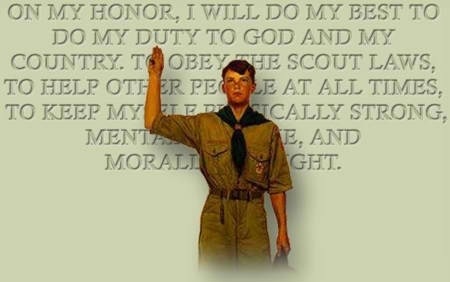
boy scouts
The health of the BSA was already being challenged via lawsuits, and as revelations of pedophiles in the Scouts have become more broadly known. From WND again

In fact, the examination of sex abuse in Scouting reveals a long-standing paradox for the nation’s most revered youth group: For 80 years the Boy Scouts of America have given boys some of the best experiences of their lives, but for 80 years some men have used the Boy Scouts of America to have sexual relations with those boys.

“That’s been an issue since the Boy Scouts began,” said James Tarr, the nation’s chief Scout executive from 1979 through 1984.

More than 1,100 Scouts reported being molested by Scout workers over a single 19 year period.

Reflecting on these facts raises a few questions:

Where were the “end-of-the-world” pronouncements when the Boy Scouts of America’s “perversion files” were made public last year?

Why is it morally problematic for the Scouts to welcome gays, but not problematic for them to hide a multi-decade history of keeping molestation out of the public eye?

If the two are equally problematic, why not equally speedy and earnest responses to each?

Why is it problematic for churches to host a gay-friendly organization, but not problematic when the organization was “only” hiding child abuse for nearly a century?

Are we seeing the reaction of people for whom gay-rights is the last domino standing, after which there are no more culture wars to fight?

Is their sense of loss greater than their sense of truth?

Why have Scout leaders not been called to repentance by evangelical leaders, especially those who are decrying the recent announcement?

Why do we not emphasize that the Boy Scouts are now–and always have been–a moral organization focused on good citizenship not a gospel organization focused on discipleship?

Do we even recognize the two are not the same?

Why are some fighting to save moralism, rather than drawing a distinction between moralism and the saving grace of God?

Why do evangelical leaders not acknowledge the words “morally straight” are ambiguous, open to interpretation, malleable, and not scripturally moored?

Are some evangelical leaders not blurring the truth when they gloss over this reality: the Scouts’ generic “God” is not necessarily the God of the Bible?

Which God is it that both evangelicals and Mormons can affirm without qualification?

How is one God the same for Buddhists, followers of Native American religions, Muslims, Jews, Christians, those who define their own spirituality, Baha’i, Zoroastrianism, Hinduism, and more all of whom are included in the BSA’s definition of “God”?

If the Scouts are a Judeo-Christian organization why are more troops hosted by the Mormons than any other other single group?

Does our reaction to this announcement reveal confusion over biblical Christianity and civil religion?

Why would most Christians have no problem with this statement, “We have all the American values: the values of hard work, the values of integrity, the values of fairness and respect,” even though uttered by Bill Marriott explaining why his faith (Mormonism) does not interfere with his business?

Are we more concerned about the loss of Americanism than finding an authentic expression of a Christ-bought church?

If we are more concerned with an authentic expression of the church, why are we so afraid of a faltering culture since the church has usually shone brightest in the rubble?

Will we ever grasp that “reclaiming America” is not the same as “revival”?

Will we ever grasp there is no biblical mandate–or even a suggestion–that “reclaiming America” is a call on God’s people?

Have we misinterpreted the fall of Christendom as the work of Satan, rather than considering it could be God destroying our most grand, safe, and preferred idol?

Parallels between abortion and the Holocaust, Part 1

In the early days of the Internet, before what we now know as social media, people exchanged ideas in forums and Usenet groups. After observing many such discussions an attorney named Mike Godwin postulated an argument that has become one of my favorite things to spring from the entire online enterprise. He said, “As an online discussion grows longer, the probability of a comparison involving Nazis or Hitler approaches 1.” In other words, the longer an online discussion goes–regardless of topic or scope–someone at some point will bring up a comparison to Hitler or the Nazis.

This statement is now known as Godwin’s Law, sometimes called Godwin’s Law of Nazi Analogies.

The problem Godwin highlights is most comparisons are glib involving neither a valid historical nor philosophical basis. Godwin himself says he wants people “to think a bit harder about the Holocaust.” If you have spent any time at all online you know Godwin’s Law to be true. At times I’ve seen a non-participant jump into a rapidly fraying thread with the single word “Hitler” or “Nazis.” By skipping ahead to the inevitable they demonstrate the degeneration taking place in the discussion.

But, what happens when a comparison to the Third Reich is warranted? Should it be ignored? Because the comparison has been worn out are there never appropriate parallels? So recklessly and mindlessly has Hitler been invoked to use the comparison almost automatically invalidates one’s argument. It is seen as an admission of a weak, unsupportable point of view. This knee-jerk reaction speaks both to the shallow analysis of the over-user and the intellectual laziness of the person who would dismiss the argument out of hand.

The very nature of the Holocaust demands earnestness of thought. Our concept of genocide, indeed the coining of the term, has arisen as a result of Hitler’s Final Solution. Raphael Lemkin, in his work Axis Rule in Occupied Europe (1944), coined the term by combining Greek genos (γένος; race, people) and Latin cīdere (to kill). Though other genocides have taken place in the last 100 years (i.e., Armenians, the Rwandan Genocide, and Srebrenica Genocide), “Holocaust” is generally reserved for the attempted total extinguishing of European Jewry by Hitler’s Third Reich.

One area of clear parallels with the Third Reich is the abortion-on-demand mindset in America. Children have been linguistically reengineered in ways that would make Orwell seem positively straightforward. Since January 1972 some 50 million lives have been artificially and often violently ended before birth in the United States. Comparison to the Nazis are real, valid and ongoing. These articles are only intended to start your own thinking process, not to raise every conceivable point. However, on this 4oth anniversary of Roe v Wade these ideas are worth our consideration.

Introduction

More than three decades ago Notre Dame professor James T. Burtchaell published a series of essays on abortion. Compiled into the book, Rachel Weeping: The Case Against Abortion, it remains a blistering assault on national pro-abortion policy. No less than the Los Angeles Times called it “a searing, impeccable documentation,” while the Library Journal said it offered “extensive information and profound reflection.” “Unassailable” and “unequaled” could easily be added.

Each is worth reading (the book itself should be added to every personal library), but the two historical essays comparing abortion to American slavery and the Holocaust should not be missed. I cannot emphasize strongly enough the power in these writings. Today we will look at abortion and the Holocaust.

Burtchaell is careful to distinguish arguments and process used by the Nazis from the Nazis themselves. In other words, he does not equate pro-abortion advocations to the Nazis in a direct parallel. He does, however, draw clear comparisons to the arguments and mindsets used in both cases to introduce scenarios beforehand thought improbable, impossible or unthinkable.

Ponder the Germanic scenario. There must be an answer as to why millions and millions of human beings died without hearing or trials. There were no hearing or trials because no victims were accused of any crime; they simply were not wanted. Burtchaell asks and answers.

Who did this to them? The SS, the Gestapo, the German Wehrmacht, military and civilian medical and hospital personnel, conscripts from subject countries like Lithuania and the Ukraine, the police of Germany and its tributaries, the governments of cooperative regimes, and the German government in its many ministries: military, Reichsbank, Propaganda, Interior, Transport, Economy, Food and Agriculture, Finance, Labor, Security, Foreign Affairs, and Justice. Many tens of thousands of people–mostly but not exclusively Germans–merged their wits and their efforts that many millions of their fellow humans–not as soldiers nor as criminals–might be destroyed. (pgs. 144, 145)

In Burtchaell’s mind there were “seven factors in the Holocaust which may help us to understand it as an archetype of massacre that is acknowledged only after the fact.” [Emphasis mine.] We will look at five of these in brief–two today and three in the next post.

1. Depersonalization of the victims.
Germany did not simply awaken one day to find its citizenry acquiescent to a genocidal culture. Many years of treating certain groups as sub-human or not human prepared the normal German to view Slavs, Jews and others as life not worthy of life.

When Dr. Eugen Haagen, professor of hygiene at Strassburg University, was receiving prison inmates in batches of two hundred to be injected with typhus, a question was raised whether some of the experimental subjects might be Alsatians. Haagen’s assistant explained reassuringly that “the experiments would not be conducted with prisoner but only with Poles” as “Poles really are not human beings.” Slavs, in the National Socialist racial scale, were classed as subhumans, Untermenschen, only one grade above Jews. (p. 145) Emphasis in original.

Also,

Himmler once cautioned his SS generals not to tolerate the stealing of property which had belonged to dead Jews. “Just because we exterminated a dead bacterium,” he said, “we do not want, in the end, to be infected by that bacterium and die of it.” (p. 147)

There are endless examples of dogmatic racial superiority and eugenics in Nazi Germany and well before. It was all over medical texts, psychiatry and psychology teachings, propaganda, and even math books.

Below is a list of words and phrases used in the “transformation of nomenclature for the unborn.”

The unborn has been designated as “protoplasmic rubbish,” “a gobbet of meat protruding from a human womb” (Philip Wylie); “a child-to-be” (Glanville Williams); “the fetal-placental unit” (A. I. Csapo); “gametic materials,” “fallopian and uterine cell matter” (Joseph Fletcher); “a part of the mother” (Oliver Wendell Holmes); or “a part of the mother’s body” (Thomas Szasz); “unwanted fetal tissue” (Ellen Frankfort); “the products of pregnancy” or “the product of conception” (HEW); “sub-human non-personhood” (F. Raymond Marks); “child Who-Might-Have-Been” (James Kidd); “so much garbage” (Peter Stanley)…”a collection of cells” (Malcolm Potts)…”potential life” (Mr. Justice Blackmun)…and “a non-viable fetus ex-utero” by the National Commission for the Protection of Human Subjects of Biomedical and Behavioral Research. (p. 196, 197)

nazi propaganda sign

Two people read Nazi propaganda. The left column reads, “The Jews are our misfortune.” [Image credit]


2. Euphemistic language to cover torment
Speaking of language and the end result, Burtchaell notes, “The most common outcome was death, but, to avoid all open mention of death and its violent forms, official documents developed an elaborate, almost elegant, euphemy” (p. 152). Think Orwellian and you will get the idea.

I’ll forego the German and list only some English translations:

evacuation, resettlement, clean-up, labor in the East, cleansing, disinfection, special treatment, return undesirable, departed, special actions, forwarded for special measures, inoculated off, separately quartered, transit camp, bath houses, clean-up of the Jewish question. (pg. 152, 153)

And most well known of all the “final solution to the Jewish question.”

This pastel colored language of the grave–this whitewashing of tombs–did not appear only in words and phrases. It was found in the corridors of official life.

There was the 1933 Law for the Prevention of Hereditarily Diseased Posterity (which affected prevention through sterilization or death); the Reich Committee for Children (which destroyed them); the Reich Committee for Research on Hereditary Diseases and Constitutional Susceptibility to Severe Diseases (which identified those to be eliminated); the Non-Profit Patient Transport Corporation (which conveyed them to the clinics where they would die); the Charitable Foundation for Institutional Care (which paid for it); and there was “euthanasia” and “mercy death” (which was what it was all about). (p. 153)

The Nazis, of course, addressed all issues of potential dilution to the master race including the crippled, retarded and infirm. “These victims were characterized as ‘useless eaters’ and ‘socially unfit.’ Their treatment, as one book described it, posed ‘The Problem of Abbreviation for Worthless Lives'” (pg. 154). Death as abbreviation; how lovely.

The same euphemistic obfuscation was present in the move toward legalized abortion and continues to this day.

“termination of potential life,” “termination of pregnancy,” “therapeutic abortion,” “treatment,” “life-rationing,” “post-conception planning,” “menstrual extraction,” “insure non-pregnancy,” “non-meaningful life,” “unwanted child” (pgs. 202, 204, 205)

Since publication of Rachel Weeping we can add others: “women’s health and reproductive freedom,” “private family matters,” “ensuring fetal demise,” “women’s rights,” and perhaps the most Orwellian of all: “choice.”

And where, exactly, might one go for “post-conception planning”? At the time of Burtchaell’s writing he knew of at least these:

In Pittsburgh there is Women’s Health Services, where the services have little or nothing to do with women’s health. In Florida there is the Orlando Birthing Center, which will handle second-trimester abortions but no births. In Leiden one finds the Center for Human Reproduction, which is concerned to arrest reproduction, as also the Water Tower Reproductive Center in Chicago. In Missouri, Parents Aid aids women to avoid being parents, while in Chicago “Family Guidance” guides people to prevent families. Pre-Term and Pre-Birth in Chicago preclude full-term births. (p. 204)

Be reminded: he is not saying these people are Nazis. He is saying the same “language as smoke screen to the truth” was used in both instances. Any convincing disproval is unlikely.

Next up: 3. Disavowed malicious intent, 4. Once initiated, killed indiscriminately, and 5. Found it an occasion to acquire wealth.