Tag Archives: Christianity

Frederick Douglass on authentic Christianity

A few months back the twitters and blogosphere erupted over a song by hip-hop artist, Propaganda. I wrote about it as well.

The song is entitled “Precious Puritans” and is, in a Grand Canyon of understatement, thought provoking. Concerning well beloved puritan theologians, he raps:

How come the things the Holy Spirit showed them in the valley of vision didn’t compel them to knock on they neighbors door and say, “You can’t own people!”?

Your precious puritans were not perfect.

You romanticize them as if they were inerrant. As if the skeletons in they closet was pardoned due to the they hard work and tobacco growth.

As if abolitionists weren’t racist and just pro-union.

As if God only spoke to white boys with epic beards.

You know Jesus didn’t really look like them paintings. That was just Michaelangelo’s boyfriend.
Your precious puritans.

Dr. Anthony Bradley, addressing the response to the song (too often White and negative), tweeted this:

The link is to a scholary paper from Cambridge University Press entitled, “Language, Discourse and Power in African American Culture.”

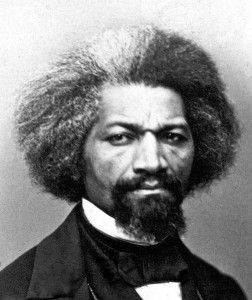
One African-American who used language, discourse and power to rip the church the proverbial “new one,” was Frederick Douglass. Douglass (1818-95), a prominent American abolitionist, author and orator, launched a critique at the American Christianity of his day the comprehensiveness of which has scarcely been equaled. The intensity, analysis and truth shames many an attempt that have followed.

My friend Alan Cross, who blogs at Downshore Drift, recently made me aware of an excerpt from Douglass’ autobiography, Narrative of the Life of Frederick Douglass, an American Slave. In it the former slave writes:

I love the pure, peaceable, and impartial Christianity of Christ: I therefore hate the corrupt, slaveholding, women-whipping, cradle-plundering, partial and hypocritical Christianity of the land. Indeed, I can see no reason, but the most deceitful one, for calling the religion of this land Christianity. I look upon

frederick douglass

Frederick Douglass

as the climax of all misnomers, the boldest of all frauds, and the grossest of all libels. Never was there a clearer case of ‘stealing the livery of the court of heaven to serve the devil in.’ I am filled with unutterable loathing when I contemplate the religious pomp and show, together with the horrible inconsistencies, which everywhere surround me. We have men-stealers for ministers, women-whippers for missionaries, and cradle-plunderers for church members. The man who wields the blood-clotted cowskin during the week fills the pulpit on Sunday, and claims to be a minister of the meek and lowly Jesus. . . . The slave auctioneer’s bell and the church-going bell chime in with each other, and the bitter cries of the heart-broken slave are drowned in the religious shouts of his pious master. Revivals of religion and revivals in the slave-trade go hand in hand together. The slave prison and the church stand near each other. The clanking of fetters and the rattling of chains in the prison, and the pious psalm and solemn prayer in the church, may be heard at the same time. The dealers in the bodies and souls of men erect their stand in the presence of the pulpit, and they mutually help each other. The dealer gives his blood-stained gold to support the pulpit, and the pulpit, in return, covers his infernal business with the garb of Christianity. Here we have religion and robbery the allies of each other—devils dressed in angels’ robes, and hell presenting the semblance of paradise.

Thoughts?

The Kindle version of Narrative of the Life of Frederick Douglass is available free below. Just click the Amazon link.

‘Religiously unaffiliated’ on the rise says Pew Research

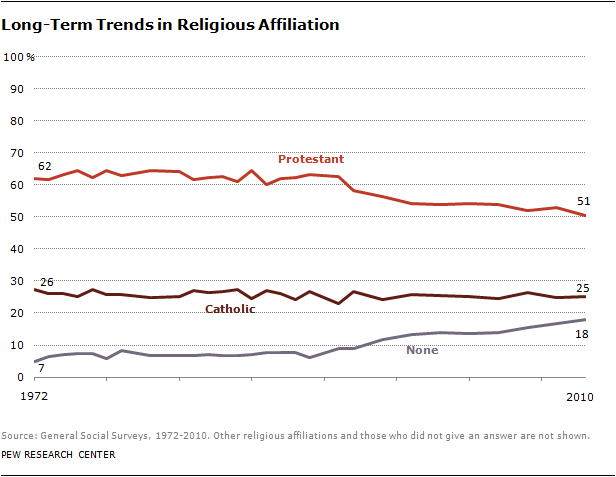
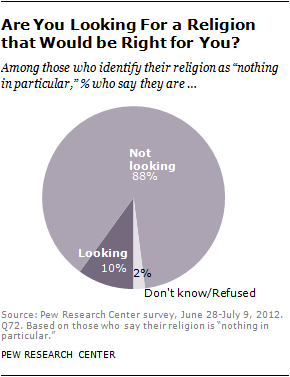
The number of Americans who do not identify with any particular religion continues to increase rapidly according to newly released data from Pew Research. One-fifth of the U.S. public–and about a third of adults under 30–are religiously unaffiliated today, the highest percentages ever in Pew Research Center polling.

In the last five years the unaffiliated have increased from just over 15% to just under 20% of all U.S. adults. Among them are more than 13 million self-described atheists and agnostics (nearly 6% of the U.S. public), as well as nearly 33 million people who claim to have no particular religious affiliation. That number represents 14% of the population.

What makes this even more troubling for followers or Christ is that 88% of the “nones” are not looking for any kind of religious system.
religious preference from pew research“Overwhelmingly, they think that religious organizations are too concerned with money and power, too focused on rules and too involved in politics,” says Pew.

The report continues:

While the ranks of the unaffiliated have grown significantly over the past five years, the Protestant share of the population has shrunk. In 2007, 53% of adults in Pew Research Center surveys described themselves as Protestants. In surveys conducted in the first half of 2012, fewer than half of American adults say they are Protestant (48%). This marks the first time in Pew Research Center surveys that the Protestant share of the population has dipped significantly below 50%.

The decline is concentrated among white Protestants, both evangelical and mainline. Currently, 19% of U.S. adults identify themselves as white, born-again or evangelical Protestants, down slightly from 21% in 2007. And 15% of adults describe themselves as white Protestants but say they are not born-again or evangelical Christians, down from 18% in 2007. There has been no change in minority Protestants’ share of the population over the past five years.

religious affiliation trend chart

Thinking about the religiously unaffiliated people you know, what are their reasons for not seeking God? Or, is it God they seek outside of a religious connection?

Learning from Turkish Muslims

My friend Joel Rainey recently returned from a trip to Turkey. Joel has been a pastor and church planter, is an author, blogger, husband and father. He currently is the Director of Missions for the Mid Maryland Baptist Association.

This week he blogged about his trip to the nation of Turkey; a trip he took with several pastors from his area. It is an illuminating story with truths that benefitted me, and I hope will benefit you, too. He has given me to publish, “What Turkish Muslims Taught Me About our Changing World” in its entirety. The original post is at his blog, themelios.

My job sometimes requires pretty extensive travel, and through my service to our churches, I’ve had the opportunity to, literally, see the world. But I’ve just returned from a trip that I think has had a greater impact on me than any other trip I’ve taken.
Turkey trip

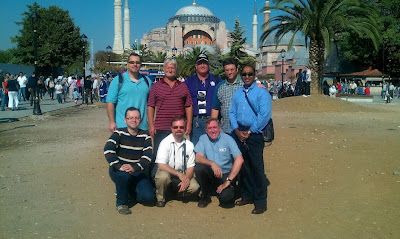
Joel Rainey (back left) and team in Turkey

From September 21-30, six area pastors and myself traveled throughout the Republic of Turkey with members of the Muslim community. This journey actually started more than a year ago with a call from one of our state legislators who is a member of one of our churches. The Governor of Maryland had included her in a trip to Turkey as part of an eventual “sister-state” agreement that was signed between my state and a province in that country, but once the leader of the Turkish organization discovered that this representative was an evangelical Christian, he expressed hesitation, because, as he put it, “I always thought evangelical Christians hated Muslims.”

Seeking to put this false rumor to rest, I reached out to the members of this community, and got a warm embrace in response that has lasted more than a year. I’ve been in the company of people from nearly every tribe and tongue, but when it comes to hospitality, no one does it better than the Turkish people! They are some of the finest and most gracious people I’ve ever met! Eventually, this new relationship resulted in their invitation for us to join them in their home country last week.

Let me say that again. Muslims openly invited more than a half dozen Baptist preachers to the middle east, and even covered a significant portion of the cost of the trip!

During our time abroad with our new friends, I have never experienced such hospitality! We toured sites together that were important to both Christians and Muslims. We visited schools, newspapers, and hospitals built by this group in the hopes of improving the lives of others in their home country. We visited the homes of influential Turkish business leaders and learned of their own involvement in trying to improve conditions, not only in Turkey, but throughout the middle east. One young pharmacist we met near the border with Syria told me “I want to take what we have done in this city, and spread that peace across the border and throughout this part of the world. I want my city to be the starting gate for peace.” I love that guy’s heart!

It is unfortunate that nearly everything about this part of the world that is broadcast on American news media focuses on extremist elements. To be sure, those elements are very present (as was demonstrated after our departure with the Syrian violence crossing the border into Turkey), but the so-called “Muslim world” is full of good people who are trying to make a positive difference, and its working!

All of this probably sounds very strange coming from the mouth of an evangelical Christian, and to be sure, my convictions have not changed. I still believe the Bible is the Word of God. I still believe Jesus is God, that He was crucified as a substitute for sinners, that he rose bodily from the dead, and that nothing short of repentance and total faith in His death and resurrection will save. But these convictions don’t hold me back from the relationship I now have with my Muslim friends. On the contrary, they propel me more deeply into relationship with these precious people!

This experience is but one example of how the way we engage the world as followers of Jesus needs to change, and I’ve addressed that issue in more depth here. But as we explore further ways to walk together with the Muslim community here, I’m taking several things away from our recent trip that will continue to inform our ongoing relationship.

1. The sincerety of their faith is motivating them to change the world, starting with the region where they live. Our Turkish-American guide for this trip told me that years ago he asked the question, “why is it that when it comes to science and technology, education, and health care, that the Muslim world seems to lag behind everyone else?” According to his own testimony, he found mentors within his own faith who believed that Islam should actively engage all these areas, and contribute to the global community. In short, he and others like him who live in Turkey have found meaning and purpose that they believe is anchored in their faith.

2. The Movement we witnessed in Turkey is cross-generational. While many young people are “out in front” seeming to make positive waves, older generations are seeing their passion and responding with financial support and other things necessary to accomplish their goals. Inspired by Imams of centuries past who encouraged Muslims to invite “outsiders” in, they have taken one step further and are taking the initiative to introduce themselves to the non-Muslim world. They are disheartened by the way the media have focused almost exclusively on the radical elements of their faith, are weary of being automatically identified with those radical elements, and are eager to share the good that is happening throughout the middle east and among Muslims worldwide which is so under-reported. It was not uncommon for us to visit a home where three or four generations of Turkish Muslims spoke of their commitment to these goals.

3. They speak boldly and loudly to the violent elements in their faith, and so should we! Though the media pay them little attention (honest appraisal of the positive elements of a movement or religion rarely sells a lot of newspapers or increases viewer ratings), they are quick to condemn violence committed in the name of Islam. We had barely landed when our guests openly and forcefully condemned the recent attack on our embassy in Libya in response to the “Innocence of Muslims” film made in the U.S., and apologized to us for the way their faith was represented in that violence. (We responded by condemning the film itself. The language and sexual content alone should make that film as offensive to Christians as it is to Muslims. We also acknowledged that idiots are entitled to their 1st amendment rights also!)

Call it propaganda if you want, but the truth is that Muslim critics of violence abound, we just don’t listen for their voices. (Harris Zafar is but one example in our own country.) Instead, we tend to suppress our awareness of the violent tendencies present in ourselves. Sure, we Christians don’t have anyone flying airplanes into skyscrapers. But when was the last time you heard a Christian openly condemning a violent attack on an abortion clinic, or the bullying of a homosexual? Our new Muslim friends agree with us that ALL people are created in God’s image and likeness, and when violence is done to any of them, the reason doesn’t matter. Such violence should be condemned.

4. This new relationship is a new platform for the very kind of “public square” evangelism in which Paul participated. You could spend years as a “traditional” missionary in a Muslim country and never achieve the level of access we achieved in a single week! From the beginning, we have been up front with our Muslim friends regarding what we believe, and told them our greatest desire is for them to come to know Jesus as we know Him. But we have also stressed that our continued friendship is not contingent on whether they become Christian. After all, “forced conversion,” is not conversion. It is conquest, and both Christians and Muslims have already given each other too much of that in our history together.

At the same time, I can’t help but think that if Paul were alive today, this is precisely the platform he would leverage in order to spread the Gospel. On several occasions, our group had this opportunity, and we seized it with the blessing of our hosts, most of whom were and are curious about Jesus. In general, Muslims have great respect for Jesus. They just don’t know much about him, and recognize that Christians spend much more time focusing on Him. So when they encounter Christians, they are often anxious to hear a story about him. Though most seminary textbooks on the subject claim that Muslims reject the doctrine of penal substitution, the truth is that many Muslims have never even been offered the opportunity to consider the concept. In one of my conversations this past week, one man asked “tell me again what you mean by ‘Jesus paid the price.’ I’ve never heard that before!”

5. In our current North American context, walking in close relationship with Muslims is the epitome of being “counter-cultural.” Let’s face it. Most Americans, even Christians, are afraid of Muslims. We are conditioned by our media, and even most of our political leadership to keep our distance. So what could possibly be more counter-cultural than our willingness to to walk together with these precious people, and do it publicly?

6. If the Gospel is truly “the power of God unto salvation,” then what on earth are we afraid of? I still believe Romans 1:16-17 is true. And because I believe this, I want to walk closely with those who have yet to accept its claim. Our new friends are anxious to talk about faith, and there is much that we hold in common! But in the midst of discussing those commonalities, I have, and will continue to challenge them concerning the basis for forgiveness, and a sure hope of eternal life. And I’ll do it because they are my friends.

Our group learned much while traveling with our friends, and we look forward to learning more, to engaging them in matters of common interest, and to consistently present the Gospel of Jesus to them at every opportunity. God is at work in places we too quickly brush off as “lost.” I saw it for myself, and I look forward to experiencing all that He has in store in the future for us, and for our new friends.

I will just add that Joel’s strategy for meeting and learning from members of the Islamic religion is also needed for any area where you and I differ from others. We cannot claim to “know” about Islam if we do not know any Muslims. We cannot claim to know the needs of the homeless unless we talk to them and ask. Those in the racial majority cannot claim to know how racial minorities are affected by government policy unless those in the majority are friends with minorities. Wisdom requires nothing less of us.
Christianity or Americanism?

american-flag-2a
For many years, observers of the church in America have been warning that too many believers may have inadvertently swallowed a bitter pill thinking it was good medicine. The re-prioritizing of the two kingdoms, man’s and God’s, has long been a temptation and it seem that we are destined to see it repeated over and over again until the return of Christ.

Whether the belief that England was in a covenant relationship with God, thus the moral authority to launch crusades against infidels, or that France was in a covenant relationship with God, thus the moral authority assumed by Joan of Arc to crusade against the antagonistic English, or the belief that “New England” was in a covenant relationship with God since “Old England” has turned away from the covenant, nations and peoples since the ascension of Christ have sought to pick up, dust off and wear the mantle of Israel’s covenant with God. Almost without fail this leads to an idolatry from which there is rarely a return. Even many pre-WW2 Christians in Germany welcomed the influence of the Nazi Party as if it were the evident blessing of God on “the Fatherland.” Thankfully the Confessing Church stood against the embodied blasphemy that was the 3rd Reich.

Amid the many “taking America back” ideas that permeate that portion of Americans who are Christians there seems to run a common thread of misunderstanding. There has never been a Christian America and never will be. Just as there has never been nor ever will be a Christian Sudan, Ghana, Canada, Russia or Egypt. “Christian” should refer to people who have been redeemed by the blood of Christ, not countries, bookstores or concerts. While it should be obvious to any reader of the Scriptures that Jesus died to save Americans, He did not die to save America. To think that God has only used America for His purposes is to misunderstand history; to think that God has chosen American for special blessing in a way that He has chosen no other country is to misunderstand theology. Second Peter 2:9 makes it clear that the “holy nation” God has chosen in these day is the church, not a geopolitical entity. The church exists within the borders of United Nations national charters, she does not take the place of them or become them. The ongoing conflation of the two kingdoms has created an unhealthy relationship between church and government even here in the United States where both left and right leaning Christians equate the presence of the Kingdom of God with whether or not we get a single payer healthcare option or we finally drill for oil in the arctic preserve. It bears remembering for all American believers that every time the church has crawled in bed with the state, the government prospers and the church is left cold, wretched, miserable, blind and naked.

Valid questions for all American Christians are: Do we worship America or Jesus Christ? Have we been brought into the relationship marked by Christianity or the religion of Americanism? Consider the following as possible indicators that we might have switched kingdoms:

Does your blood pressure goes through the roof when you see someone burning the American flag, yet you can hear someone take the name of Jesus in vain and you don’t flinch?

Are you angered when you see disrespect to an American soldier, yet when the persecution of Christians is reported on the news you give it not a second thought?

Will you walk across a restaurant to thank a service man/woman you have never met, but never thank your pastor for taking care of the flock?

Are you worried more about the country going into socialism than you are praying for the financial obedience of your own church?

Do you actively recruit people to your political positions, but ignore the need those same people have to know Jesus?

Does the national anthem or “American the Beautiful” brings tears to your eyes while worship songs bring dullness to your ears?

Are you more concerned when the Constitution is ignored than when the Bible is ignored?

Are you more appreciative of freedom of religion granted in the First Amendment than of freedom in Christ promised in John 3:16?

Is there a greater place in your heart for Washington, Adams and Jefferson than for Abraham, Paul and Peter?

Is it more important to you to support war or to try and bring peace?

At the National Prayer Breakfast in 1973 Former Senator Mark Hatfield said, “Let us beware of the real danger of misplaced allegiance, if not outright idolatry, to the extend we fail to distinguish between the god of an American civil religion and the God who reveals Himself in the Holy Scriptures and in Jesus Christ.

If we as leaders appeal to the god of civil religion, our faith is in a small and exclusive deity, a loyal spiritual adviser to power and prestige, a defender of only the American nation, the object of a national folk religion devoid of moral content. But if we pray to the biblical God of justice and righteousness, we fall under God’s judgment for calling upon His name, but failing to obey His commands.”

Hatfield had it right. God help us not to get it wrong.