Tag Archives: voting

Food stamps and voting: What do the maps show?

Before the election much hubbub was made about the numbers of people being added as recipients to the SNAP (food stamp) program. Some wondered at the possibility of those being bought votes. In the form of a question, did the Obama administration recruit people to the assistance program to ensure a re-election victory? In the mean time, people wondered, were we being bled dry be a bunch of lazy, shiftless, good for nothings who are just taking advantage of the governmental teat?

According to the Wall Street Journal the average food stamp family in 2010 had $731 per month in gross income. They received just $287 per month from SNAP. The Journal also reported

Nearly 21% of households on food stamps also received Supplemental Security Income, assistance for the aged and blind. Some 21.4% received Social Security benefits. Just 8% of households also received Temporary Assistance for Needy Families, the cash welfare program.

But some 20% of households had no cash income of any kind last year, up from 15% in 2007, the year the recession began, and up from 7% in 1990.

That’s partly because most household heads who were receiving food stamps were also out of work. Just 21.8% of them had jobs in 2010, while 19.8% were jobless and looking for work.

More than half of household heads who received food stamps, 51.1%, weren’t in the labor force and weren’t searching for work. Labor-force dropouts have been a particular concern for economists, who worry their lost potential damages economic output. Those who drop out of the work force often turn to other government programs, such as Social Security disability, which is costly.

[…]

Just 6.7% of households who received food stamps were getting jobless benefits.

Nearly half of all food-stamp recipients, 47%, were children under the age of 18. Another 8% of recipients were age 60 or older.

Whites made up the largest share of food stamp households, 35.7%. Some 22% of households receiving food stamps were counted as African American and 10% were Hispanic.

U.S. born citizens made up the majority, 94%, of food stamp households.

While it is true SNAP users have increased dramatically under the Obama administration a substantial increase had already begun under the Bush 43 administration. The extent of the economic downturn between the fall of 2007 and 2011 would likely have seen a continued increase if there had been a third Bush term. (Only Clinton at -8.2% and Reagan at -2.4% have overseen declines in the last eight presidencies.)

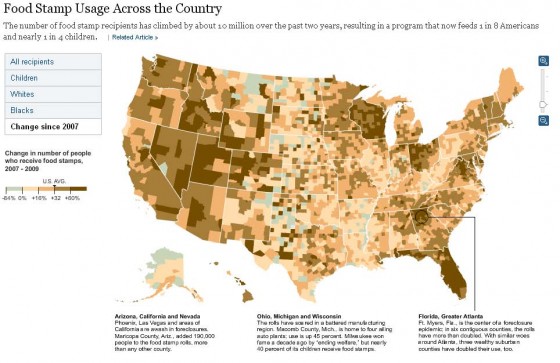
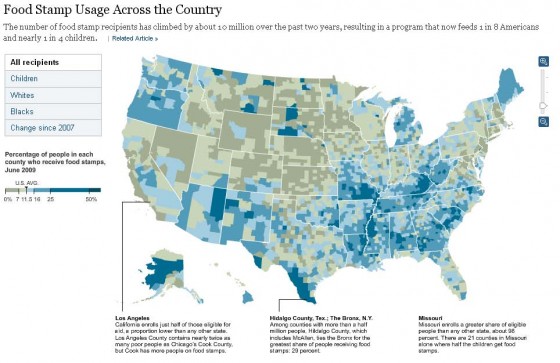
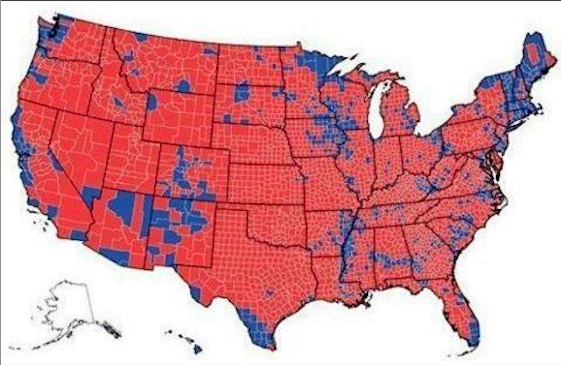
So what about the votes? Below are four national county maps. The first is voting by county for the 2008 election. Then the amount of county-by-county increase in food stamps recipients between 2007-2009. Beneath that is the percentage of residents on food stamps in each county nationally in 2009. Finally, a county-by-county voting map of the 2012 election.

I am neither a cartographer, a politician nor the son of either. However, it looks like an awful lot of counties with high concentrations of food stamp recipients voted Red (ie, GOP). It is true that the highest numbers of recipients are in Blue (Dem) areas, but I think it is too strong a suggestion to say all food stamp recipients voted Democratic. It is also too strong to say Obama carried the day because of that vote. Since 18M people been added since Obama took office and he won by less than 3M votes, and since he garnered 9M more votes in 2008, it seems hard to argue that SNAP recipients contributed meaningfully to his victory.
2008 election map

u.s. county map food stamp growth

2009 u.s. county map food stamps

2012 election u.s. county map

Thoughts?

Six reasons to consider voting third party

Throughout this election season, as in the last one, I have written and discussed here and on Facebook about the need to break the two party, Democrat-Republican dominated political system in the United States. The adversarial aspect of this system has led to a stymied congress, lies, deceit, and an ongoing “lesser of two evils” approach to voting.

voting boothThe election tomorrow seems to be potentially as close as any since Bush-Gore in 2000. Some have even speculated of an Electoral College tie between president Barack Obama and Republican challenger Mitt Romney. Some of my friends have made the informed decision not to vote–and have been castigated for it.

The objection I normally face has been that a vote for a third party candidate is a vote for Barack Obama (if the objection is coming from a conservative) or a vote for Mitt Romney (if coming from a liberal). I reject this reductionistic approach as inaccurate and illogical. Others say a vote for a third party candidate is akin to throwing away one’s vote. On the contrary, I say voting for someone who does not best represent your principles and philosophy of government is throwing away your vote.

Considering such dominance from the Democratic and Republican parties when should you vote for a national candidate not among the two major parties?

1. When you would have to violate your conscience to do so. If an issues or issues important to you are ignored by the most well known candidates do not cast a vote for them.

2. If neither candidate has earned your vote. I do not look at my vote as something I give to a candidate. It is something they must earn. If he or she does not earn it, they do not get it.

3. If your state is polling overwhelmingly toward one candidate or the other. My state, Tennessee, has been Republican since before Obama was elected. It is not about to change; polling is not close to the margin of error. Because of the Electoral College, every single vote truly does not matter; only the total number of votes matter. For that reason you can confidently vote for the candidate your prefer with no concern you might rip the space time election continuum.

4. If you consider the lesser of two evils argument to be abhorrent. Some Christians will make the argument that we will never have a perfect candidate, so every choice is a lesser of two evils. I find this to be thoroughly unpersuasive. First because the “two evils” necessarily eliminates other, better choices. Second because the lack of perfection does not equate to evil. (Try that on your wife: “No, she’s not perfect. In fact, you might as well say she’s evil.” Good luck with that one.)

5. If you are more concerned about being the cure than spreading the cancer. Our political system, while functional, spews a dangerous toxicity. Abuses of power, mindless spending and selfish gain seem to be the norm on The Hill.

6. If neither major party candidate even begins to address issues of vital importance to justice. Most on the Right have reduced the idea of justice to abortion, while most on the Left have similarly reduced it to taking care of the poor. Where, in three presidential debates and one vice-presidential debates, were discussions about our unjust justice system, the unjust “War” on Drugs, concerns to address human trafficking, the NDAA, the unjust drone war? They were nowhere to be found. A candidate who thinks these major issues not worth a mention does not even qualify for the office.

Can you think of any other reasons to consider voting for a third (or “minor”) party candidate?

Eleven states needed to win the presidency

What is the fewest number of states needed to win the presidency? With our electoral college system it might be far fewer than you think.

You may not have misread the title, but you probably did not get the meaning. I do not mean, “The eleven states a candidate must carry to win.” I mean, “Any candidate can win the presidency by carrying only eleven states.”

Your now have the idea.

It is possible to lose the the popular vote and lose 39 of the 50 states, yet still be the president of these United States.

How? The Electoral College.

The Electoral College was approved September 6, 1786, for reasons known only to the members of Skull and Bones and makers of “corn likker.” According to Wikipedia, “Delegates from the small states generally favored the Electoral College out of concern that the large states would otherwise control presidential elections.”

Can you say irony? Smaller states, for purposes of the college, are not determined by size, but by population.

While polls can be a good measure of popular sentiment, they are not sufficient to gage the electoral map. That is why you often hear of “swing states.” These are states candidate X or Y must get to reach the magical 270 electoral votes needed.

You can look elsewhere for more specifics on the electoral college. For now I just wanted to share the eleven states one can win to become president:

California (55 votes)
Texas (38 votes)
Florida (29 votes)
New York (29 votes)
Illinois (20 votes)
Pennsylvania (20 votes)
Ohio (18 votes)
Georgia (16 votes)
Michigan (16 votes)
North Carolina (15 votes)
New Jersey (14 votes)

electoral college map 2012

Electoral College map 2012 [Image credit]

You might be interested to know, based on 2011 data, 177,215,379 people live in those eleven states (total U.S. population 311,591,917). Another way of saying it is around 57% of the United States lives in these eleven states.

Interesting?