Tag Archives: Joel Rainey

Pastoral challenges in the next 20 years

Joel Rainey is Executive Director of the Mid-Maryland Baptist Association. He is on the adjunct faculty of two seminaries, and the author of two books: Planting Churches in the Real World and Sidestepping Landmines: Five Principles for Pastor Search Teams. Joel works closely with numerous pastors in a state not known for its evangelical values. He is a strategic thinker on many things related to the kingdom of God.


On his blog, themelios, he recently wrote on the nature of pastoral leadership in the next 20 years. Joel asked a question once posed to him, “Are we really up to this?” This post is adapted from his writing.

American society is morphing at an unprecedented rate. This means more for the church than perhaps any other area as we claim God’s unchanging truth in changing times. Rainey asks whether pastors are “up to this”? I wonder if churches are.

If Rainey’s thoughts are on target, I think three things will happen as it relates to churches (and denominations) in the United States. First is capitulation. Many will simply agree with the surrounding culture that truth is maleable, subjective and suggestive. These churches will become indistinguishable from other societal organizations whose purpose is “to make the world a better place.” They bother not with sin, judgment or a cross. Second is separation. As in every generation these are they who are not of the world, but neither are they in it. They have no actual influence and their loudly sounded trumpets of culture wars fall mostly on deaf ears. Third is contextualization as the remaining churches seek to exegete culture, relate to it and bring the uncompromised gospel to everyone in a way that both illuminates their need and introduces the remedy: Jesus Christ. For these, mercy truly triumphs over judgment.

From Joel Rainey:

Scenario One: A pastor is called to a church with the expectation that he will “help us reach the young families.” Problem is, everyone in the church is over the age of 60, and more than 50% of the community within 10 minutes of the church is also in that age range.

By 2030, it is estimated that more than half of the U.S. population will be over the age of 50. This “graying” of America is presently going almost completely unnoticed by most churches, who tend to go after the prized “young families with children” category. Yet 80% of those over 50 live in a multi-housing situation (“55 and older” apartments, duplex communities, retirement and assisted living communities), and 98% of all multi-housing residents are without a relationship to Jesus. Are you keeping pace with the generational shifts that are taking place around your church, and how your church should respond to those shifts?

Scenario Two: Multiple families visit the church who do not speak English, politely nod and smile, and never return.

By 2025, Hispanics will outnumber African Americans by 3 to 2, and will comprise approximately 40% of the U.S. population. Over a decade ago, Oscar Romo noted that America, “hardly the ‘melting pot’ described by history texts, has become a land marked more by diversity than homogeneity.” In no area is this fact more clear than in the area of language.

Scenario Three: A married homosexual couple with three adopted children visit your church.

This is one of those issues when if you are a pastor, you need to go ahead and check all your political arguments at the door. What we believe society should or shouldn’t do in this situation is of absolutely no consequence, because they are doing it anyway!

[…]

Truth is, we live in a nation and culture in which our understanding of marriage has been devolving for decades.

Now that this is a reality, how will we minister to the parents and their children? How should our children’s departments be equipped to minister to the kids? How are you equipping other couples in your church to interact with and minister to these precious souls? How can you uphold clear Biblical standards in love?

Scenario Four: A young person who has visited your church for a while repents of her sin and receives Jesus as Lord and Savior. As you prepare for her baptism, you discover through her testimony that she was born male, but had gender-reassignment surgery a few years ago.

Scripture has no category for an “androgynous Christian.” There are Christian men, and Christian women, and the discipleship models spelled out for us in the New Testament tend to be described in conjunction with one’s gender.

[…]

Are you prepared for the Biblical, moral, psychological and bioethics questions that will necessarily be part of that conversation?

Scenario Five: More and more people, it seems, are asking you to perform funeral ceremonies for their pets. You have noticed over time that the grieving process for a family losing a pet, as well as the elements of the funeral itself (pictures, memorials, poems, etc.) indicate a much greater value on animals than in the past.

We are already witnessing attitudes in our culture that betray a gravitation towards increased “equalizing” of animals and humans, and too many in the church have bought into this idea. Are you prepared to lovingly confront the false idea that “all dogs go to heaven,” and re-assert the essential distinction between human beings, who are created in God’s own image and likeness, and pets, who are not?

Scenario Six: Because of growth, your church starts a “video venue,” and begins live-streaming worship and sermons via the internet. You notice that you have a growing “online” audience, many of whom log in every Sunday, and who financially support the ministry. Through connections with these people on social media you discover that, although they may live hundreds or even thousands of miles away, they consider your church their “church home.”

Today’s advanced and inexpensive technology means that churches are asking questions that would never have been considered even 20 years ago, and one of the biggest questions today has to do with the legitimacy of the so-called “internet church.” In the future, how will your church ensure that the Biblical principles and practices commensurate with a covenant community are observed in this environment?

Scenario Seven: You discover through casual conversation that a yoga class has been started by leaders in the church, that participants freely greet one another with “namaste,” and that Christian meditation has been confused with the emptying of the mind that is endorsed in many Hindu communities.

Over the past decade, there has been a huge increase in ancient pagan practices, much like those that occurred in the days of the Old Testament. The digital age, among other things, presents opportunities for the “blending” of faiths that was unheard of even two decades ago. In what ways should you be prepared to bifurcate for your people between what can, and cannot, be part of the life of someone who follows Jesus according to Scripture?

Scenario Eight: You receive a call from a mainline church in town. The size of their congregation has dropped to less than 20 members. They are fearful for their future, and they ask for your help.

It is simply a statistical fact that theological liberalism kills churches. As such, expect the mainline protestant churches in your town to continue slowly bleeding to death. Yet, the people in those dying churches need someone to love them by ministering to their needs and reminding them of what their faith once stood for. Are you prepared to raise up leaders who can utilize those facilities to start a second campus for your church, or start a new church altogether?

Scenario Nine: Parents come to you for counseling regarding their son, who has been diagnosed with multiple “generic” disorders, but doctors have been incapable of specifying the problem, and the child has been largely un-treatable by psychiatrists. You suspect the presence of demonic activity.

I truly believe that we will see a sharp rise in obvious demonic activity in the west, and I believe it will unfortunately be mis-diagnosed as a solely medical or psychiatric problem. As a result, too many children will grow up expressing the personality of a psychotrophic drug unless wise and godly pastors in the west learn to recognize the presence of demonic activity.

Scenario Ten: In this “brave new world,” God continues to seek worshippers, and Jesus continues to save people from sin, Satan, death, and hell in miraculous ways.

What I’ve described above is a culture that is emerging, and that is filled with people Jesus died to save. And it is in this environment when I hear evangelical Christians having the dumbest arguments!

What would you add? Is Joel right in his assertions?
Learning from Turkish Muslims

My friend Joel Rainey recently returned from a trip to Turkey. Joel has been a pastor and church planter, is an author, blogger, husband and father. He currently is the Director of Missions for the Mid Maryland Baptist Association.

This week he blogged about his trip to the nation of Turkey; a trip he took with several pastors from his area. It is an illuminating story with truths that benefitted me, and I hope will benefit you, too. He has given me to publish, “What Turkish Muslims Taught Me About our Changing World” in its entirety. The original post is at his blog, themelios.

My job sometimes requires pretty extensive travel, and through my service to our churches, I’ve had the opportunity to, literally, see the world. But I’ve just returned from a trip that I think has had a greater impact on me than any other trip I’ve taken.

Turkey trip

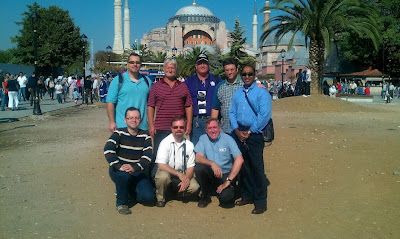
Joel Rainey (back left) and team in Turkey

From September 21-30, six area pastors and myself traveled throughout the Republic of Turkey with members of the Muslim community. This journey actually started more than a year ago with a call from one of our state legislators who is a member of one of our churches. The Governor of Maryland had included her in a trip to Turkey as part of an eventual “sister-state” agreement that was signed between my state and a province in that country, but once the leader of the Turkish organization discovered that this representative was an evangelical Christian, he expressed hesitation, because, as he put it, “I always thought evangelical Christians hated Muslims.”

Seeking to put this false rumor to rest, I reached out to the members of this community, and got a warm embrace in response that has lasted more than a year. I’ve been in the company of people from nearly every tribe and tongue, but when it comes to hospitality, no one does it better than the Turkish people! They are some of the finest and most gracious people I’ve ever met! Eventually, this new relationship resulted in their invitation for us to join them in their home country last week.

Let me say that again. Muslims openly invited more than a half dozen Baptist preachers to the middle east, and even covered a significant portion of the cost of the trip!

During our time abroad with our new friends, I have never experienced such hospitality! We toured sites together that were important to both Christians and Muslims. We visited schools, newspapers, and hospitals built by this group in the hopes of improving the lives of others in their home country. We visited the homes of influential Turkish business leaders and learned of their own involvement in trying to improve conditions, not only in Turkey, but throughout the middle east. One young pharmacist we met near the border with Syria told me “I want to take what we have done in this city, and spread that peace across the border and throughout this part of the world. I want my city to be the starting gate for peace.” I love that guy’s heart!

It is unfortunate that nearly everything about this part of the world that is broadcast on American news media focuses on extremist elements. To be sure, those elements are very present (as was demonstrated after our departure with the Syrian violence crossing the border into Turkey), but the so-called “Muslim world” is full of good people who are trying to make a positive difference, and its working!

All of this probably sounds very strange coming from the mouth of an evangelical Christian, and to be sure, my convictions have not changed. I still believe the Bible is the Word of God. I still believe Jesus is God, that He was crucified as a substitute for sinners, that he rose bodily from the dead, and that nothing short of repentance and total faith in His death and resurrection will save. But these convictions don’t hold me back from the relationship I now have with my Muslim friends. On the contrary, they propel me more deeply into relationship with these precious people!

This experience is but one example of how the way we engage the world as followers of Jesus needs to change, and I’ve addressed that issue in more depth here. But as we explore further ways to walk together with the Muslim community here, I’m taking several things away from our recent trip that will continue to inform our ongoing relationship.

1. The sincerety of their faith is motivating them to change the world, starting with the region where they live. Our Turkish-American guide for this trip told me that years ago he asked the question, “why is it that when it comes to science and technology, education, and health care, that the Muslim world seems to lag behind everyone else?” According to his own testimony, he found mentors within his own faith who believed that Islam should actively engage all these areas, and contribute to the global community. In short, he and others like him who live in Turkey have found meaning and purpose that they believe is anchored in their faith.

2. The Movement we witnessed in Turkey is cross-generational. While many young people are “out in front” seeming to make positive waves, older generations are seeing their passion and responding with financial support and other things necessary to accomplish their goals. Inspired by Imams of centuries past who encouraged Muslims to invite “outsiders” in, they have taken one step further and are taking the initiative to introduce themselves to the non-Muslim world. They are disheartened by the way the media have focused almost exclusively on the radical elements of their faith, are weary of being automatically identified with those radical elements, and are eager to share the good that is happening throughout the middle east and among Muslims worldwide which is so under-reported. It was not uncommon for us to visit a home where three or four generations of Turkish Muslims spoke of their commitment to these goals.

3. They speak boldly and loudly to the violent elements in their faith, and so should we! Though the media pay them little attention (honest appraisal of the positive elements of a movement or religion rarely sells a lot of newspapers or increases viewer ratings), they are quick to condemn violence committed in the name of Islam. We had barely landed when our guests openly and forcefully condemned the recent attack on our embassy in Libya in response to the “Innocence of Muslims” film made in the U.S., and apologized to us for the way their faith was represented in that violence. (We responded by condemning the film itself. The language and sexual content alone should make that film as offensive to Christians as it is to Muslims. We also acknowledged that idiots are entitled to their 1st amendment rights also!)

Call it propaganda if you want, but the truth is that Muslim critics of violence abound, we just don’t listen for their voices. (Harris Zafar is but one example in our own country.) Instead, we tend to suppress our awareness of the violent tendencies present in ourselves. Sure, we Christians don’t have anyone flying airplanes into skyscrapers. But when was the last time you heard a Christian openly condemning a violent attack on an abortion clinic, or the bullying of a homosexual? Our new Muslim friends agree with us that ALL people are created in God’s image and likeness, and when violence is done to any of them, the reason doesn’t matter. Such violence should be condemned.

4. This new relationship is a new platform for the very kind of “public square” evangelism in which Paul participated. You could spend years as a “traditional” missionary in a Muslim country and never achieve the level of access we achieved in a single week! From the beginning, we have been up front with our Muslim friends regarding what we believe, and told them our greatest desire is for them to come to know Jesus as we know Him. But we have also stressed that our continued friendship is not contingent on whether they become Christian. After all, “forced conversion,” is not conversion. It is conquest, and both Christians and Muslims have already given each other too much of that in our history together.

At the same time, I can’t help but think that if Paul were alive today, this is precisely the platform he would leverage in order to spread the Gospel. On several occasions, our group had this opportunity, and we seized it with the blessing of our hosts, most of whom were and are curious about Jesus. In general, Muslims have great respect for Jesus. They just don’t know much about him, and recognize that Christians spend much more time focusing on Him. So when they encounter Christians, they are often anxious to hear a story about him. Though most seminary textbooks on the subject claim that Muslims reject the doctrine of penal substitution, the truth is that many Muslims have never even been offered the opportunity to consider the concept. In one of my conversations this past week, one man asked “tell me again what you mean by ‘Jesus paid the price.’ I’ve never heard that before!”

5. In our current North American context, walking in close relationship with Muslims is the epitome of being “counter-cultural.” Let’s face it. Most Americans, even Christians, are afraid of Muslims. We are conditioned by our media, and even most of our political leadership to keep our distance. So what could possibly be more counter-cultural than our willingness to to walk together with these precious people, and do it publicly?

6. If the Gospel is truly “the power of God unto salvation,” then what on earth are we afraid of? I still believe Romans 1:16-17 is true. And because I believe this, I want to walk closely with those who have yet to accept its claim. Our new friends are anxious to talk about faith, and there is much that we hold in common! But in the midst of discussing those commonalities, I have, and will continue to challenge them concerning the basis for forgiveness, and a sure hope of eternal life. And I’ll do it because they are my friends.

Our group learned much while traveling with our friends, and we look forward to learning more, to engaging them in matters of common interest, and to consistently present the Gospel of Jesus to them at every opportunity. God is at work in places we too quickly brush off as “lost.” I saw it for myself, and I look forward to experiencing all that He has in store in the future for us, and for our new friends.

I will just add that Joel’s strategy for meeting and learning from members of the Islamic religion is also needed for any area where you and I differ from others. We cannot claim to “know” about Islam if we do not know any Muslims. We cannot claim to know the needs of the homeless unless we talk to them and ask. Those in the racial majority cannot claim to know how racial minorities are affected by government policy unless those in the majority are friends with minorities. Wisdom requires nothing less of us.