Category Archives: Race

The New Jim Crow, by Michelle Alexander, book review [VIDEO]

What do you get when you add American slavery, the convict-lease system, the Jim Crow era, and the “War on Drugs”?

Give up? You get 150+ years of nearly uninterrupted mistreatment of young, African American men at the hands of businesses, individuals and various governmental agencies in the United States.
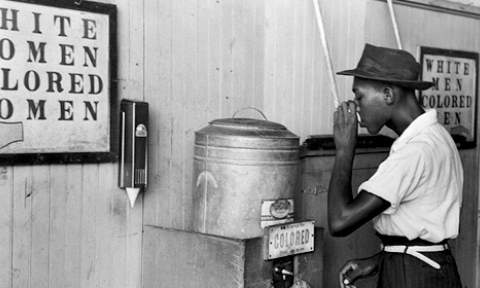

We in hallowed suburbia who see the brutality of slavery and the lynchings and “coloreds only” water fountains of Jim Crow only in an ever dustier rear-view mirror are perhaps ignorant of the current realities. Those who are ignorant of the multi-decade convict lease system in the South are in our own good company: we know little and most of our friends know less. (I interviewed Douglas Blackmon, Pulitzer prize-winning author of Slavery by Another Name, in this series: Part 1, Part 2, Part 3, and Part 4.)

Subtitled “Mass Incarceration in the Age of Colorblindness”, The New Jim Crow takes its name from the condition author Alexander sees exemplified, for instance, in the massive government effort knows as the War on Drugs. This “war” has been so disproportionately prosecuted that a disproportionately large percentage of one specific demographic section of the U.S. population is either imprisoned, on probation or parole: African-American men.

Alexander’s case is built brick-by-brick as she examines policing, the court system, laws like Civil Asset Forfeiture, abuses of the Constitution and the favoritism shown to white defendants. She writes:

The United States imprisons a larger percentage of its black population than South Africa did at the height of apartheid. In Washington, D.C., our nation’s capitol, it is estimated that three out of four young black men (and nearly all those in the poorest neighborhoods) can expect to serve time in prison. Similar rates of incarceration can be found in black communities across America.

These stark racial disparities cannot be explained by rates of drug crime. Studies show that people of all colors use and sell illegal drugs at remarkably similar rates. If there are significant differences in the surveys to be found, they frequently suggest that whites, particularly white youth, are more likely to engage in drug crime than people of color. That is not what one would guess, however, when entering our nation’s prisons and jails, which are overflowing with black and brown drug offenders. In some states, black men have been admitted to prison on drug charges at rates twenty to fifty times greater than those of white men. And in major cities wracked by the drug war, as many as 80 percent of young African American men now have criminal records and are thus subject to legalized discrimination for the rest of their lives. (pgs. 6, 7)

Aiding and abetting this treatment are prosecution and sentencing requirements mandated by War on Drugs styled legislation like “Three Strikes and You’re Out.”

In 1986, Congress passed The Anti-Drug Abuse Act, which established extremely long mandatory minimum prison terms for low-level drug dealing and possession of crack cocaine. The typical mandatory sentence for a first-time offense in federal court is five or ten years. By contrast, in other developed countries around the world, a first-time offense would merit no more than six months in jail, if jail time is imposed at all.

[…]

Now, simply by charging someone with an offense carrying a mandatory sentence of ten to fifteen years or life, prosecutors are able to force people to plead guilty rather than risk a decade or more in prison…They “load up” defendants with charges than carry extremely harsh sentences in order to force them to plead guilty to lesser offenses and–here’s the kicker–to obtain testimony for a related case. Harsh sentencing laws encourage people to snitch.

[…]

In fact, under federal sentencing guidelines, providing “substantial assistance” [ie, “snitching”] is often the only way defendants can hope to obtain a sentence below the mandatory minimum. The “assistance” provided by snitches is notoriously unreliable, as studies have documented countless informants who have fabricated stories about drug-related and other criminal activity in exchange for money or leniency in their pending criminal cases. (pgs. 87, 88)

Add to this unholy mix laws that increase federal assistance based on number of drug-related arrests, inadequate representation from the public defender’s office, warrantless searches and the like, and you have a never ending pool of “violators” into which to cast the net. (For additional contributing factors like race and the Prison Industrial Complex, see my series Our comfortable injustice Part 1 and Part 2.)

Alexander’s chapter “The Color of Justice” is particularly disturbing. In a passage on the New York Police Department’s use of “stop-and-frisk” tactics–which should be unconstitutional–she quotes the Center for Constitutional Rights’ Darius Chaney, “[W]e have been saying for the last 10 or 11 years…that with stop-and-frisk patterns–it really is race, not crime, that is driving this.” Alexander concludes,

Ultimately, these stop-and-frisk operations amount to much more than humiliating, demeaning rituals for young men of color, who must raise their arms and spread their legs, always careful not to make a sudden move or gesture that could provide an excuse for brutal–even lethal–force. Like the days when black men were expected to step off the sidewalk and cast their eyes downward when a white woman passed, young black men know the drill when they see the police crossing the street toward them; it is a ritual of dominance and submission played out hundred of thousands of times each year. (p. 136)

It should raise concerns for followers of Christ not only because of the actual injustices faced by African-Americans but for the mindsets Americans have about such injustices. From page 106:

A survey was conducted in 1995 asking the following question: “Would you close your eyes for a second, envision a drug user, and describe that person to me?” The startling results were published in the Journal of Alcohol and Drug Education. Ninety-five percent of respondents picture a black drug user, while only 5 percent imagined other racial groups. These results contrast sharply with the reality of drug crime in America. African Americans constituted only 15 percent of current drug users in 1995, and they constitute roughly the same percentage today. Whites constituted the vast majority of drug users then (and now), but almost no one pictured a white person when asked to imagine what a drug user looks like. The same group of respondents also perceived the typical drug trafficker as black. [Emphasis mine.]

One sentencing issue reversed in 2010 by Congress and President Obama had to do with the differences in punishments for possession of crack cocaine (more common among blacks) and powder cocaine (more common among whites). “A conviction for the sale of five hundred grams of powder cocaine triggers a five-year mandatory sentence,” notes Alexander, “while only five grams of crack triggers the same sentence.” The sentencing disparity was reduced to from a 100:1 to an 18:1 ratio. Why there is any disparity at all remains unexplained.

According to Alexander the same kind of race-based disparity can be seen in the differences between drug use and drunk driving.

At the close of the [1980s], drunk drivers were responsible for approximately 22,000 deaths annually, while overall alcohol-related deaths were close to 100,000 a year. By contrast, during the same time period, there were no prevalence statistics at all on crack, much less crack-related deaths. In fact, the number of deaths related to all illegal drugs combined was tiny compared to the number of deaths caused by drunk drivers. The total of all drug-related deaths due to AIDS, drug overdose, or the violence associated with the illegal drug trade, was estimated at 21,000 annually.

In response to growing concern–fueled by advocacy groups such as MADD and by the media coverage of drunk-driving fatalities–most states adopted tougher laws to punish drunk driving. Numerous states now have some type of mandatory sentencing for this offense–typically two days in jail for a first offense and two to ten days for a second offense.

[…]

The vastly different sentences afforded drunk drivers and drug offenders speaks volumes regarding who is viewed as disposable–someone to be purged from the body politic–and who is not. Drunk drivers are predominantly white and male. White men comprised 78 percent of the arrests for this offense in 1990 when new mandatory minimums governing drunk driving were being adopted. (pgs. 206, 207) [Emphasis in original]

Alexander concludes that the result of this embedded racism throughout these multiple levels of the legal system is a new caste system. It is into this caste a permanent underclass of young black men are thrown.

The New Jim Crow is well worth the read even if you do not come to all the same conclusions as its author. The preponderance of evidence on the misuse of our legal system alone justifies the time spent.

Below the video of Michelle Alexander are several resources about race, mass incarceration, and the War on Drugs. I’d love to hear your thoughts in the comments.
[youtube http://www.youtube.com/watch?v=RYgxkt6-JNc?rel=0&w=560&h=420]
For Election Day: Malcolm X on blind party allegiance [AUDIO]

Before you start down that path, understand I am not defending, promoting or worshiping Malcolm X. From his bio on Wikipedia:

Malcolm X ( /ˈmælkəm ˈɛks/; May 19, 1925 – February 21, 1965), born Malcolm Little and also known as El-Hajj Malik El-Shabazz[1] (Arabic: الحاجّ مالك الشباز‎), was an African-American Muslim minister and human rights activist. To his admirers, he was a courageous advocate for the rights of blacks, a man who indicted white America in the harshest terms for its crimes against black Americans. Detractors accused him of preaching racism, black supremacy, and violence. He has been called one of the greatest and most influential African Americans in history.

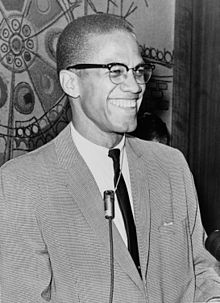
Malcom X in 1964


Malcolm X’s father died—killed by white supremacists, it was rumored—when he was young, and at least one of his uncles was lynched. When he was thirteen, his mother was placed in a mental hospital, and he was placed in a series of foster homes. In 1946, at age 20, he went to prison for breaking and entering.

In prison Malcolm X became a member of the Nation of Islam and after his parole in 1952 he quickly rose to become one of its leaders. For a dozen years Malcolm X was the public face of the controversial group, but disillusionment with Nation of Islam head Elijah Muhammad led him to leave the Nation in March 1964. After a period of travel in Africa and the Middle East, he returned to the United States, where he founded Muslim Mosque, Inc. and the Organization of Afro-American Unity. In February 1965, less than a year after leaving the Nation of Islam, he was assassinated by three members of the group.

Malcolm X’s expressed beliefs changed substantially over time. As a spokesman for the Nation of Islam he taught black supremacy and advocated separation of black and white Americans—in contrast to the civil rights movement’s emphasis on integration. After breaking with the Nation of Islam in 1964—saying of his association with it, “I was a zombie then … pointed in a certain direction and told to march”—and becoming a Sunni Muslim, he disavowed racism and expressed willingness to work with civil rights leaders, though still emphasizing black self-determination and self-defense.

Below is the audio from a speech to a group of African Americans. Though Malcolm X is deriding them unceasingly for their support of the Democratic party, his observations about party loyalty are true across the board. The last build-up and closing sentence are the stuff of a speaker’s dreams.

If you are heading to the polls today, I encourage you to give a listen to this four minutes and think about how these words apply to what we as a nation continue to experience as a result of blind party loyalty.

African-American responses to Propaganda’s ‘Precious Puritans’

For no particular reason I have never been a fan of rap or hip-hop, but last week I was drawn into that genre. The fellow responsible for the drawing is an artist known as Propaganda, a self-described “fire baptized, battle rapper, who’s heavily influenced by boat music and bound creative freedom in poetry.” At least I think that’s what he says. The song by which I was drawn is called “Precious Puritans.”

The song, from Propaganda’s new project, Excellence, takes pastors to task for uncritically quoting the theology of many Puritan pastors. These would be the same Puritans who owned and abused slaves, while excusing it as the order of things. The lyrics to the song (below) are blistering, insightful, and revealing.

jonathan edwards

Puritan pastor Jonathan Edwards [Image credit]


Chicago area pastor Joe Thorn brought the song into my field of view with two posts on his blog. The first is an interview with historian and author Dr. Richard Bailey, professor of early American history at Canisius College, and author of Race and Redemption in Puritan New England, (OUP, 2011).

The second is an interview with Propaganda, with a lengthy discussion about the song.

In short order a twitter exchange broke out with Owen Strachan taking the position the song went too far and would possibly cause avoidance of Puritans altogether. Like not enough fiber in ones diet, I suppose. Last week Strachan took to his blog with the same assertions. It was a weak attempt at a critique. If anything Strachan demonstrated with sterling clarity the very mindset challenged by Propaganda.

Next, influential blogger Steve McCoy weighed-in. McCoy is well known for his breadth of musical knowledge and affirmation of the arts. He correctly notes too many people have missed the point of “Precious Puritans.” I could not agree more. Today Steve asks, “Where are the voices of our white, Puritan-loving Southern Baptist leaders, and seminary presidents, and deans, and entity leaders, and prominent pastors? We need your voices on this.” It is a needed, important question.

I do not fit into any of those categories, but I do have a few thoughts.

One, mainly.

Where are the white believers who are seeking responses from African-Americans? Why, when issues of race propel themselves to the fore, do so many white folks think a white opinion is all that is needed? Worse, why do we so readily believe that we automatically provide a correct analysis on any racial issue?

Today, Dr. Anthony Bradley, associate professor of theology and ethics at The King’s College in New York City and research fellow at the Acton Institute for the Study of Religion and Liberty, tackled the issue on the Urban Faith blog. Addressing this crucial item he writes:

Propaganda’s point is that if white evangelicals do not talk about the bones of their heroes they run the risk of doing great harm to people of color. Many of us are beginning to wonder why white evangelicals do not seem to care much about this and seem willing to trade off “honoring” their forefathers for their own comfort over doing what is necessary to build racial solidarity. Some of my liberation theology friends, in the end, would see Strachan’s critique as a dismissal of acknowledging the importance of caring about how the Puritans are presented to African Americans and would constitute a racial microaggression or a micro-invalidation.

There is an ongoing disconnect between most white evangelicals and anything to do with minority culture, especially as it relates to African-American culture. We are so blind and insular that we do not even attempt bridging divides. This is not typically out of hate, but because we know of no such divide.

Were the slaves not freed? Was the Voting Rights Act not passed? Was the Civil Rights Act not passed? Do we not have a president who is African-American? Then, what is the fuss? Such is a typical white line of thinking.

Two of my African-American pastor friends took the time to respond with their thoughts on “Precious Puritans.” James Roberson III is the Missional Communities Pastor at Blueprint Church in Atlanta, GA. Dr. Dwight McKissic is the Senior Pastor of Cornerstone Baptist Church in Arlington, TX.

From James Roberson:

Here are some historical facts that aren’t talked about:
George Whitfield campaigned to have slaves at his orphanage.
Jonathan Edwards owned slaves as well.
The Southern Baptist Convention made negro inferiority a theological conviction amongst its convention.

Did these negative attributes define who these people were? Not in my opinion. But I wonder if the issue was abortion?

What if George Whitfield campaigned for the rights of women to have abortions.
Jonathan Edwards owned abortion clinics.
The Southern Baptist Bonvention made a woman’s right to choose a theological conviction amongst its convention.

I have heard abortion and slavery compared on more than one silly occasion so I figured I would use it here. I think abortion would make us think of these folks very differently. It shows how we value certain issues more than others.

I love what Propaganda said in his album and I’m surprised that he hasn’t received more flack than he has. Prop was right. I think the entirety of the poem speaks to the flaws of all leaders, which is a healthy reminder. But what I think we are unwilling to embrace is that white people are far too often tired of the slavery conversation and want to move on.

I understand that many white people feel like they shouldn’t have to discuss something they weren’t apart of. Yet what we should embrace is that humans were once used like a rake or luggage; nothing but tools. Black people were considered three-fifths of a human and made white people a fortune. A fortune that many whites have gained a considerable amount of privilege from. It would only be healthy to consistently take a look at how we actually thought God was ok with that. It would also be a benefit to our missiology within cities to understand how slavery and Jim Crow have effected the black population to day.

Sin is never easy to talk about. Yet my prayer is that we grow more comfortable with examining, confessing, and praying over the sins of our fathers. It will as James 5:16 promises, bring healing to our nation.

From Dwight McKissic:

(1) It is alright for the pastor to quote Puritans, because anyone quoted could probably be disqualified in someones eyes for various reasons, including Propaganda who is bothered by the pastor quoting Puritans. (2) I applaud and appreciate Propaganda for voicing his viewpoint. Whenever I quote someone that may be objectionable to a large segment of my audience (for whatever reasons), I usually make some kind of disclaimer or qualifying remark to make that person more palatable to my audience. Similar to the song I’ve said, “God sometimes hit straight licks with crooked sticks,” or “The Great Puritan, Jonathan Edwards was a slavemaster–we’ll forgive him for that without him asking. He preached a great sermon, “Sinners in the Hands….”. You get the point.

So, the preacher needs to qualify or “ask permission” to quote the slaveholder, and the rapper must accept the fact that one never receives ministry from a person totally without fault or sin. He alludes to this in his song.

And certainly, I recognize that slaveholding was a sin on par with abortion, murder, and even more egregious than same-sex marriage. But to the slave-holder, it was a blind spot. That is no excuse, but the reason we call it a blind spot is because–they were blind. Both parties need to seek to understand the other on this issue and meet somewhere in the middle.

Below are the lyrics to “Precious Puritans,” and the song itself from YouTube.

If you would allow me second to deal with some in-house issues here…

Pastor, you know it’s hard for me when you quote puritans.
Oh the precious puritans.
Have you not noticed our facial expressions?
One of bewilderment and heart break.
Like, not you too pastor.
You know they were the chaplains on slaves ships, right?
Would you quote Columbus to Cherokees?
Would you quote Cortez to Aztecs?
Even If they theology was good?
It just sings of your blind privilege wouldn’t you agree?
Your precious puritans.

They looked my onyx and bronze skinned forefathers in they face,
Their polytheistic, god-hating face.
Shackled, diseased, imprisoned face.
And taught a gospel that says God had multiple images in mind when he created us in it.
Their fore-destined salvation contains a contentment in the stage for which they were given which is to be owned by your forefathers’ superior image-bearing face.
Says your precious puritans.

And my anger towards this teaching screams of an immature doctrine and a misunderstanding of the gospel.
I should be content in this stage, right? Isn’t that Paul taught?
According to your precious puritans.

Oh, you get it but you don’t get it.
Oh, that we can go back to an America that once were, founded on Christian values.
They don’t build preachers like they used to. Oh, the richness of their revelations.
It must be nice to not have to consider race.
It must be nice to have time to contemplate the stars.
Pastor, Your colorless rhetoric is a cop-out.
You see my skin, and I see yours. And they are beautiful.
Fearfully and wonderfully divinely designed uniqueness.
Shouldn’t we celebrate that rather that act like it ain’t there?
I get it. Your puritans got it. But,

How come the things the Holy Spirit showed them in the valley of vision didn’t compel them to knock on they neighbors door and say, “You can’t own people!”?
Your precious puritans were not perfect.
You romanticize them as if they were inerrant. As if the skeletons in they closet was pardoned due to the they hard work and tobacco growth.
As if abolitionists weren’t racist and just pro-union.
As if God only spoke to white boys with epic beards.
You know Jesus didn’t really look like them paintings. That was just Michaelangelo’s boyfriend.
Your precious puritans.

They got it but they didn’t get it.
There’s not one generation of believers that figured out the marriage between proper doctrine and action.
Don’t pedestal these people, your precious puritans partners purchased people.
Why would you quote them?
Step away.

Think of the congregation that quotes you. Are you inerrant?
Trust me I know the feeling.
It’s the same feeling I get when people quote me.
Like, if you only knew!
I get it. But I don’t get it.
Ask my wife.
And, it bothers me when you quote puritans, if I’m honest, for the same reason it bothers me when people quote me–they precious propaganda.
So, I guess it’s true.
God really does use crooked sticks to make straight lines.
Just like your precious puritans.