Category Archives: Religion

Against the objectification of females

When you see an image of a woman who is presented passively, and who demonstrates no other attributes aside from her physical or sexual being, that’s objectification.
Naomi Rockler-Gladen, from her article “Media Objectification of Women

A year or so ago I removed all my domain registration accounts from Godaddy.com. It was the first hosting company I ever used because it was the most well known due to their heavy advertising.

Gradually though, something began to gnaw at me about their ads. For years companies have used sensuality to sell everything from beer (remember the Swedish Bikini Team?) to burgers (the current Hardee’s middle-school mentality). Go Daddy was doing the same thing. It was like they were afraid most people could not conceive of domain space in the same way they could a hamburger. The result was skin tight leather, lots of cleavage and scant information about how to reserve mywebsite.com.

The movement to liberate women from the supposed shackles of male oppression in the U.S. celebrated the right of women to assert themselves, to use their feminine wiles to their lasting advantage. “If you have it, flaunt it,” was expressed by more than one approving feminist.

But a not-so-funny thing happened on the way to, or perhaps as a result of liberation: objectification.

One end of liberation has clearly been a loss of respect. Men have certainly lost respect for women, but women have also lost respect for themselves. When primary expressions of liberation include women making objects out of themselves someone needs to ask, “Is this all there is?”

objectification of women media

A mild depiction of media objectification of women. [Image credit]


While Rockler-Gladen’s definition above is valid, I think the issue is deeper. Objectification is to disregard the humanness of any person for any purpose of self-satisfaction.

Objectification takes place when a pimp beats a women into submission and lies repeatedly to keep her there, so he can sell her for profit. She is not feminine, she is not human, she is an object to be traded. Objectification takes place when a professional rapist humiliates, assaults and violates an eight-year old girl in some dank Indian brothel until her spirit is broken. She is not feminine, she is not human, she is an object to be rented. Objectification takes place when twenty adult males file in to rape that same girl on Monday, twenty more on Tuesday and another twenty day after day until emotionally she is destroyed, mentally she is decimated and physically she is diseased. Then, like an object, she is thrown onto the streets.

Nicholas Kristof reports:

In India, a 23-year-old student takes a bus home from a movie and is gang-raped and assaulted so viciously that she dies two weeks later.

In Liberia, in West Africa, an aid group called More Than Me rescues a 10-year-old orphan who has been trading oral sex for clean water to survive.

In Steubenville, Ohio, high school football players are accused of repeatedly raping an unconscious 16-year-old girl who was either drunk or rendered helpless by a date-rape drug and was apparently lugged like a sack of potatoes from party to party.

And in Washington, our members of Congress show their concern for sexual violence by failing to renew the Violence Against Women Act, a landmark law first passed in 1994 that has now expired.

Most do not see most objectification for what it is. However, the attitude is the same even if the end result is not. That we oft mistake it for beauty speaks as poorly on the viewer as on the victimized.

In January 2012 Kent Meuller posted “Marketing and our Messed Up Priorities: How We Got it Wrong with GoDaddy” on his blog at Inkling Media. Part of his argument against objectification included this story from a girl who worked for a short time at a Hooters restaurant. She said,

A restaurant like that makes it appear okay to objectify women in a sexual state and a sexual state only. I’m an attractive girl carrying your food wearing a tank top showing off my [breasts] and booty shorts. On top of this, we were encouraged to flirt and ‘tease’ our customers in order to not only get bigger tips, but continue business. Even worse, people bring their CHILDREN in there…we had a birthday party for an 8 or 9 year old. I mean, they have a kids menu!

I was embarrassed by my job so much that I didnt tell my family thats where I worked. At that time, I was also suffering from the affects of bulimia and anorexia, so I think obviously it had a negative effect on that as well.

I felt like a stripper with clothes on, basically. Innapropriate is not even the word to use with some patrons. They feel it is okay to brush against your butt, stare down your shirt, but the uniforms encourage that, so in return, the restaurant is basically encouraging it.

Being asked on a date is one thing, but being solicited for sex, is another. If a patron was very rude or inappropriate, they would be asked to leave [by management], but butt taps, etc, were not punishable. “Just let it go,” was a normal response.

It absolutely was my choice to work there, and it gave me a better understanding of self worth and what our society has done to women.

When a society allows, yea encourages, objectification of a class that class loses their innate humanity. It is not possible to see people as humans created in God’s image and as objects at the same time.

Objectification and exploitation can only be stopped by men, because in almost every case men are the end users. Men fill the brothels, men descend upon the Super Bowl host city to pay for the opportunity to exploit women and girls for the night, men fly into cities like Atlanta, Georgia to attend “parties” where they’ve paid for the opportunity to rape girls, many of them drugged into compliance. Men pimp, men coerce, men kidnap, and even when women are in the line of exploitation it is often because they have victimized previously. Men can stop this. Men must.

The differences between the woman in the revealing swimwear, drunken coeds on Girls Gone Wild, a prostitute, a stripper or a sexually exploited child are only in the extremes and opportunities. The mindset is the same. Objects have no opinion, no right of refusal, no humanity, no femininity. Like a tire or a piece of lumber they are only good for as long as needed, then discarded. Human waste.

Christian husbands are instructed to

love your wives, just as Christ loved the church and gave Himself for her to make her holy, cleansing her with the washing of water by the word. He did this to present the church to Himself i splendor, without spot or wrinkle or anything like that, but holy and blameless. In the same way, husbands are to love their wives as their own bodies. He who loves his wife loves himself. (Ephesians 5:25-28, New Testament, HCSB)

Far from objectifying my wife, or allowing others to do it, my responsibility as a husband is to prevent such a thing.

I was amazed to read last year a Christian man on social media excited because he could not wait to get to the beach to see his wife in her hot new bikini. What kind of attempt is this to inspire Christlikeness? Unless they were heading to a private beach, then he encouraged her to be the object of other men’s lust. Human? Feminine? Objectified.

Recognition and rejection of the objectifying mindset is also something we must teach our children. Our daughters need to learn the God given gifts of femininity and mystique (think Ruth) and our sons the view of Jesus toward those He died to redeem.

If you want to stop prostitution, the sex trade, manipulative advertising, exploitive movies and television, then refuse to participate in objectification at any level. The money flow will cease when all humans are treated as created in God’s image, marred as it may be. And, when money can no longer be made, it will stop.

Click to read a similar post, “The Comparison Trap.”

Barack Obama the accidental pro-life president

If only our president was moved to compassion over the plight of unborn children as he was after the tragedy at Sandy Hook. He has never been more eloquent. If only…
barack obama solemn
But when it comes to the most defenseless of all, our president is double-minded at best. Which is more defenseless, a six year old in a classroom facing a gunman or a child still attached to the mother confined by the walls of the womb facing a medical technician with dismemberment in mind? If a child in a classroom is defenseless against a madman, how much more so a unborn child against calm, methodical, professional annihilation?

Mr. President, get your thinking in order. A double minded man is unstable in all his ways (James 1:8).

(HT: Justin Taylor)

Touch not God’s anointed?

December brought another frustrating, heartbreaking story of a multiple pastors guilty of sexual sins ranging from adultery to child molestation to rape. The influence of two successive pastors at one church were the focal point of a lengthy essay in Chicago Magazine. Entitled, “Let Us Prey: Big Trouble at First Baptist Church,” writer Bryan Smith chronicles both accusations and admissions of Jack Hyles and Jack Schaap, both former pastors at the storied and fabled First Baptist Church of Hammond, Indiana.


The Chicago Magazine expose reveals a cult-like organization in which members are never to question the pastor, allowing for the most offensive and egregious actions to be swept under the rug. Or, equally as bad, allows them to be propagated for years. Writes Smith:

[Former pastor, Jack] Schaap is not simply one of those rogue evangelists who thunders against the evils of forbidden sex while indulging in it himself. According to dozens of current and former church members, religion experts, and historians interviewed by Chicago—plus a review of thousands of pages of court documents—he is part of what some call a deeply embedded culture of misogyny and sexual and physical abuse at one of the nation’s largest churches. Multiple websites tracking the First Baptist Church of Hammond have identified more than a dozen men with ties to the church—many of whom graduated from its college, Hyles-Anderson, or its annual Pastors’ Schools—who fanned out around the country, preaching at their own churches and racking up a string of arrests and civil lawsuits, including physical abuse of minors, sexual molestation, and rape.

The article also recounts some of the extreme teachings of the leadership, in particular the immensely influential former pastor Jack Hyles.

Virtually no one would marry without Hyles’s blessing, several former church members say. He soon took it upon himself to arrange marriages. According to Kaifetz, “When a guy like Hyles says, ‘This is God’s will for your life,’ you just say, ‘Well, I guess it is.’ ”

One area in which Hyles—a father of four—exerted particular control was child rearing. In this, his views were severe unto merciless. Using biblical passages as justification, Hyles preached that spanking was more than tolerable; it was a sacred duty. In his 1979 book How to Rear Infants, he wrote: “The parent who spanks his child keeps him from going to hell.”

Spanking “should be deliberate and last at least ten or fifteen minutes,” he continued. The blows “should be painful and should last . . . until the child is crying, not tears of anger but tears of a broken will.” They should “leave stripes” if need be. The age at which such punishment should begin? Infancy.

Several people who grew up at First Baptist recall that parents took the instruction to heart. “Beatings would last endlessly, it seemed,” says Mary Jo McGuire, 45, a corporate trainer in Colorado whose father was a deacon in the church. As a seven-year-old, she “used to count the lashes as a way to cope through the searing pain.” McGuire’s younger sister, Sherri Munger, told me she once received more than 300 lashes from a thick leather belt. When authorities were called, McGuire says, Hyles told the girls’ parents how to avoid arrest.

“What was going on [at First Baptist] was kind of like a process of hollowing out the followers and repopulating them with yourself,” says Schaap’s former editor. “[Hyles] took your voice, he took your beliefs, he took your likes and dislikes and opinions, and he gave you his own. But in the process of hollowing you out, he made you very weak.”

In her first one-on-one interview about the church, Hyles’s middle daughter, Linda Murphrey, a motivational speaker and coach in Southern California, remembers his followers as “zombies” who were “willing to believe and obey whatever he said.”

Some of my earliest memories of church harken to the influence of Jack Hyles and others in the “Independent Baptist” church movement. Sometime in my late elementary school years our church, under the leadership of a new, dynamic pastor, left our denomination and became independent. Hyles was among the most influential leaders of that movement. FBC Hammond was synonymous with the movement and Hyles with its theology. We heard a steady diet of short-hair and long skirts. Sometime after our family left they actually installed a sign forbidding any woman from entering the buildings if she was wearing pants.

On of the unmistakeable tenets of the Independent Baptist theology was that of extreme pastoral authority. This was taught as “touch not God’s anointed,” based on a verse from the Old Testament (Psalm 105:15). Pastors, we learned, if not explicitly then implicitly, were awaiting a vacancy in the Trinity.

It is with great sorrow I note how the abuse of this scripture has led to the kind of sinfulness recorded above. Unless your pastor is currently the king of Israel, that verse–indeed, that concept–does not apply. And if he is the king of Israel, he’d better be Jesus Christ.

The idea of “touch not God’s anointed” has been wielded like a light saber by many a pastor both in sinful power grabbing and in honest efforts to live according to God’s plan for His church. The Bible does teach us to learn from–even submit to–those in spiritual authority (Hebrews 13:7 & 17), but warns those leaders as well (1 Peter 5). The New Testament qualifications placed on church leadership are designed to prevent the very abuses we see all to often.

There are a few things that should send up all kinds of red flags should you see them in the pastor of your church:

1. Any claim to divine power or authority. Contrary to the “Lord’s anointed” teaching and those scary dying deacon stories the traveling evangelist told you, pastors are people, too. This is not to say we should disrespect them; we should not. Even when they do and stay dumb things. It does mean, however, that they are not God-like. The New Testament does not speak of church leaders in the same way David talked about king Saul. Pastors fill a divinely established office, but they are not divine, inerrant or infallible.

2. An insistence on unquestioning support. While some pastors act as if high school boys need more accountability than anyone else, the truth is pastors need as much accountability as anyone. Pastors need more than one person who will ask them hard questions, force them to rest, ensure they are spending enough time with their spouse, and that their own time in prayer and the Word is not suffering. Any pastor who demands or expects unflinching support has replaced God with his own ego, and is leading himself and the church down a destructive path. Such a demand often arises from his own irrational fears or sinful desires but, rather than doing the painful work of humble self-examination efforts are made to squelch any questions.

3. Excusing sin at the leadership level. In these church there is almost an obvious and ongoing double standard between the top pastor, the other leaders and the rest of the people. Those comprising the “inner circle” are often beyond criticism, having any transgression short of murder swept over the rug. This behavior has been seen in other places besides FBC Hammond.

4. Preaching the same things over and over. Preaching the whole counsel of God takes a lot of work. Avoiding the comfortable ruts of routine comes from immersing one’s heart and mind in the Word of God. Pastors who refuse accountability will soon find themselves preaching what they know. It’s all they can do. When pastors do not study, they do not learn, they are not changed. They have nothing to give. The same jokes, stories, verses and “hobby-horses” are signs of an inner breakdown.

5. A seeming obsession with a single subject matter. The Bible instructs us, “Out of the abundance of the heart the mouth speaks.” A video of Jack Schaap simulating masturbation during a youth sermons can be found online. It is so graphic even the Chicago Magazine writer was nonplussed about it. When a “man of God” refuses correction from those around him, he has already refused correction from God’s word. At that point the mind overflows with garbage. It might be sex, materialism or power, but that which is inhabiting the pastor’s heart will make its way out.

Perhaps, rather than looking for verses like “touch not God’s anointed,” pastors should look at verses addressed to their Old Testament counterparts. Today’s pastors are not equivalent to the kings of Israel. They would more likely be related to the priests as those tasked with spiritual oversight. Why are verses like Jeremiah 2:8 not referenced by more pastors:

The priests did not say, ‘Where is the LORD?’ And those who handle the law did not know Me; The rulers also transgressed against Me; The prophets prophesied by Baal, And walked afterthings that do not profit.

Or maybe Jeremiah 5:31:

The prophets prophesy falsely, And the priests rule by their ownpower; And My people love to have it so. But what will you do in the end?

(It’s worth noting the attitude of the people. They “love” their wayward prophets and priests.)

Jeremiah was not alone. Hear Ezekiel:

Her priests have violated My law and profaned My holy things; they have not distinguished between the holy and unholy, nor have they made known the difference between the unclean and the clean; and they have hidden their eyes from My Sabbaths, so that I am profaned among them.

Then this from Hosea (6:9):

As bands of robbers lie in wait for a man, So the company of priests murder on the way to Shechem; Surely they commit lewdness.

Now, I’m not saying there is a direct parallel from the New Testament pastor to the Old Testament priest or prophet. But, the roles do seem to be more closely related than that of pastor and king.

Those whose eyes are opened to the truth and attempt to leave spiritually abusive situation are often shamed and shunned. There is a biblical role for both, but it has nothing to do with power-hungry, sex-crazed pastors retaining manipulative control. If you are in one of these situations, then run with all of your might. All pastors do not exhibit cult-leaders like qualities, and all churches are not peopled by the blind and confused. For your own spiritual safety and maturity, find a church that reflects the life and teachings of Jesus, especially amongst its leadership.

Jesus Christ, marriage and sex

In a day when fewer people have a biblical understanding of marriage than ever before these reminders are apropos. Marriage is not simply a social arrangement as we in the West have come to understand it. It is not merely a means by which the state garners more little potential taxpayers or soldiers. It is not a man and woman who decide to live together. It is not two people of the same sex who decide to unite and call it “marriage.”

It is a holy institution that has probably endured as much violence from Christ’s followers as from Christ’s enemies. Yet, it remains what it is.

The following quotes are from the book, Who is This Man: The Unpredictable Impact of the Inescapable Jesus by John Ortberg. I highly recommend it.

In the ancient world, sexuality was celebrated as a means of procreation and as an appetite to be gratified, much like appetites for food and drink. Greek physicians often diagnosed women with “hysteria,” which comes from the Greek word for “uterus,” a condition they said was caused by a wandering uterus. They said hysteria could be cured by intercourse. The Roman physician Rufus prescribed sex to adolescents as a cure for melancholia, epilepsy, and headaches. One imagines he had a thriving practice.

[…]

The gods had little to say about marriage. The rules for a public cult in Pergamum demanded a day’s interval after sex with one’s wife but two days after sex with someone else’s wife. Zeus’s sexual history (one writer describes him as “the ultimate player”) did not suggest that restraint was an Olympian virtue. The silence of the gods about sex also led to a very different world of sexuality and children. Particularly in Greek culture, sexual relationships between adult men and younger boys, often between ages twelve and sixteen, were taken for granted. The Roman emperor Commodus is said to have had three hundred young boys available for sex. The Christian writer Tatian said that Romans “consider pederasty to be particularly privileged and try to round up herds of boys like herds of grazing mares.”

[…]

Slave girls were made available for sexual purposes at the decision of the paterfamilias. Freeborn girls were often married by their families as early as possible: A study based on inscriptions indicated that 20 percent of pagan girls were married before the age of thirteen (in the Christian community it was about a third of that)
[…]

Marriage, Jesus was saying, is not at its heart just an economic or social institution. It is a God-directed covenant that reflects the human capacity for self-transcendence and community. It is a joining of spirit and flesh. It does not serve the state; it precedes the state.

[…]

Jesus connects marriage to creation. In Genesis God is making creation good by separating: he separates the light from the darkness, the dry land from the sea, the heavens from the earth. But now, with the man and the woman, he takes what was separate and joins them. And so Jesus says what God has joined let man not separate.

[…]

Walter Wangerin wrote, “Marriage begins with a promise.” A man and a woman stand in a church or a chapel or a backyard before each other, before witnesses, and before almighty God. They make a vow. They say a promise. They give their word. That’s what a marriage is built on. A promise freely offered, fully embraced, joyfully witnessed, painstakingly kept —that’s what makes a marriage. Sometimes people will say: “I don’t need a piece of paper.” It was never about the paper. In Jesus’ day they didn’t have paper. It’s about the promise: “as long as we both shall live.”

[…]

In the ancient world, one’s primary loyalty was to parents. But the man and the woman are to leave their parents to create a new primary loyalty—a union, and their union with each other is to be expressed through sexual intimacy, one flesh. In other words, sex is kind of a sacrament. It is an outward sign that points to an inward reality, to a spiritual state.

[…]

In a broader way, something like this went on in the ancient world. For Greco-Roman culture, the idea of reserving sexual intimacy wasn’t quaint and old-fashioned; it was new and revolutionary. As a whole, it never did get established terribly well. And to this day, no one I know doesn’t struggle with it. But the framework that Jesus taught—the idea that marriage is a covenant relationship between and man and a woman, that sex has a spiritual component, that fidelity is a quality to be prized in men as well as women, that children are to be protected rather than exploited sexually — would come to shape our world.

[…]

In the book of Hebrews, the eleventh chapter is called the Hall of Faith, and great heroes in the Bible—Noah, Abraham, Moses, Gideon, and David — are all listed there. Then there is this comment, “By faith the prostitute Rahab, because she welcomed the spies, was not killed.” The writer does not mention anybody else’s occupation — not David the king, or Samuel the priest, or Abraham the rancher, or Gideon the judge. Why Rahab’s? Grace. The same Jesus who was a magnet for sexual sinners who had flunked marriage was the same Jesus who redefined what a marriage could be. “Husbands, love your wives, just as Christ loved the church and gave himself up for her.” More marriages have been performed, more wedding vows have been made, more nuptial blessings have been asked in his name than any other.

All quotes taken from Chapter 11: The Truly Old-Fashioned Marriage.
Click below to order from Amazon.com.

One Minute Book Reviews, January 2013

The January 2013 edition of One Minute Book Reviews includes Blood Brothers, by Elias Chacour, Ordinary Injustice, by Amy Bach, and The Insanity of God, by Nik Ripken.
Library-Books
Blood Brothers, by Elias Chacour, book review.

The one book you must read to be fully informed about the Palestinian-Israeli conflict. Chacour was a 9-year old Palestinian Christian when the his generational homeland became the destination of a world-wide Jewish immigration. This is a firsthand account of dispossession, murder, terrorism, political scheming, ministry, forgiveness, and the hand of God. He recounts how his hometown of Biram was completely destroyed by the Israeli military on Christmas day 1951, for no other reason than disallowing the rightful owners back home. Chacour ministers to Palestinians and Jews alike to this day, as he writes:

Before me stood my two commitments–one to God and one to my people. They were inextricably bound together. And suddenly, I knew I would rather be on God’s side which is stronger than human might.

Then I knew where I should be–not living in comfort, but back in the place where villages and churches were being reunited, where schools and community centers and spirits were being built up, where, amid the terrible noise of violence I could hear the whispers of the Man of Galilee, saying, “Behold, I make all things new.”

Ordinary Injustice: How America Holds Court, by Amy Bach, book review.

Bach, an attorney with the New York Bar and a journalist, spent eight years observing, interviewing and writing about the legal system in the United States. Drawing from experiences in Georgia, Mississippi, New York and Chicago, she examines over-zealous prosecutors, over-worked public defenders, wrongful convictions, lack of prosecution, and judicial improprieties. This fascinating look inside our legal system is at the same time extremely disheartening. According to Bach problems are known, but accepted at every turn, regularly bringing injustice to defendants across the nation. That this is quite unremarkable is the problem. The injustice in our justice system is quite ordinary. For instance in Coweta County, GA:

The Southern Center…charged that over a two-and-a-half-year period, more than half of the poor people found guilty in felony cases had pleaded to crimes without a lawyer present.

And, after discussing Quitman County, MS:

Prosecutor’s decisions are not transparent, except in those major trials, that make it to court. Prosecutors are not accountable and rarely have to justify their actions or identify the facts that contributed to them. With too little oversight on potentially momentous decisions that are made behind closed doors, prosecutors have no incentive to be neutral, fair, or to seek justice.

The Insanity of God, by Nik Ripken, book review

I’ve nearly finished The Insanity of God and recommend it for anyone who struggles with the big question: “Where is God in the midst of evil and suffering?” From the publisher’s summary:

“The Insanity of God” is the personal and lifelong journey of an ordinary couple from rural Kentucky who thought they were going on just your ordinary missionary pilgrimage, but discovered it would be anything but. After spending over six hard years doing relief work in Somalia, and experiencing life where it looked like God had turned away completely and He was clueless about the tragedies of life, the couple had a crisis of faith and left Africa asking God, “Does the gospel work anywhere when it is really a hard place? It sure didn’t work in Somalia.

How does faith survive, let alone flourish in a place like the Middle East? How can Good truly overcome such evil? How do you maintain hope when all is darkness around you? How can we say “greater is He that is in me than he that is in the world” when it may not be visibly true in that place at that time? How does anyone live an abundant, victorious Christian life in our world’s toughest places? Can Christianity even work outside of Western, dressed-up, ordered nations? If so, how?

“The Insanity of God” tells a story—a remarkable and unique story to be sure, yet at heart a very human story—of the Ripkens’ own spiritual and emotional odyssey. The gripping, narrative account of a personal pilgrimage into some of the toughest places on earth, combined with sobering and insightful stories of the remarkable people of faith Nik and Ruth encountered on their journeys, will serve as a powerful course of revelation, growth, and challenge for anyone who wants to know whether God truly is enough.

By ordering through the Amazon.com links below you help support this blog. You pay the same low price and I get a small commission.

And a Merry Christmas to all

Fa la la la la, la la la la…

I love the season of Christmas, the giving and receiving of gifts, the awareness in society that things should be different than they are even if many cannot say why. I love spending time with family. I love having time off work. I love the food, mostly baked goodies, around every turn.


Most of all I love the reflection of God becoming human in order to redeem me from sin. This descending to the earth = mind blown for me. The first necessary step on the way to Jesus dying on the cross, Bethlehem’s manger has always captured me entirely.

Perhaps because I am human I can at least imagine the idea of dying for another. I have run such scenarios over in my mind many times.

Perhaps because I know people who have lost children I can at least imagine the pain of having a child die.

But, being holy, omnipotent, and distinct from an entire universe I had created, I cannot imagine. Creating a race upon whom I could bestow love and grace then for those beings turn against me, I cannot imagine. Then leaving aside my privilege, my throne, my universal vantage point, my safety, to become one of the created race as an infant, I cannot imagine. There just is no point of reference for it.

Think for a moment about that. Unlimited power traded for powerlessness. Eyes that oversaw all of creation, now fuzzy, blurry and unfocused. Hands that could weigh the world, barely large enough to wrap around his mother’s finger. The king of angels born in a nondescript, unknown Jewish stall.

The incarnation is the greatest miracle of all. Josh Howerton calls the Incarnation “by far – the most shocking, glorious, mysterious miracle in Redemptive History.” I agree.

We are always warned to not lose Christ in the trappings of Christmas. Let that warning sink in deeply.

Now allow me to wish you a “merry Christmas.” And, rejoice over what that means.

Thank you for your faithful reading of my blog. I will be taking the rest of the year off from writing and doing very little other social media, so Happy New Year as well.

Until the Prince of Peace shall come

War must be, while we defend our lives against a destroyer who would devour all; but I do not love the bright sword for its sharpness, nor the arrow for its swiftness, nor the warrior for his glory. I love only that which they defend.

J.R.R. Tolkien, The Two Towers

Of all the promises of Christmas one seemingly stirs our hearts above all others: that the Prince of Peace has come. The Old Testament prophet Isaiah, in one of the earliest writings about the Advent of the Messiah, indicated He would be “named Wonderful Counselor, Eternal Father, Mighty God, Prince of Peace” (9:6).

Most people would readily acknowledge such a hope has yet to be realized.

Iraqi soldiers Iraqi helicopter

Iraqi soldiers exiting Iraqi air force helicopter [Image credit]

Following the mass murder in Newtown, Connecticut last week our thoughts again turned to violence. Twenty children killed before they could even reach the prime of life, whatever that is. Correlations were made to abortion, and, in the view of this writer, rightfully so.

By no measure of divine justice will violence outside the womb outweigh violence inside it.

Childhelp.org reports five U.S. children die each day as a direct result of abuse while 6 million are abused and/or neglected annually. That equates to another Sandy Hook every four days.

According to the International Center for Assault Prevention more than “40 million children below the age of 15 are subjected to child abuse each year” (2001). In addition the World Health Organization estimates that 150 million girls and 73 million boys under 18 experienced forced sexual intercourse or other forms of sexual violence during 2002.

What about war? Statistics on war deaths are varied and cover different periods of time, but this site lists conflicts since the American Civil War:

1860-65: USA civil war (628,000)
1886-1908: Belgium-Congo Free State (8 million)
1898: USA-Spain & Philippines (220,000)
1899-02: British-Boer war (100,000)
1899-03: Colombian civil war (120,000)
1899-02: Philippines vs USA (20,000)
1900-01: Boxer rebels against Russia, Britain, France, Japan, USA against rebels (35,000)
1903: Ottomans vs Macedonian rebels (20,000)
1904: Germany vs Namibia (65,000)
1904-05: Japan vs Russia (150,000)
1910-20: Mexican revolution (250,000)
1911: Chinese Revolution (2.4 million)
1911-12: Italian-Ottoman war (20,000)
1912-13: Balkan wars (150,000)
1915: the Ottoman empire slaughters Armenians (1.2 million)
1915-20: the Ottoman empire slaughters 500,000 Assyrians
1916-23: the Ottoman empire slaughters 350,000 Greek Pontians and 480,000 Anatolian Greeks
1914-18: World War I (20 million)
1916: Kyrgyz revolt against Russia (120,000)
1917-21: Soviet revolution (5 million)
1917-19: Greece vs Turkey (45,000)
1919-21: Poland vs Soviet Union (27,000)
1928-37: Chinese civil war (2 million)
1931: Japanese Manchurian War (1.1 million)
1932-33: Soviet Union vs Ukraine (10 million)
1932: “La Matanza” in El Salvador (30,000)
1932-35: “Guerra del Chaco” between Bolivia and Paraguay (117.500)
1934: Mao’s Long March (170,000)
1936: Italy’s invasion of Ethiopia (200,000)
1936-37: Stalin’s purges (13 million)
1936-39: Spanish civil war (600,000)
1937-45: Japanese invasion of China (500,000)
1939-45: World War II (55 million) including holocaust and Chinese revolution
1946-49: Chinese civil war (1.2 million)
1946-49: Greek civil war (50,000)
1946-54: France-Vietnam war (600,000)
1947: Partition of India and Pakistan (1 million)
1947: Taiwan’s uprising against the Kuomintang (30,000)
1948-1958: Colombian civil war (250,000)
1948-1973: Arab-Israeli wars (70,000)
1949-: Indian Muslims vs Hindus (20,000)
1949-50: Mainland China vs Tibet (1,200,000)
1950-53: Korean war (3 million)
1952-59: Kenya’s Mau Mau insurrection (20,000)
1954-62: French-Algerian war (368,000)
1958-61: Mao’s “Great Leap Forward” (38 million)
1960-96: Guatemala’s civil war (200,000)
1961-98: Indonesia vs West Papua/Irian (100,000)
1961-2003: Kurds vs Iraq (180,000)
1962-75: Mozambique Frelimo vs Portugal (10,000)
1962-75: Angolan FNLA & MPLA vs Portugal (50,000)
1964-73: USA-Vietnam war (3 million)
1965: second India-Pakistan war over Kashmir
1965-66: Indonesian civil war (250,000)
1966-69: Mao’s “Cultural Revolution” (11 million)
1966-: Colombia’s civil war (31,000)
1967-70: Nigeria-Biafra civil war (800,000)
1968-80: Rhodesia’s civil war (?)
1969-: Philippines vs the communist Bagong Hukbong Bayan/ New People’s Army (40,000)
1969-79: Idi Amin, Uganda (300,000)
1969-02: IRA – Norther Ireland’s civil war (2,000)
1969-79: Francisco Macias Nguema, Equatorial Guinea (50,000)
1971: Pakistan-Bangladesh civil war (500,000)
1972-: Philippines vs Muslim separatists (Moro Islamic Liberation Front, etc) (150,000)
1972: Burundi’s civil war (300,000)
1972-79: Rhodesia/Zimbabwe’s civil war (30,000)
1974-91: Ethiopian civil war (1,000,000)
1975-78: Menghitsu, Ethiopia (1.5 million)
1975-79: Khmer Rouge, Cambodia (1.7 million)
1975-89: Boat people, Vietnam (250,000)
1975-87: civil war in Lebanon (130,000)
1975-87: Laos’ civil war (184,000)
1975-2002: Angolan civil war (500,000)
1976-83: Argentina’s military regime (20,000)
1976-93: Mozambique’s civil war (900,000)
1976-98: Indonesia-East Timor civil war (600,000)
1976-2005: Indonesia-Aceh (GAM) civil war (12,000)
1977-92: El Salvador’s civil war (75,000)
1979: Vietnam-China war (30,000)
1979-88: the Soviet Union invades Afghanistan (1.3 million)
1980-88: Iraq-Iran war (435,000)
1980-92: Sendero Luminoso – Peru’s civil war (69,000)
1984-: Kurds vs Turkey (35,000)
1981-90: Nicaragua vs Contras (60,000)
1982-90: Hissene Habre, Chad (40,000)
1983-: Sri Lanka’s civil war (70,000)
1983-2002: Sudanese civil war (2 million)
1986-: Indian Kashmir’s civil war (60,000)
1987-: Palestinian Intifada (4,500)
1988-2001: Afghanistan civil war (400,000)
1988-2004: Somalia’s civil war (550,000)
1989-: Liberian civil war (220,000)
1989-: Uganda vs Lord’s Resistance Army (30,000)
1991: Gulf War – large coalition against Iraq to liberate Kuwait (85,000)
1991-97: Congo’s civil war (800,000)
1991-2000: Sierra Leone’s civil war (200,000)
1991-2009: Russia-Chechnya civil war (200,000)
1991-94: Armenia-Azerbaijan war (35,000)
1992-96: Tajikstan’s civil war war (50,000)
1992-96: Yugoslavian wars (260,000)
1992-99: Algerian civil war (150,000)
1993-97: Congo Brazzaville’s civil war (100,000)
1993-2005: Burundi’s civil war (200,000)
1994: Rwanda’s civil war (900,000)
1995-: Pakistani Sunnis vs Shiites (1,300)
1995-: Maoist rebellion in Nepal (12,000)
1998-: Congo/Zaire’s war – Rwanda and Uganda vs Zimbabwe, Angola and Namibia (3.8 million)
1998-2000: Ethiopia-Eritrea war (75,000)
1999: Kosovo’s liberation war – NATO vs Serbia (2,000)
2001-: Afghanistan’s liberation war – USA & UK vs Taliban (40,000)
2002-: Cote d’Ivoire’s civil war (1,000)
2003-11: Second Iraq-USA war – USA, UK and Australia vs Saddam Hussein and subsequent civil war (160,000)
2003-09: Sudan vs JEM/Darfur (300,000)
2004-: Thailand vs Muslim separatists (3,700)
2007-: Pakistan vs PAkistani Taliban (38,000)
2012-: Syria’s civil war (14,000)

(Estimates are near 100,000,000 direct war deaths, government sponsored deaths and civilian casualties in the 20th century.)

Malcolm X is quoted saying, “Sometimes you have to pick the gun up to put the Gun down.” He might, on occasion, be sadly accurate. The Bible does say to live peacefully with everyone as much as it depends on us. That is to say Christ’s followers should view the sword as the very last resort.

God’s people, who are encouraged to be “peace makers,” should, more than most, long for the re-appearing of the Prince of Peace. We should be wary of those who would rush to war, the first to weary of war itself, and aware of the toll violence–in all its forms–takes on men, women, boys and girls the world over in every generation. Even when war is absolutely necessary we should be the first to critique its excesses and encourage its end. Until the Prince of Peace shall come.

SNL almost gets it right

saturday night live graphicOver the weekend the iconic and well known comedy program, Saturday Night Live, used their “cold opening” in a memorable way. Rather than a sketch The New York Children’s Chorus sang two verses of Silent Night. It was poignant, well performed, and touching. Kudos to the SNL gang for sensitivity during a trying time.

Interestingly, the second verse brought substantially changed lyrics. Rather than “Christ our Savior is born, Christ our Savior is born” the singers repeated the phrase “sleep in heavenly peace” from the first verse.

Thought this is a day of pluralism I will not speculate as to why the lyrics were changed or who was behind it. But, it does substantially change the meaning of the song. Silent Night is not a generic holiday song like Santa Claus and Popcorn. It remembers the incarnation–the entrance of God Almighty into this world as a human. That is worth the specific lyrics the author intended.

(Apologies to Jay Sanders.)

My favorite Christmas art

Each year Hobby Lobby releases original artwork for certain holidays. From the mid-1990s until the mid-2000s these were published in major newspapers on Christmas and Easter. In 2006 Independence Day was added.

Especially in regard to the first two I always thought this was a great example of missional activity by corporate ownership. Run your business well, honor God with your income, and speak the gospel into culture as you can.

Below is the Christmas art from 2004. I remember seeing this for the first time. It was arresting.

Hobby Lobby Christmas art

The 2004 Christmas art from Hobby Lobby [Original]

I realize this may not be art in the classic sense. Da Vinci probably will not be brought to mind. But…

Most Christmas art focuses on Jesus and Mary. Even the recent postage stamps I purchased were Madonna and Child. At best you might get the “holy family” as all three are at the manger.

In this picture, though, the manger is secondary. The cattle may be lowing, but they are more doing what animals do when humans are around: sleeping or watching. The only thing better would have been a big cow with hay protruding from both sides of her mouth. Even Mary is asleep. After all, that is what women do after childbirth if they have a chance.

The scene is thus reframed as son and dad.

Often, I think, Joseph is not given enough credit. He stood with Mary when harsh rumors must have been swirling. We know the rumors of Mary’s sexual impurity were whispered about for years since even after Jesus was an adult He was still thought of by some as “one born from sexual immorality.”

Joseph was obedient to a heavenly vision that may not have made any more sense than how he must have felt when Mary first told him about Gabriel’s annunciation. “Joe, you might want to sit down for a second…”

He was a faithful provider for his family and, as was custom, taught his oldest, albeit adopted, son the trade of being a carpenter. At various times in his life Jesus was called both “the son of the carpenter” and “the carpenter from Nazareth.”

Joseph was a faithful Jew talking Jesus to Jerusalem for the feast. And like any other dad he lost his Son for a couple of days on the return and never missed him.

Men often get a bad rap in our culture. But there is hardly a dad at all who cannot identify with this scene. A young mom resting while first-time dad holds his squirming, stretching, sniffling, yawning, peeing, pooping, crying bundle of wonder.

And in this crowded stall a young Jewish dad held the greatest Wonder of all.

(You can see all Hobby Lobby holiday art here.)

One Christ follower thinks about Gaza, Israel and Palestinians, Part 3

In the first two installments of this series we looked at some of the history of the Conflict between Israel and the Palestinian people. We also considered the current condition of Palestinians who are in Gaza and the West Bank. Those and this post are aiming to consider not whether Israel is always right or wrong, not whether the Palestinian people are completely without fault. I accept there is fault on all sides.

The purpose in this exercise is to consider whether Bible believers must support any action taken by the government of Israel. To put it in the form of a question, must followers of Christ affirm every political or military action taken by national Israel? Or, can the actions of Israel be critiqued biblically just like every other geo-political entity on Earth, including the United States?

The uniqueness of Israel throughout biblical history can hardly be overstated. Birthed from the beyond-her-prime-wife of a former pagan, Abram (then, Abraham), the descendants of Jacob (then, Israel) were the apple of God’s eye. Chosen to be a light to the nations and form the cultural cradle for the Savior of the world, God’s people–His wife–were unique among all ancient people.

With that privilege was a responsibility they often shirked in favor of more attractive, available, temporal gods, even those “requiring” acts of adherence the true God expressly forbade. A cycle of obedience, sin, enslavement and deliverance became the title page, closing comments and every chapter of the chosen nation. This lasted for centuries.
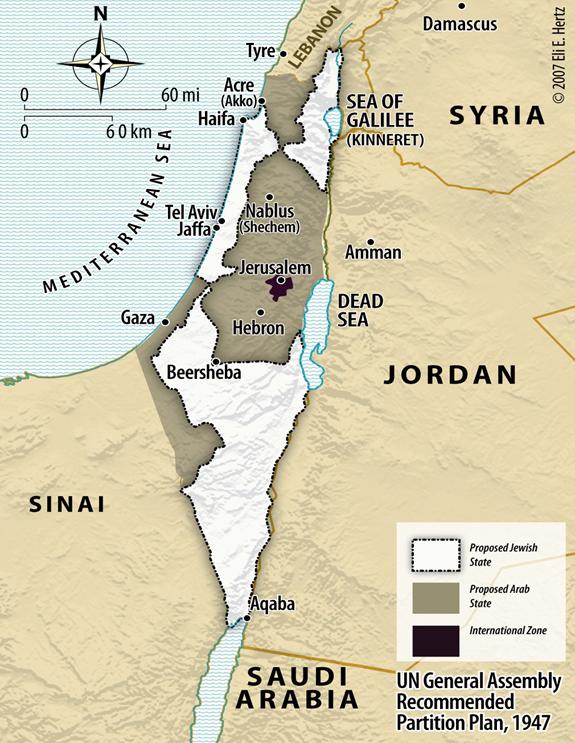
1947 UN partition map of palestine gaza west bank
The New Testament narrative opens with Israel enduring the occupation of a foreign army. That idea about carrying a cloak two miles after being asked to carry it only one? It was related to the occupying Roman army. That centurion at the foot of the cross? A member of the occupying Roman army. Even Jesus crucifixion needed the approval of the Roman procurator, Pontius Pilate. Israel had a measure of freedom, but the Jews were not free people.

Enter the Messiah, meek and lowly and riding on a donkey. Instead of a chariot, a four legged beast of burden. Rather than a cannonade, followers waved palm branches. Replacing the shout of the conqueror, we hear, “Hosanna! Blessed is He who comes in the name of The Lord!” Substituted for a victory over Rome was a mysterious kingdom “not of this world.”

There was nothing humanly militaristic about the coming of Christ. It was completely upside down from the expectation of His day.

When His disciples tried to pin Him down on Israel’s return to power, He shrugged off their concerns insisting that God knew, it was in His control and that was all that mattered. Then He went back to heaven and we have been awaiting His return ever since.

Before Jesus left, however, He pulled off a pretty major celestial coup de tat. Eternal, you could say. He destroyed death, and him who had previously held the power of death–Satan–dishing him a mortal blow, from the cross no less. Jesus most significant point of defeat was only apparent defeat. Turns out it was actual victory over sin, death and hell. Immediate, progressive and ultimate.

By this victory Jesus instituted a different group, called the church. His words were that the church would be of His own construction, empowered by His Spirit, commissioned to carry the gospel to all nations. In other words, the church–which would be transnational, transcultural, transgenerational, and timeless–would assume the assignment that once belonged to national Israel. An assignment they finally and thoroughly rejected with the cry, “Let the blood of this man be on us and our children!”

All the descriptions bestowed upon Israel in the Old Testament–chosen, washed, righteous, holy–were bestowed upon Christ’s followers in the New Testament. Additionally, the book of Hebrews makes it clear the priesthood unique to Old Testament Israel (still functioning at the time of Christ) was inferior to the new priesthood Jesus Himself introduced and headed. This was and is a priesthood inclusive of all believers.

I do not plan to argue the Replacement view of Israel and the church. These thoughts are being introduced primarily to demonstrate our dominant, accepted view is not the only biblical way of viewing Israel’s role in modern times.

For the sake of argument, though, let’s assume pre-tribulation, pre-mill, dispensational theology is correct. Let’s assume the church will be raptured at some point and God’s gospel spreading work will return to national Israel.

Would this mean the current government of Israel is beyond criticism and critique? I submit it does not.

If Christ followers do not demand from Israel the same justice we demand for Israel, we are being hypocritical. This hypocrisy will not only be tragic it will be noticeable. We will appear double-minded and unstable because we will be double-minded and unstable. The church does not receive its instruction from the descendants of Abraham; she receives instruction from the God of Abraham.

The history of the Old Testament is a chronicle of the critique and rebuke of Israel’s sinful behavior. Why should we believe this to have changed in an era when Israel has rejected her Messiah? The church is to be the voice of God’s kingdom, the light of truth to the world! Shall we hush our mouths from witness to His truth and justice simply because Israel would be rebuked?

Such biblically warranted correction is not bruising the apple of God’s eye; if anything, it is polishing it.