War must be, while we defend our lives against a destroyer who would devour all; but I do not love the bright sword for its sharpness, nor the arrow for its swiftness, nor the warrior for his glory. I love only that which they defend.
J.R.R. Tolkien, The Two Towers
Of all the promises of Christmas one seemingly stirs our hearts above all others: that the Prince of Peace has come. The Old Testament prophet Isaiah, in one of the earliest writings about the Advent of the Messiah, indicated He would be “named Wonderful Counselor, Eternal Father, Mighty God, Prince of Peace” (9:6).
Most people would readily acknowledge such a hope has yet to be realized.
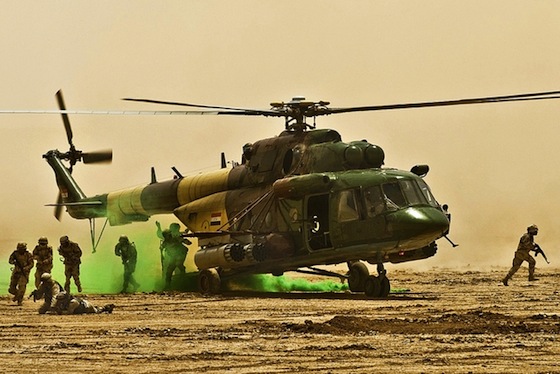
Iraqi soldiers exiting Iraqi air force helicopter [Image credit]
Following the mass murder in Newtown, Connecticut last week our thoughts again turned to violence. Twenty children killed before they could even reach the prime of life, whatever that is. Correlations were made to abortion, and, in the view of this writer, rightfully so.
By no measure of divine justice will violence outside the womb outweigh violence inside it.
Childhelp.org reports five U.S. children die each day as a direct result of abuse while 6 million are abused and/or neglected annually. That equates to another Sandy Hook every four days.
According to the International Center for Assault Prevention more than “40 million children below the age of 15 are subjected to child abuse each year” (2001). In addition the World Health Organization estimates that 150 million girls and 73 million boys under 18 experienced forced sexual intercourse or other forms of sexual violence during 2002.
What about war? Statistics on war deaths are varied and cover different periods of time, but this site lists conflicts since the American Civil War:
1860-65: USA civil war (628,000)
1886-1908: Belgium-Congo Free State (8 million)
1898: USA-Spain & Philippines (220,000)
1899-02: British-Boer war (100,000)
1899-03: Colombian civil war (120,000)
1899-02: Philippines vs USA (20,000)
1900-01: Boxer rebels against Russia, Britain, France, Japan, USA against rebels (35,000)
1903: Ottomans vs Macedonian rebels (20,000)
1904: Germany vs Namibia (65,000)
1904-05: Japan vs Russia (150,000)
1910-20: Mexican revolution (250,000)
1911: Chinese Revolution (2.4 million)
1911-12: Italian-Ottoman war (20,000)
1912-13: Balkan wars (150,000)
1915: the Ottoman empire slaughters Armenians (1.2 million)
1915-20: the Ottoman empire slaughters 500,000 Assyrians
1916-23: the Ottoman empire slaughters 350,000 Greek Pontians and 480,000 Anatolian Greeks
1914-18: World War I (20 million)
1916: Kyrgyz revolt against Russia (120,000)
1917-21: Soviet revolution (5 million)
1917-19: Greece vs Turkey (45,000)
1919-21: Poland vs Soviet Union (27,000)
1928-37: Chinese civil war (2 million)
1931: Japanese Manchurian War (1.1 million)
1932-33: Soviet Union vs Ukraine (10 million)
1932: “La Matanza” in El Salvador (30,000)
1932-35: “Guerra del Chaco” between Bolivia and Paraguay (117.500)
1934: Mao’s Long March (170,000)
1936: Italy’s invasion of Ethiopia (200,000)
1936-37: Stalin’s purges (13 million)
1936-39: Spanish civil war (600,000)
1937-45: Japanese invasion of China (500,000)
1939-45: World War II (55 million) including holocaust and Chinese revolution
1946-49: Chinese civil war (1.2 million)
1946-49: Greek civil war (50,000)
1946-54: France-Vietnam war (600,000)
1947: Partition of India and Pakistan (1 million)
1947: Taiwan’s uprising against the Kuomintang (30,000)
1948-1958: Colombian civil war (250,000)
1948-1973: Arab-Israeli wars (70,000)
1949-: Indian Muslims vs Hindus (20,000)
1949-50: Mainland China vs Tibet (1,200,000)
1950-53: Korean war (3 million)
1952-59: Kenya’s Mau Mau insurrection (20,000)
1954-62: French-Algerian war (368,000)
1958-61: Mao’s “Great Leap Forward” (38 million)
1960-96: Guatemala’s civil war (200,000)
1961-98: Indonesia vs West Papua/Irian (100,000)
1961-2003: Kurds vs Iraq (180,000)
1962-75: Mozambique Frelimo vs Portugal (10,000)
1962-75: Angolan FNLA & MPLA vs Portugal (50,000)
1964-73: USA-Vietnam war (3 million)
1965: second India-Pakistan war over Kashmir
1965-66: Indonesian civil war (250,000)
1966-69: Mao’s “Cultural Revolution” (11 million)
1966-: Colombia’s civil war (31,000)
1967-70: Nigeria-Biafra civil war (800,000)
1968-80: Rhodesia’s civil war (?)
1969-: Philippines vs the communist Bagong Hukbong Bayan/ New People’s Army (40,000)
1969-79: Idi Amin, Uganda (300,000)
1969-02: IRA – Norther Ireland’s civil war (2,000)
1969-79: Francisco Macias Nguema, Equatorial Guinea (50,000)
1971: Pakistan-Bangladesh civil war (500,000)
1972-: Philippines vs Muslim separatists (Moro Islamic Liberation Front, etc) (150,000)
1972: Burundi’s civil war (300,000)
1972-79: Rhodesia/Zimbabwe’s civil war (30,000)
1974-91: Ethiopian civil war (1,000,000)
1975-78: Menghitsu, Ethiopia (1.5 million)
1975-79: Khmer Rouge, Cambodia (1.7 million)
1975-89: Boat people, Vietnam (250,000)
1975-87: civil war in Lebanon (130,000)
1975-87: Laos’ civil war (184,000)
1975-2002: Angolan civil war (500,000)
1976-83: Argentina’s military regime (20,000)
1976-93: Mozambique’s civil war (900,000)
1976-98: Indonesia-East Timor civil war (600,000)
1976-2005: Indonesia-Aceh (GAM) civil war (12,000)
1977-92: El Salvador’s civil war (75,000)
1979: Vietnam-China war (30,000)
1979-88: the Soviet Union invades Afghanistan (1.3 million)
1980-88: Iraq-Iran war (435,000)
1980-92: Sendero Luminoso – Peru’s civil war (69,000)
1984-: Kurds vs Turkey (35,000)
1981-90: Nicaragua vs Contras (60,000)
1982-90: Hissene Habre, Chad (40,000)
1983-: Sri Lanka’s civil war (70,000)
1983-2002: Sudanese civil war (2 million)
1986-: Indian Kashmir’s civil war (60,000)
1987-: Palestinian Intifada (4,500)
1988-2001: Afghanistan civil war (400,000)
1988-2004: Somalia’s civil war (550,000)
1989-: Liberian civil war (220,000)
1989-: Uganda vs Lord’s Resistance Army (30,000)
1991: Gulf War – large coalition against Iraq to liberate Kuwait (85,000)
1991-97: Congo’s civil war (800,000)
1991-2000: Sierra Leone’s civil war (200,000)
1991-2009: Russia-Chechnya civil war (200,000)
1991-94: Armenia-Azerbaijan war (35,000)
1992-96: Tajikstan’s civil war war (50,000)
1992-96: Yugoslavian wars (260,000)
1992-99: Algerian civil war (150,000)
1993-97: Congo Brazzaville’s civil war (100,000)
1993-2005: Burundi’s civil war (200,000)
1994: Rwanda’s civil war (900,000)
1995-: Pakistani Sunnis vs Shiites (1,300)
1995-: Maoist rebellion in Nepal (12,000)
1998-: Congo/Zaire’s war – Rwanda and Uganda vs Zimbabwe, Angola and Namibia (3.8 million)
1998-2000: Ethiopia-Eritrea war (75,000)
1999: Kosovo’s liberation war – NATO vs Serbia (2,000)
2001-: Afghanistan’s liberation war – USA & UK vs Taliban (40,000)
2002-: Cote d’Ivoire’s civil war (1,000)
2003-11: Second Iraq-USA war – USA, UK and Australia vs Saddam Hussein and subsequent civil war (160,000)
2003-09: Sudan vs JEM/Darfur (300,000)
2004-: Thailand vs Muslim separatists (3,700)
2007-: Pakistan vs PAkistani Taliban (38,000)
2012-: Syria’s civil war (14,000)
(Estimates are near 100,000,000 direct war deaths, government sponsored deaths and civilian casualties in the 20th century.)
Malcolm X is quoted saying, “Sometimes you have to pick the gun up to put the Gun down.” He might, on occasion, be sadly accurate. The Bible does say to live peacefully with everyone as much as it depends on us. That is to say Christ’s followers should view the sword as the very last resort.
God’s people, who are encouraged to be “peace makers,” should, more than most, long for the re-appearing of the Prince of Peace. We should be wary of those who would rush to war, the first to weary of war itself, and aware of the toll violence–in all its forms–takes on men, women, boys and girls the world over in every generation. Even when war is absolutely necessary we should be the first to critique its excesses and encourage its end. Until the Prince of Peace shall come.