Category Archives: Justice

The priority of biblical justice

Woe to you, scribes and Pharisees, hypocrites! You pay a tenth of mint, dill and cumin, yet you have neglected the more important matters of the law–justice, mercy, and faith. These things you should have done without neglecting the others. (Matthew 23:23, HCSB)

A friendly exchange over the weekend addressed whether abortion is “the human rights issue of our day.” It will be obvious to most that I believe abortion to be a human rights issue. My challenge concerned the use of the word the. Can we rightly hold the position that abortion is the human rights issue of our day? I contend abortion is an incredible injustice carried out not only in the United States, but worldwide. But I am not persuaded it is any greater moral evil than human trafficking, slavery in its various forms, governmental “disappearing” of those who resist injustice, or other types of oppression.

Since 1973 many Christians have elevated one injustice, abortion, to a level above all others. Emphasizing the “right-to-life” for unborn babies is important, but we have understood it less within a framework of biblical justice than as a constitutional right. As many Christians cannot articulate a fully biblical view of justice we have watched abortion become a political rallying cry for our two party system of mutual antagonism. Failure to declare the biblical breadth of God’s justice allows “woman’s right to privacy”–which should be discarded as a non-sequitur–to guide the conversation.
injustice engraved

Worse, the dearth of a justice framework has allowed some to reduce biblical justice issues as “social justice” or “economic justice” to mere politics. Both fit within the Bible’s call for justice, but neither sociology nor economy completely wrap their arms around biblical justice.

Calls to help the poor and disadvantaged are sometimes derided as left-wing distractions from the church’s primary role of evangelism. However, even a cursory search of scriptures reveals more than 130 uses of justice. It is used of God’s character, as a basis for asking for His intervention, as commands to His children, as expectations and examples. Justice is used in the context of helping the poor, taking care of business affairs, how orphans are treated, and judgments “in the gate,” ie, legal decisions. Consider this sampling:

Psalm 106:3-“Blessed are they who observe justice, who do righteousness at all times.”
Psalm 112:5– “It is well with the man who deals generously and lends; who conducts his affairs with justice.”
Proverbs 21:3-“To do righteousness and justice is more acceptable to the Lord than sacrifice.”
Proverbs 21:15-“When justice is done, it is a joy to the righteous but terror to evildoers.”
Isaiah 1:17-“Learn to do good; seek justice, correct oppression; bring justice to the fatherless, plead the widow’s cause.”
Isaiah 59:14, 15-“Justice is turned back, and righteousness stands far away; for truth has stumbled in the public squares, and uprightness cannot enter. Truth is lacking and he who departs from evil makes himself a prey. The Lord saw it, and it displeased him, that there was no justice.”
Hosea 12:6-“So you, by the help of your God, return, hold fast to love and justice, and wait continually for your God.”
Amos 5:24-“But let justice roll down like waters, and righteousness like an ever-flowing stream.”
Micah 6:8-“He has told you, O man, what is good; and what does the Lord require of you but to do justice, and to love kindness, and to walk humbly with your God?”
Hebrews 11:32, 33-“And what more shall I say? For time would fail me to tell of Gideon, Barak, Samson, Jephthah, of David and Samuel and the prophets–who…enforced justice,” (all ESV)

In scripture justice does not supplant the character of God, it flows from it. Calls for justice do not obscure the gospel, they bear witness to it. If justice is a left-wing, commie pinko plot the only alternative is to call the Bible a left-wing, commie pinko book.

It is to the discredit of American Christians that we have so readily and uncritically embraced our political system. We join the rancor of the powerful and gorge ourselves on the rewards of an earthly throne. We are reticent to “speak truth to power” because our team may be back in power after the next election. We have swallowed worldly systems hook, line, sinker, rod, reel and boat. Thus, care for the poor, to use a single example, with its clear biblical imperative, is bounced about as a Democrat-Republican debate.

God forbid.
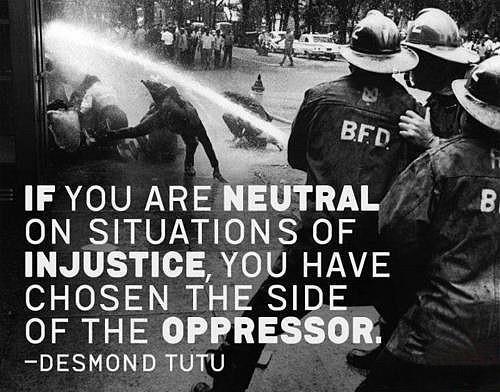

Surely the prophet Nathan scratches his head at what passes for prophetic these days. Preaching against abortion to a TV audience is not prophetic. Mother Teresa speaking against abortion before the president of the United States is.

The Holy Spirit is yet quenched if we create a ranking system for justice based merely on what tugs on our heart strings, rather than what offends God’s character. And it is this–offending God’s character–that reveals injustice.

A few months ago I mused on a broad expression of injustice:

Injustice is the deprivation of basic human rights, dignity or freedoms by those in authority through oppressive or unfair laws, customs or mores that allow the physical, sexual, or economic exploitation of men, women or children who lack power, position or voice, affecting individuals and groups, whether unique or systemic, hidden or known, all of which grows from contempt toward or ignorance of God’s standard of righteousness.

If this is a fair enough description, what follows is what it would mean to “do justice” or “enforce justice.”

Doing justice is using all righteous means to restore basic human rights, dignity and freedom to men, women or children everywhere, becoming their voice to address, rebuke or replace those abusing power so God’s standard of righteousness is recognized and reflected as much as it is possible within the fallen systems of this world until Christ brings the kingdom of God in its fulness.

To “do” or “enforce” justice is a clear call to God’s people. The extensive Old Testament groundwork is affirmed in the New. Where power is abused, and when the established authority, ie, government, is either complicit or ignorant, justice must be pursued.

We are not given the option to pick and choose between preferable justice issues. Doing justice is shining light in the darkness. It is being a city on a hill. It is the kingdom of God displayed on earth. And only a full framework of biblical justice prepares us to do justice when and where the righteousness of God should most be on display.

Some of my other articles on justice and injustice:
Our Comfortable Injustice-Part 1 and Part 2.
The gospel to the poor
When injustice is enough justice: Parsing theology into nothingness

Check out shade-grown, direct-trade Highlands Coffee

Russ Rankin has been a good friend for nearly a decade. He’s also a food and coffee aficionado of the first order. An attentive magazine or newspaper editor would have him write a periodic food critic column.

Conversations on justice led to the idea of him “reviewing” coffees for Kingdom in the Midst. For these posts Russ will only be reviewing coffees that reflect fairness toward growers and roasters. All coffees may not be “Fair Trade,” but they will be fairly traded. This is the first in an ongoing, occasional series. Follow Russ on Twitter or on Instagram (where he posts numerous photos of coffee and food).

Highlands Mission CooperativeFlor de Jinotega by Highlands Coffee (more about the organization below) is a classic high-mountain, shade-grown Central American coffee grown at elevations of 3,200-4,600 feet above sea level.
Whatʼs the big deal about shade grown? Coffee fruit growing under shade — like under jungle foliage or forestation — takes a longer time to ripen and mature. If picked and dried well and not over-roasted, shade-grown coffee will yield a very nice complex palette of flavor. This is truly the best way to grow coffee, but the practice is omitted by commercial growers because coffee shrubs kept in direct sunlight will grow their fruit faster. Itʼs more about the volume.

If your go-to morning coffee is a bold blend from the worldʼs largest coffee chain, or if you regularly pound black espressos (raising my hand here), your first inclination will be to say Flor de Jinotega coffee is weak. But donʼt dismiss it. Flor de Jinotega has a hint of sweet, nutty cacao and I found the flavor actually pleasantly grows as it lingers. It doesnʼt deliver an intense deep flavor, but has a smooth, wide, clean note. Thereʼs no bitter aftertaste; it is flavorful with an earthy, almost fruity nuttiness.

I probably would not choose Flor de Jinotega as my morning kickstart (see the pounding espressos reference above), but I would definitely love a French press of this bean after lunch. Followed by another one. Or three.

The Cause:
This coffee is sold by Highlands Mission Cooperative (HMC). Driven by a compassion to serve others and love as Christ, HMC and its partners are working together to improve the quality of life and to share Christʼs story of redemption and hope. By assisting and providing the “basics of living” — clean water, sanitation, health education, and nutrition, HMC helps the rural villages improve their quality of life. In sharing the love and joy found in Christ, HMC is able to nuture “community” and bring new hope and purpose to living.

HMC partners with The Society of Small Producers for Coffee Export (SOPPEXCCA) — a coffee cooperative comprised of 650 producers from the province of Jinotega in northern Nicaragua. Despite the severe challenges of natural and economic disasters, the self-sustaining co-op has become one of the highest quality coffee cooperatives in the country and produces, processes and markets its own coffee. SOPPEXCCAʼs 65 percent female membership and gender-equality blends makes this a truly exemplary cooperative. SOPPEXCCA became Fair Trade certified by Fairtrade Labeling Organizations International (FLO) in 1998.

FROM MARTY: Sonya and I have been drinking Highlands Coffee for about a week and love it. We have become coffee snobs anyway, but the opportunity to support this local co-op really excites us. I recommend it compared to any medium-roast I have tried.

To order Highlands Mission Coffee (ground or whole bean), which sells for $12.00/lb + shipping, click here. To read more about Marty’s mission trip this summer with Highlands Mission Cooperative, click here.

Russ Rankin has been called a coffee snob, but really heʼs just a guy who appreciates quality and the adventure found in a good cup of coffee. He has drank coffee in the jungles of Sumatra that was pounded in mortar and pestle and roasted in front of him; heʼs enraged a man in Cyprus by accidentally complimenting him on his Turkish coffee (the two countries hate each other); and heʼs brought a French press and bag of Italian Roast along with him backpacking in the Himalayan Plateau so he wouldnʼt have to drink prepackaged powdered Nescafe. He loves the Americanos at a couple of great coffeeshops in Nashville, especially at one that he canʼt tell you about because itʼs a secret.

One Christ follower thinks about Gaza, Israel and Palestinians, Part 3

In the first two installments of this series we looked at some of the history of the Conflict between Israel and the Palestinian people. We also considered the current condition of Palestinians who are in Gaza and the West Bank. Those and this post are aiming to consider not whether Israel is always right or wrong, not whether the Palestinian people are completely without fault. I accept there is fault on all sides.

The purpose in this exercise is to consider whether Bible believers must support any action taken by the government of Israel. To put it in the form of a question, must followers of Christ affirm every political or military action taken by national Israel? Or, can the actions of Israel be critiqued biblically just like every other geo-political entity on Earth, including the United States?

The uniqueness of Israel throughout biblical history can hardly be overstated. Birthed from the beyond-her-prime-wife of a former pagan, Abram (then, Abraham), the descendants of Jacob (then, Israel) were the apple of God’s eye. Chosen to be a light to the nations and form the cultural cradle for the Savior of the world, God’s people–His wife–were unique among all ancient people.

With that privilege was a responsibility they often shirked in favor of more attractive, available, temporal gods, even those “requiring” acts of adherence the true God expressly forbade. A cycle of obedience, sin, enslavement and deliverance became the title page, closing comments and every chapter of the chosen nation. This lasted for centuries.
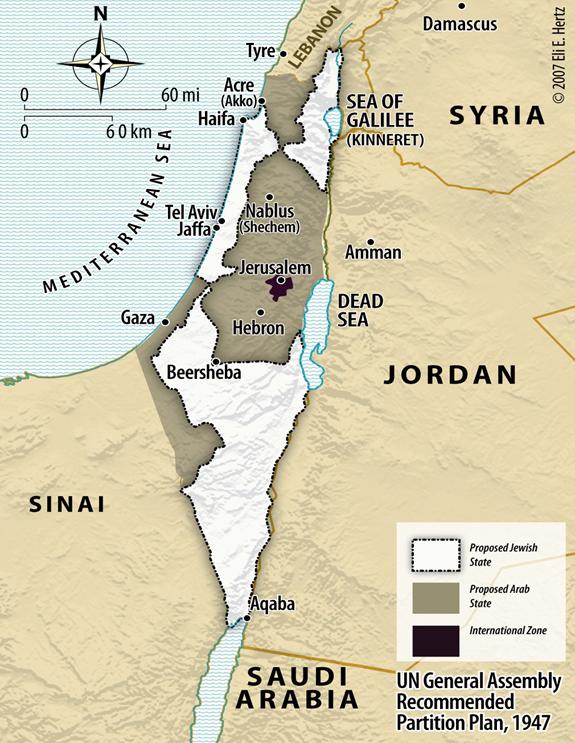
1947 UN partition map of palestine gaza west bank
The New Testament narrative opens with Israel enduring the occupation of a foreign army. That idea about carrying a cloak two miles after being asked to carry it only one? It was related to the occupying Roman army. That centurion at the foot of the cross? A member of the occupying Roman army. Even Jesus crucifixion needed the approval of the Roman procurator, Pontius Pilate. Israel had a measure of freedom, but the Jews were not free people.

Enter the Messiah, meek and lowly and riding on a donkey. Instead of a chariot, a four legged beast of burden. Rather than a cannonade, followers waved palm branches. Replacing the shout of the conqueror, we hear, “Hosanna! Blessed is He who comes in the name of The Lord!” Substituted for a victory over Rome was a mysterious kingdom “not of this world.”

There was nothing humanly militaristic about the coming of Christ. It was completely upside down from the expectation of His day.

When His disciples tried to pin Him down on Israel’s return to power, He shrugged off their concerns insisting that God knew, it was in His control and that was all that mattered. Then He went back to heaven and we have been awaiting His return ever since.

Before Jesus left, however, He pulled off a pretty major celestial coup de tat. Eternal, you could say. He destroyed death, and him who had previously held the power of death–Satan–dishing him a mortal blow, from the cross no less. Jesus most significant point of defeat was only apparent defeat. Turns out it was actual victory over sin, death and hell. Immediate, progressive and ultimate.

By this victory Jesus instituted a different group, called the church. His words were that the church would be of His own construction, empowered by His Spirit, commissioned to carry the gospel to all nations. In other words, the church–which would be transnational, transcultural, transgenerational, and timeless–would assume the assignment that once belonged to national Israel. An assignment they finally and thoroughly rejected with the cry, “Let the blood of this man be on us and our children!”

All the descriptions bestowed upon Israel in the Old Testament–chosen, washed, righteous, holy–were bestowed upon Christ’s followers in the New Testament. Additionally, the book of Hebrews makes it clear the priesthood unique to Old Testament Israel (still functioning at the time of Christ) was inferior to the new priesthood Jesus Himself introduced and headed. This was and is a priesthood inclusive of all believers.

I do not plan to argue the Replacement view of Israel and the church. These thoughts are being introduced primarily to demonstrate our dominant, accepted view is not the only biblical way of viewing Israel’s role in modern times.

For the sake of argument, though, let’s assume pre-tribulation, pre-mill, dispensational theology is correct. Let’s assume the church will be raptured at some point and God’s gospel spreading work will return to national Israel.

Would this mean the current government of Israel is beyond criticism and critique? I submit it does not.

If Christ followers do not demand from Israel the same justice we demand for Israel, we are being hypocritical. This hypocrisy will not only be tragic it will be noticeable. We will appear double-minded and unstable because we will be double-minded and unstable. The church does not receive its instruction from the descendants of Abraham; she receives instruction from the God of Abraham.

The history of the Old Testament is a chronicle of the critique and rebuke of Israel’s sinful behavior. Why should we believe this to have changed in an era when Israel has rejected her Messiah? The church is to be the voice of God’s kingdom, the light of truth to the world! Shall we hush our mouths from witness to His truth and justice simply because Israel would be rebuked?

Such biblically warranted correction is not bruising the apple of God’s eye; if anything, it is polishing it.