Tag Archives: book reviews

Test post number 3

Everywhere you turn people are talking about social media. Whether Facebook, Twitter, Google +, Pinterest, Path or any of the others, these services are now foundational to the social landscape. Facebook claims over 1 billion users worldwide, while Twitter claims some 200 million. I read just today that Google +, which is sometimes scorned, claims more than 100 million unique users a month. Not too shabby.

A primary reason social media has taken of is the breadth of usability. Do you want to reconnect with old friends? You can. Create work relationships? You can. Report breaking news? You can. Let complete strangers have the recipe you tried for dinner (and your opinion of it)? You can. Build your business, run a sales campaign, complain about bad service, call out someone in front of God and everybody, compliment your spouse publicly, show photos of Junior’s first haircut?

Test, test, test.

All that and more.

Ultimately social media is about influence. What you write can influence the decision of one or many. Where you shop, your thoughts on the crab legs at your local restaurant, the traffic heading to the big game. Your comments on these sometimes mundane events may affect anyone or everyone who sees them.

With that in mind, here are a few books on the subject of social media. Most are in some way related to business, but even those refer to principles of influence that could benefit a casual blogger, for instance.

The title of each is a link to Amazon.com. All purchases help support this blog, though you pay the same low price.

Renegades Write the Rules: How the Digital Royalty Use Social Media to Innovate

If an earlier adopter or power user of social media exists than Amy Jo Martin, let them speak now. A former employee of the NBA’s Phoenix Suns, this self-proclaimed “renegade” is responsible for bringing Shaquille O’Neal, Dwayne “The Rock” Johnson, and UFC guy into the fold of social media users. This easy to read and understand book is filled with personal stories and helpful hints.

Platform: Get Noticed in a Noisy World

There are few if any CEOs who have the blogging inluence to match, much less surpass, that of former Thomas Nelson CEO, Michael Hyatt. This is the thought leaders’s blog that is read by other thought leaders. His book, Platform, made the NYT Bestseller List almost before it was released. It is a thorough manual for building an influential presence (platform) in a world filled with competing voices.

Socialnomics: How Social Media Transforms the Way We Live and Do Business

Now in its secon edition…

Return On Influence

I received this book free as a Klout perk. Schaefer uses Klout as an example of return on influence. Positing a thesis that social media is still too new to worry about return on investment, he offers ideas to help understand return on influence instead.

Optimize: How to Attract and Engage More Customers by Integrating SEO, Social Media, and Content Marketing

A huge name in social media and marketing is Lee Odden. In Optimize he shows how and why your social media, online content and search engine optimization can work together to increase you brand’s visibility and, ultimately, your bottom line.

PyroMarketing: The Four-Step Strategy to Ignite Customer Evangelists and Keep Them for Life

Recommended by my co-worker, John Cade, Pyromarketing looks at marketing efforts through the scientific filter of what makes and fuels fire.

One Minute Book Reviews, January 2013

The January 2013 edition of One Minute Book Reviews includes Blood Brothers, by Elias Chacour, Ordinary Injustice, by Amy Bach, and The Insanity of God, by Nik Ripken.
Library-Books
Blood Brothers, by Elias Chacour, book review.

The one book you must read to be fully informed about the Palestinian-Israeli conflict. Chacour was a 9-year old Palestinian Christian when the his generational homeland became the destination of a world-wide Jewish immigration. This is a firsthand account of dispossession, murder, terrorism, political scheming, ministry, forgiveness, and the hand of God. He recounts how his hometown of Biram was completely destroyed by the Israeli military on Christmas day 1951, for no other reason than disallowing the rightful owners back home. Chacour ministers to Palestinians and Jews alike to this day, as he writes:

Before me stood my two commitments–one to God and one to my people. They were inextricably bound together. And suddenly, I knew I would rather be on God’s side which is stronger than human might.

Then I knew where I should be–not living in comfort, but back in the place where villages and churches were being reunited, where schools and community centers and spirits were being built up, where, amid the terrible noise of violence I could hear the whispers of the Man of Galilee, saying, “Behold, I make all things new.”

Ordinary Injustice: How America Holds Court, by Amy Bach, book review.

Bach, an attorney with the New York Bar and a journalist, spent eight years observing, interviewing and writing about the legal system in the United States. Drawing from experiences in Georgia, Mississippi, New York and Chicago, she examines over-zealous prosecutors, over-worked public defenders, wrongful convictions, lack of prosecution, and judicial improprieties. This fascinating look inside our legal system is at the same time extremely disheartening. According to Bach problems are known, but accepted at every turn, regularly bringing injustice to defendants across the nation. That this is quite unremarkable is the problem. The injustice in our justice system is quite ordinary. For instance in Coweta County, GA:

The Southern Center…charged that over a two-and-a-half-year period, more than half of the poor people found guilty in felony cases had pleaded to crimes without a lawyer present.

And, after discussing Quitman County, MS:

Prosecutor’s decisions are not transparent, except in those major trials, that make it to court. Prosecutors are not accountable and rarely have to justify their actions or identify the facts that contributed to them. With too little oversight on potentially momentous decisions that are made behind closed doors, prosecutors have no incentive to be neutral, fair, or to seek justice.

The Insanity of God, by Nik Ripken, book review

I’ve nearly finished The Insanity of God and recommend it for anyone who struggles with the big question: “Where is God in the midst of evil and suffering?” From the publisher’s summary:

“The Insanity of God” is the personal and lifelong journey of an ordinary couple from rural Kentucky who thought they were going on just your ordinary missionary pilgrimage, but discovered it would be anything but. After spending over six hard years doing relief work in Somalia, and experiencing life where it looked like God had turned away completely and He was clueless about the tragedies of life, the couple had a crisis of faith and left Africa asking God, “Does the gospel work anywhere when it is really a hard place? It sure didn’t work in Somalia.

How does faith survive, let alone flourish in a place like the Middle East? How can Good truly overcome such evil? How do you maintain hope when all is darkness around you? How can we say “greater is He that is in me than he that is in the world” when it may not be visibly true in that place at that time? How does anyone live an abundant, victorious Christian life in our world’s toughest places? Can Christianity even work outside of Western, dressed-up, ordered nations? If so, how?

“The Insanity of God” tells a story—a remarkable and unique story to be sure, yet at heart a very human story—of the Ripkens’ own spiritual and emotional odyssey. The gripping, narrative account of a personal pilgrimage into some of the toughest places on earth, combined with sobering and insightful stories of the remarkable people of faith Nik and Ruth encountered on their journeys, will serve as a powerful course of revelation, growth, and challenge for anyone who wants to know whether God truly is enough.

By ordering through the Amazon.com links below you help support this blog. You pay the same low price and I get a small commission.

‘Folks, this ain’t normal,’ by Joel Salatin, book review

Folks, this ain’t normal is the eighth book by the self-proclaimed “lunatic farmer” from Swoope, Virginia, Joel Salatin. Salatin, on his Polyface Farms, raises and sells “salad bar beef, pigerator pork, pastured poultry,” turkey, rabbits, eggs and more, has become a living legend in the local/organic food world. His self-published You Can Farm: The Entrepreneur’s Guide to Start and Succeed in a Farming Enterprise still sells thousands of copies annually after more than a decade in print.

Less a book Folks is more a bound collection of essays (with a couple of screeds thrown in for good measure). As a result one fair criticism of the book is there are repetitive areas, as if after writing the collection Salatin was too tired to read back through it and the editor was not paid to do so. Nonetheless, there is a wealth of good information here.

joel salatin folks this aint normal

Joel Salatin [Image credit]


Folks, this ain’t normal is the work of a man who is releasing many years worth of pent-up frustration about the foolishness of the American food system from planting and growing through processing and sales. It could easily have been sub-titled, “In Appreciation of the Simple, Agrarian Life.” His harshest words are reserved for the “food police” (the USDA and FDA) and the agri-businesses with whom they are in collusion to foist upon the world cheap, low nutrition–and sometimes deadly–food. All of this happens while making agri-business richer and keeping the small to medium sized farm owners effectively cut out of most large distribution channels.

If you do not think this is so, try and buy a gallon of raw milk at your local grocery store. (You can decide for yourself whether raw milk is good for you and your family; what you cannot decide is to go to Kroger or Publix and buy it.)

To read Salatin is to be bombarded with a wide-ranging case of common sense. Does it really make sense that people can bring untested, ungraded food, cooked in unsanitized home kitchens to a church pot-luck where everyone can eat it, but to sell that same food for a penny is against the law? Does it really make sense that the same milk our grandparents drank as kids (unadulterated, straight from the cow or goat) is more “dangerous” than 20 ounces of soda or a can of Red Bull?

Is it honoring to God for cows to be crammed into industrial feed-lots where close quartered disease is rampant, more and newer anti-biotics are necessary to fight those diseases, and toxic manure lagoons are needed to hold all the urine and excrement? It is not an example of extreme hubris that chickens are raised in such close proximity their beaks need to be removed to keep them from killing and eating each other?

Are food consumers the beneficiaries when the food chain is increasingly controlled by a corrupt, multiple-fined company like Monsanto–the Planned Parenthood of the food industry–whose greed is exceeded only by the shamelessness with which they advance it? Are American citizens the beneficiaries of a farming system where so much corn is grown that the only way most corn farmers can stay in business is thanks to U.S. government subsidies for ever acre of corn they grow?

Salatin peppers Folks, this ain’t normal with a dozen or two recommendations of books (some of which likely for the basis of his essays). The titles read like a veritable library of clean eating and healthy living advice. Though not footnoted the pages are influenced by tomes like Four-Season Harvest, Nourishing Traditions, The Omnivore’s Dilemma, Radical Homemakers, Fast Food Nation, Pottenger’s Prophecy, An Agricultural Testament, and, my favorite, Holy Sh*t: Managing Manure to Save Mankind. He is no slouch when it comes to reading, and it shows.

Consumers of Salatin’s previous “how-to” style books will be bereft of 1-2-3s and ABCs here. See this more as a collection of philosophical wisdom as to the “why” undergirding the “how.”

Is it convincing? Yes. Maddening? At times. Enlightening? Beyond belief. Worth your time? Without a doubt.

This 11 minute video by Michael Pollan features his time spent at Polyface and the genius of Salatin on display there. Be sure and check out the books below the video.

‘The Scarecrow,’ by Michael Connelly, book review

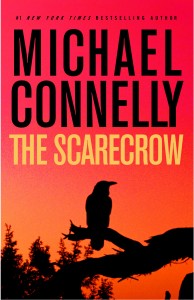
The Scarecrow Michael ConnellyThe Scarecrow was Michael Connelly’s first release of 2009, being followed by the recently released 9 Dragons. Two major hardback releases in a single year is unusual for many writers (a notable exception is James Patterson) and Connelly, if not suffering from a lack of productivity seems to be suffering from a lack of creativity.

Scarecrow features one of Connelly’s four main protagonists, L.A. Times reporter Jack McEvoy (the others being LAPD detective Harry Bosch, FBI agent Terry McCaleb and attorney Mickey Haller ) and begins with McEvoy’s investigation into the arrest of a young man, Alonzo Winslow, who is found driving around with a body in the trunk of his stolen car. A call from the accused’s grandmother/mother gives the soon-to-be unemployed (due to corporate downsizing) reporter a final big story, which he hopes to turn into a Pulitzer as a means of payback to the paper which no longer needs him. The “big story” is that Winslow has been wrongfully charged for the crime; a charge from which McEvoy’s investigative skills will extricate him.

At this point of the narrative I had high hopes. The book is quite thick, so I was prepared for many chapters of L. A. culture, racial apprehension and tension, legal maneuvering and a bang up finish.

Maybe next time.

Instead, the story takes a turn into serial killer land and only returns to its start as Alonzo is paraded out unceremoniously for a TV appearance. McEvoy ultimately is teamed with a recurring Connelly character, FBI agent Rachel Walling, who is also a former love-interest of McEvoy’s (and Bosch’s) hearkening back to Connelly’s earlier effort, The Poet. Other than background information on the ease by which one’s entire life can be pieced together via public information on the Internet, this book simply does not work. There is too little character development, the action is predictable and the ending unsatisfying. Rather than being a story that draws one into a vortex, it ends up more as a sermon about the dangers of the Internet.

Having read virtually all of Connelly’s novels, McEvoy has always seemed his weakest character and The Scarecrow does nothing to dissuade me of that thinking. If Bosch was not to appear this time around, I was hoping to see another full length Haller story since Connelly’s turn at the legal genre was quite satisfying. (Haller does return in 9 Dragons along with Bosch.)

The Scarecrow will, quite likely, please some, perhaps many, die-hard Connelly fans, but new readers wanting to absorb his finest work should look earlier to Trunk Music or The Concrete Blonde or later to The Lincoln Lawyer, each of which may be purchased below.

‘The Prodigal God,’ book review

The Prodigal God, is the latest book by New York Times best selling author and New York pastor Timothy Keller. Keller, of Redeemer Presbyterian Church, has been called a “C. S. Lewis for the 21st century” as his books are for thinking people, Christian and irreligious alike. Keller’s previous book, The Reason for God, was named book of the year by World magazine.

Exploring the familiar New Testament story of the son who asks for his inheritance and then proceeds to squander it on wine, women and song (well, mostly wine and women), The Prodigal God uses historical and cultural realities to bring out nuances in the story that the modern reader might easily overlook.

Moving the emphasis of the story from the rebellious younger son to the “obedient” elder brother, Keller demonstrates that the true focus of the parable is not on the “prodigal” at all, but that both brothers had, in their own way, rejected the love of the father. And it is the love of the father toward each brother, offering each the redemption that they need, that reveals the true Father of the story, God. The lostness of both sons relates to the people who were in and around Jesus’ ministry. The younger, rebellious son with the drunkards, prostitutes and thieves that were entering the kingdom of God, and the prideful, older son with the Pharisees and religious hypocrites who refused to enter God’s kingdom and who made up the actual audience for the parable in Luke 15.

After exploring the family dynamic in its cultural sense and it’s relation to the kingdom of God, the story turns to a person who is missing from the narrative, but would have been expected to be there if the story was fully joyful: a true older brother–an older brother who would have left home to find his life-wasting sibling and spared no expense to return him to his father. This true older brother, who was absent from the story, is present for every believer. He is Jesus Christ.

Writes Keller,

Jesus’ message, which is ‘the gospel,’ is a completely different spirituality. The gospel of Jesus is not religion or irreligion, morality or immorality, moralism or relativism, conservatism or liberalism. Nor is it something halfway along a spectrum between two poles–it is something else altogether.

It is Jesus’ saving work available to the younger and the elder, pictured by the Father’s lavish party, that is the ultimate focus of the story and of the book. The Prodigal God is an amazing, thought provoking, illuminating work that demands beneficial self examination from the reader.

You can purchase The Prodigal God directly from Amazon.com by clicking on the image or link below.