Tag Archives: Church

Pastoral challenges in the next 20 years

Joel Rainey is Executive Director of the Mid-Maryland Baptist Association. He is on the adjunct faculty of two seminaries, and the author of two books: Planting Churches in the Real World and Sidestepping Landmines: Five Principles for Pastor Search Teams. Joel works closely with numerous pastors in a state not known for its evangelical values. He is a strategic thinker on many things related to the kingdom of God.


On his blog, themelios, he recently wrote on the nature of pastoral leadership in the next 20 years. Joel asked a question once posed to him, “Are we really up to this?” This post is adapted from his writing.

American society is morphing at an unprecedented rate. This means more for the church than perhaps any other area as we claim God’s unchanging truth in changing times. Rainey asks whether pastors are “up to this”? I wonder if churches are.

If Rainey’s thoughts are on target, I think three things will happen as it relates to churches (and denominations) in the United States. First is capitulation. Many will simply agree with the surrounding culture that truth is maleable, subjective and suggestive. These churches will become indistinguishable from other societal organizations whose purpose is “to make the world a better place.” They bother not with sin, judgment or a cross. Second is separation. As in every generation these are they who are not of the world, but neither are they in it. They have no actual influence and their loudly sounded trumpets of culture wars fall mostly on deaf ears. Third is contextualization as the remaining churches seek to exegete culture, relate to it and bring the uncompromised gospel to everyone in a way that both illuminates their need and introduces the remedy: Jesus Christ. For these, mercy truly triumphs over judgment.

From Joel Rainey:

Scenario One: A pastor is called to a church with the expectation that he will “help us reach the young families.” Problem is, everyone in the church is over the age of 60, and more than 50% of the community within 10 minutes of the church is also in that age range.

By 2030, it is estimated that more than half of the U.S. population will be over the age of 50. This “graying” of America is presently going almost completely unnoticed by most churches, who tend to go after the prized “young families with children” category. Yet 80% of those over 50 live in a multi-housing situation (“55 and older” apartments, duplex communities, retirement and assisted living communities), and 98% of all multi-housing residents are without a relationship to Jesus. Are you keeping pace with the generational shifts that are taking place around your church, and how your church should respond to those shifts?

Scenario Two: Multiple families visit the church who do not speak English, politely nod and smile, and never return.

By 2025, Hispanics will outnumber African Americans by 3 to 2, and will comprise approximately 40% of the U.S. population. Over a decade ago, Oscar Romo noted that America, “hardly the ‘melting pot’ described by history texts, has become a land marked more by diversity than homogeneity.” In no area is this fact more clear than in the area of language.

Scenario Three: A married homosexual couple with three adopted children visit your church.

This is one of those issues when if you are a pastor, you need to go ahead and check all your political arguments at the door. What we believe society should or shouldn’t do in this situation is of absolutely no consequence, because they are doing it anyway!

[…]

Truth is, we live in a nation and culture in which our understanding of marriage has been devolving for decades.

Now that this is a reality, how will we minister to the parents and their children? How should our children’s departments be equipped to minister to the kids? How are you equipping other couples in your church to interact with and minister to these precious souls? How can you uphold clear Biblical standards in love?

Scenario Four: A young person who has visited your church for a while repents of her sin and receives Jesus as Lord and Savior. As you prepare for her baptism, you discover through her testimony that she was born male, but had gender-reassignment surgery a few years ago.

Scripture has no category for an “androgynous Christian.” There are Christian men, and Christian women, and the discipleship models spelled out for us in the New Testament tend to be described in conjunction with one’s gender.

[…]

Are you prepared for the Biblical, moral, psychological and bioethics questions that will necessarily be part of that conversation?

Scenario Five: More and more people, it seems, are asking you to perform funeral ceremonies for their pets. You have noticed over time that the grieving process for a family losing a pet, as well as the elements of the funeral itself (pictures, memorials, poems, etc.) indicate a much greater value on animals than in the past.

We are already witnessing attitudes in our culture that betray a gravitation towards increased “equalizing” of animals and humans, and too many in the church have bought into this idea. Are you prepared to lovingly confront the false idea that “all dogs go to heaven,” and re-assert the essential distinction between human beings, who are created in God’s own image and likeness, and pets, who are not?

Scenario Six: Because of growth, your church starts a “video venue,” and begins live-streaming worship and sermons via the internet. You notice that you have a growing “online” audience, many of whom log in every Sunday, and who financially support the ministry. Through connections with these people on social media you discover that, although they may live hundreds or even thousands of miles away, they consider your church their “church home.”

Today’s advanced and inexpensive technology means that churches are asking questions that would never have been considered even 20 years ago, and one of the biggest questions today has to do with the legitimacy of the so-called “internet church.” In the future, how will your church ensure that the Biblical principles and practices commensurate with a covenant community are observed in this environment?

Scenario Seven: You discover through casual conversation that a yoga class has been started by leaders in the church, that participants freely greet one another with “namaste,” and that Christian meditation has been confused with the emptying of the mind that is endorsed in many Hindu communities.

Over the past decade, there has been a huge increase in ancient pagan practices, much like those that occurred in the days of the Old Testament. The digital age, among other things, presents opportunities for the “blending” of faiths that was unheard of even two decades ago. In what ways should you be prepared to bifurcate for your people between what can, and cannot, be part of the life of someone who follows Jesus according to Scripture?

Scenario Eight: You receive a call from a mainline church in town. The size of their congregation has dropped to less than 20 members. They are fearful for their future, and they ask for your help.

It is simply a statistical fact that theological liberalism kills churches. As such, expect the mainline protestant churches in your town to continue slowly bleeding to death. Yet, the people in those dying churches need someone to love them by ministering to their needs and reminding them of what their faith once stood for. Are you prepared to raise up leaders who can utilize those facilities to start a second campus for your church, or start a new church altogether?

Scenario Nine: Parents come to you for counseling regarding their son, who has been diagnosed with multiple “generic” disorders, but doctors have been incapable of specifying the problem, and the child has been largely un-treatable by psychiatrists. You suspect the presence of demonic activity.

I truly believe that we will see a sharp rise in obvious demonic activity in the west, and I believe it will unfortunately be mis-diagnosed as a solely medical or psychiatric problem. As a result, too many children will grow up expressing the personality of a psychotrophic drug unless wise and godly pastors in the west learn to recognize the presence of demonic activity.

Scenario Ten: In this “brave new world,” God continues to seek worshippers, and Jesus continues to save people from sin, Satan, death, and hell in miraculous ways.

What I’ve described above is a culture that is emerging, and that is filled with people Jesus died to save. And it is in this environment when I hear evangelical Christians having the dumbest arguments!

What would you add? Is Joel right in his assertions?

Comedian Russell Brand on addiction

In a recent piece for The Guardian British comedian Russell Brand pulled back the curtain on his struggle with drug and alcohol addiction. It is an troubling read, or I anticipate it will be to many. If my post yesterday was revealing to those for whom depression is not an issue, this will likewise be for those of us who have no struggle with addiction.

Brand’s piece is also surprisingly eloquent. He seems to write less to gain sympathy for himself than to gain empathy for those walking his path in his shoes.

Here are some excerpts:

The last time I thought about taking heroin was yesterday. I had received ‘an inconvenient truth’ from a beautiful woman. It wasn’t about climate change (I’m not that ecologically switched on). She told me she was pregnant and it wasn’t mine.

I had to take immediate action. I put Morrissey on in my car and as I wound my way through the neurotic Hollywood hills my misery burgeoned. Soon I could no longer see where I ended and the pain began. So now I had a choice.

russell brand

Russell Brand [Image Credit]


I cannot accurately convey to you the efficiency of heroin in neutralising pain. It transforms a tight white fist into a gentle brown wave, and from my first inhalation 15 years ago it fumigated my private hell. A bathroom floor in Hackney embraced me like a womb, and now whenever I am dislodged from comfort my focus falls there.

It is ten years since I used drugs or drank alcohol and my life has immeasurably improved. I have a job, a house, a cat, good friendships and generally a bright outlook.

But the price of this is constant vigilance, because the disease of addiction is not rational. Recently, for the purposes of a documentary on this subject, I reviewed some footage of myself smoking heroin. I sit wasted and slumped with an unacceptable haircut against a wall in another Hackney flat (Hackney is starting to seem like part of the problem), inhaling fizzy black snakes of smack off a scrap of crumpled foil. When I saw the tape a month or so ago, what was surprising was that my reaction was not one of gratitude for the positive changes I’ve experienced. Instead I felt envious of this earlier version of myself, unencumbered by the burden of abstinence. I sat in a suite at the Savoy hotel, in privilege, resenting the woeful ratbag I once was who, for all his problems, had drugs.

[…]

Drugs and alcohol are not my problem — reality is my problem. Drugs and alcohol are my solution.

If this seems odd to you, it is because you are not an alcoholic or a drug addict. You are likely one of the 90 per cent of people who can drink and use drugs safely. I have friends who can smoke weed, swill gin, even do crack, and then merrily get on with their lives. For me this is not an option. I will relinquish all else to ride that buzz to oblivion. Even if it began as a timid glass of chardonnay on a ponce’s yacht, it would end with me necking the bottle, swimming to shore and sprinting to Bethnal Green in search of a crack house.

I looked to drugs and booze to fill up a hole in me. Unchecked, the call of the wild is too strong. I still survey streets for signs of the subterranean escapes that used to provide my sanctuary. I still eye the shuffling subclass of junkies and dealers, invisibly gliding between doorways through the gutters. I see the abundantly wealthy with destitution in their stare. I have a friend so beautiful, so haunted by talent that you can barely look away from her, whose smile is such a treasure that I have often squandered my sanity for a moment in its glow. Her story is so galling that no one would condemn her for her dependency on illegal anaesthesia, but now, even though her life is trying to turn around despite her, even though she has genuine opportunities for a new start, the gutter will not release its prey. The gutter is within.

It is frustrating to love someone with this disease. A friend of mine’s brother cannot stop drinking. He gets a few months of sobriety and his family bask, relieved, in the joy of their returned loved one. His life gathers momentum, but then he somehow forgets the price of this freedom, returns to his old way of thinking, picks up a drink and Mr Hyde is back in the saddle. Once more his face is gaunt and hopeless. His family blame themselves and wonder what they could have done differently, racking their minds for a perfect sentiment wrapped up in the perfect sentence, a magic bullet. The fact is, though, that the sufferer must be a willing participant in their own recovery. They must not pick up a drink or drug. Just don’t pick it up — that’s all.

[…]

Even as I spin this web I am reaching for my phone. I call someone, not a doctor or a sage, not a mystic or a physician, just a bloke like me — another alcoholic, who I know knows how I feel. The phone rings and I half hope he’ll just let it ring out. It’s 4a.m. in London. He’s asleep, he can’t hear the phone, he won’t pick up. I indicate left, heading to Santa Monica. The ringing stops, then the dry-mouthed nocturnal mumble:

‘Hello. You alright, mate?’
He picked up. And for another day, thank God, I don’t have to.

Much of Brand’s writing is surprisingly biblical. “The gutter is within”? Whether Brand knows it or not, this is a paraphrase of Jesus. “Reality is my problem”? That is absolutely true; he simply does not seem to know how God defines that particular reality. “I see the abundantly wealthy with destitution in their stare.” Because we are not redeemed with silver or gold, but by the precious blood of Christ as a lamb without spot or blemish.

Both Brand and Craig Ferguson (below) allude to “self-medication,” to the use of drugs and/or alcohol to numb the realities of life. Sometimes I wonder if the church has not anesthetized herself against people like Brand and Ferguson. It is easier to rail against the evils of “demon liquor” than to be the person who will receive a phone call at 4:00am. It is self-medicating to my pride to keep a Russell Brand at arm’s length. We will not be the person who gets the call until we are the person who is the friend.

Several years ago late-night TV host Craig Ferguson opened up about his own addiction. This is incredibly open and personal. If you do not have time to watch the entire piece, skip ahead to about 3:30. (Two or three swear words.)

The Senior Adult Dilemma, Part 2

In my last post I explored a few issues involved with what I termed “The Senior Adult Dilemma.” I encourage you to read it first for context.

This response came from a friend via Facebook:

Consider that the Boomer generation was perhaps the first to see that government leaders often lied to them. The Sixties were radically different than anything this country had faced. Authority figures, music, sexual revolution, etc., etc. EVERYTHING changed rapidly.

I’ve read stats saying 1 out of 4 were sexually abused and we know that kind of abuse is often by someone in a place of authority in that person’s life. They were drafted into the first war (Vietnam) that was so unpopular that when coming home they were often met at airports and pelted with tomatoes. Even today one can walk in a VFW event and immediately tell the Vietnam vets. This generation was among the first to come out of college with massive student loans.

These folk (Boomers) have been told that they have spent the nation into oblivion, are guilted over abortion (the Supreme Court chief justices who wrote majority opinions were appt. by Republican Presidents Eisenhower and Nixon. Check out Republican Supreme Court appointees and their decisions. Not good. In fact, Ike said his appointment of Earl Warren was the “damnedest fool thing I ever did”.), and many are reduced to working two or three part time jobs to support themselves. One outlives early retirement. They have only know SBC live to be in turmoil their entire ministry life.

My point is that there is a lot of latent anger in almost every congregation among the seniors.

This friend spent more than a decade as a traveling evangelist, and has been nearly two decades in denominational work.

Two other friends, one via Twitter and another offline, also mentioned existing or potential issues with Baby Boomers in the Senior Adult Dilemma. As the oldest Boomers are just hitting retirement age, I think it remains to be seen. I hope, rather, to see Boomers go into their senior years pressing forward without looking back. In point of fact, I have been eyewitness to the Dilemma since before the oldest of the Boomers were out of their 40s.

While Boomers may fall to the same temptations current and past seniors have faced, this seems to be beyond a mere Boomer issue. Unless these issues are addressed, Boomers, Busters, Millennials and future generations may fall as well.

I should note I’m hardly an expert. I have been blessed with some fantastic relationships with senior adults. We loved, honored and respected each other, often in the midst of disagreements about “worship styles” or church direction. Then there were those who did not fit in that group ;^)

What I offer are thoughts as my old age grows larger in the windshield. Now let us consider a few possible solutions:

1. Seniors often feel left out, but need more than Branson, Missouri trips to help them continue to grow in Christ.
Which came first the chicken or the egg? Do churches lower discipleship expectations on seniors to little more than a travel club, or do seniors fail to respond to discipleship efforts requiring more than a travel club?

Another friend who has been in ministry for many years wrote this:

A friend of mine, a pastor and missionary of many decades reached his 70’s and told me this, “I have more time to give, more knowledge to share and a hearts desire to minister but no one wants and old man. If you are over 50-55 try and to get a position in a church, very difficult. I know there are older people who are like those in your article but there are many more who love God, love their church and desire to be in ministry but many times the church has turned them away or formed a “senior saints” group that basically takes trips for pleasure. The older generation needs to be challenged to press on just as every other generation in the church.

2. Aging entrenches routine as a form of comfort and certainty, but church leaders often miss this.
A former co-laborer on a staff once made this observation about his widowed, senior adult mother-in-law: “If a light bulb goes out at my mother-in-law’s house, she will call us every day until I can get over to replace it. Even if it is in a room or closet she rarely uses. She seems fixated on it until I can get it done.”

As we get older and more physically restricted from “adventures,” routines become places of comfort. If this is true of young people–and to some degree it is true of us all–with some it gets much worse with aging. Predictability becomes the groove through which life is comfortably lived. Like residents of The Shire many eschew the unknown and enjoy the serenity of sameness.

But, like nostalgia, routine is not a spiritual gift. Arguably, the desire for a “whole life routine” can work against spiritual growth: it is hard to invite God to break into your routine if you do not want God to break into your routine. Or fail to believe it is something He would even do.

When church leaders misunderstand the routine they multiply problems for themselves. You may not be able to change it; but you do well to take it into consideration in decision making.

3. Most people who come to Christ do so in their younger years and seniors should participate in their church’s efforts to reach them.
Every study I have ever known indicates most people who come to Christ do so while young. Youth pastors used to say the majority are saved before the age of 18. Barna says it is a “substantial majority” (2004) who do so.

If this is the case why would churches in their evangelistic attempts not focus a lot of energy in reaching those under 18? Further, why would senior adults not rejoice to be a part of leading young people to Christ?

One of the great blessings of my ministry was Mrs. Jessie Lancaster. Mrs. Jessie died several years ago. She was single for many, many years. Having no children or relatives in the community, she depended, more than most, on her church family. She was active in an intergenerational small group at our church, and prayed for me relentlessly. She once told me when I had a conflict between leaving for a youth camp and seeing her in the hospital, “Preacher, don’t you ever come see me if you have a chance to lead some young person to Jesus. That’s way more important.”

That is the outlook I want to have at 80.

4. Churches should view aging as a unique discipleship opportunity.
It is a little too easy to say, “You didn’t hear the Apostle Paul complaining while he was chained up in that dark Roman jail!!” I kind of doubt he is in your church. I kind of doubt he is in the pastor’s office, either. But, if we want to produce a different kind of senior adult believer, we might need to develop a different discipleship strategy for senior adults.

Esteemed professor, Howard Hendricks, who died February 20, 2013, described aging as a:

quiet, ill-defined blur that steals up on one with little advance warning. My body refuses to cooperate with my mind, as if it were a stranger. Mysterious little aches and odd moments of forgetfulness pop up. Birthdays become irrelevant. The surprise is that I no longer seem to be quite the ‘me’ I have always known.

It also rings true that you do not see in the mirror what everyone else sees when looking at you.

Perhaps one solution is for churches to implement “aging out” of age-graded small groups. For illustrative purposes let us say age fifty-nine. When reaching 60 members should join younger groups. That would be the only option since no senior adult groups would exist. This combats the feelings of isolation, opens the eyes of all involved to the needs of each age, and helps facilitate organic mentoring. It also helps disconnect the problem of complaints feeding on themselves.

I have heard people talk about “cradle to grave” ministry, but I have seen few ministries last that long.

One thing seems certain: if we want to reduce the amount of stress and heartache experienced both by church leaders and seniors a modified approach to discipleship is needed.

Despite all the challenges in the senior adult dilemma I have been blessed to know many seniors like Jessie Lancaster. Among them:

My Mom and Dad
My Mother began a writing ministry to women in prison after she was 65 years old. She continued ministry to them after they exited prison. For months she drove to Atlanta each Sunday to pick-up a lady and bring her to church. My Dad, in addition to never missing a work day at church, picks up a blind man for church every Sunday and takes him home after Sunday School and church are over. My Dad often takes this man to the doctor.

Their pastor, Chris, has told me on more than one occasion, “Your Mom and Dad are truly missional people.”

Frances and Waymon Lamb
The Lambs were longtime members at a church where I served on staff. They were members when the church was small enough that Frances sent get-well cards to every member who went into the hospital. The first time I ever met her she was hospitalized. When I entered her room, I noticed her leg standing in the corner of the room while she was occupying the bed. Over the course of several months I visited her so many times we joked about her trying out every room in the hospital. At the end of each visit, she had a list a names for which I was to pray…but never for her. God was taking care of her.

After she died, Waymon became a de facto chaplain for the hospital. He had spent so much time there it was like a home away from home. He had already begun visiting sick people when Frances was hospitalized, and continued returning to visit sick people after she passed away. This he did until he was too old to continue.

Waymon outlived almost all his friends, and died after I was no longer on staff at his church. His graveside service was so small, the pastor conducting the service and I had to serve as impromptu pallbearers.

Mr. and Mrs. Benson
Raynor and Lois Benson, with their adult son, Drew, volunteered in the office at my last pastorate. They were amazingly sweet, showing up every Sunday morning to do paperwork, answer the phones and the like while our secretary was completing the extra records from Sunday. They never asked for a thing, never expected a thing, and always were gracious and cheerful.

One week I got a phone call they had been in a car accident and Mrs. Benson had broken a bone; her arm, I think. They insisted that I not visit. I did anyway, for just a few minutes. As I was leaving, Mrs. Benson said, “I’m not going to tell anyone you came by. You didn’t have to come, and if I do tell people all the old people will expect you to come see them every time they get sick.” I could not believe what I was hearing, but was I ever thankful for her wisdom.

Oh, and those “old people” were her peers.

Myrl Kitchens
The “Adult Ladies” teacher in my very first church. She was a great encouragement, and faithful to teach those ladies for many, many ears. She was the first person to teach me what Genesis means by the sun and moon being given for signs.

Far from “callous disregard” for seniors’ concerns, those entrusted with spiritual leadership should help seniors see their true needs, learn to trust God instead of routines, and continue to press on toward the goal of the high calling of God in Christ Jesus.

The Senior Adult Dilemma, Part 1

“When is the church going to budget as much for senior adults as for the youth or children’s ministry?”

“Why are we trying to reach primarily young families?”

“Does the preacher not remember who pays his salary?”

“What happened to the piano and organ?”

“We just feel forgotten.”

I call the issues arising from this mindset “The Senior Adult Dilemma.”

As the half-century mark stares me straight in the eyeballs, I am ever more befuddled by sentiments such as these. The Savior, from whom we hear “Deny self” and “Take up your cross daily,” seems extraordinarily at odds with them.

One would expect–or at least hope–wisdom comes with age. Often this is the case, but it is not assured by any means. What is any more sad than a decades-old-in-the-faith Christian who should have matured spiritually, yet remains an infant? A man or woman crowned with glory of gray hair should be helping grill bacon-wrapped filet mignon instead whisking a few ounces of powdered milk–spiritually speaking. This would jibe with Peter’s apostolic desire, it seems.

Everyone tends toward certain affinities. Some gravitate toward music from the 80s, others clothing styles from the 90s, some toward foods from childhood or travels. The problem comes when some try to promote those affinities as the right or only way of doing things, especially ministry in church. (More on this in Part 2.)

The truth is when we pursue God we must prefer the time in which we live. Right now. As it relates to time, we have only one culture we can reach: the current one. No amount of longing for a bygone era will cause it to return. Nostalgia is not a spiritual gift.

The senior adult dilemma is not universal in churches, but it is widespread enough to cause heartburn for many a leader. From changing Sunday School meeting rooms, to changing musical styles, to changing service times, it seems anything–no matter how trivial–can start waves of complaints. Not only is this grievous to watch, it is difficult for leaders to experience, as well as being thoroughly unbiblical. What accompanies constant complaining? Loss of influence among those who lead and loss of a hearing among those who will.

Here are a few observations after 46 years in churches, 30 years of salvation and 20 years of pastoral ministry:

1. Physical age neither guarantees nor predicts spiritual maturity.
After having walked with the Lord for nearly 30 years I have witnessed spiritual maturity–and immaturity–at every age. Although a constant growth track until death is desired, it does not always happen. Some of the most selfish and short sighted members of churches were not teenagers. They were people much older than I was then, even older than I am now.

Spiritual maturity is only gained through the obedience. It is not gained through mere participation in religious activities, no matter how noble or persistent. Spiritual maturity is not symbolized by a 142-year attendance pin. The youngest believer walking in faith exhibits more maturity than an 80-year old who has not exercised it in half-a-century.

2. Stubbornness is not a spiritual gift.
Too many senior adults seem to pride themselves on a mentality that is resistant to change. “I ain’t never used a _________ or owned a _________ or done _________ and I’m not about to start now.” While this attitude might be expected in some who are slow to learn, when championed by a full-facultied person it may reveal a disturbing lack of godliness.

To be used by God requires malleability. That whole “potter and clay” thing teaches us one is shaped as One is shaping. Pottery may have a purpose after receiving form, drying and experiencing a trip to the kiln. What it cannot be is further changed. If God must break a person to gain the simplest obedience, repeated usefulness is improbable.

3. Older is not necessarily better; often it is just older.
It never ceases to amaze me how many who complain about “new music” would never consider returning to days before electric power, indoor plumbing, automobiles, telephones, and store bought clothes. I have yet to see a senior adult walk out of a church restroom complaining about using toilet paper instead of pages from the Sears & Roebuck catalog.

Pining for hymns–as with most–has nothing to do with wanting to hear something with good theology. If that were the case, many newer songs (“modern worship music”) would suffice. Instead it is the comfort of the familiar. It can be hard to learn new things; that is true for all of us as we age. I am still trying to learn algebra.

I have heard, “We just need more hymn writers like Fanny J. Crosby.” Really? Fanny Crosby is reputed to have written about 20,000 hymns. We sing between 5 and 10 of them. By any measure that is more misses that hits.

Just because it is older does not mean it is better, and music is just one example.

4. Mentoring by seniors should be organic, not programmatic.
“We need to organize a way for seniors to mentor younger adults. They really have a lot to offer and younger people have a lot to learn.” Or something like that.

Here’s the problem: young people who are passionately seeking God are not interested in being “mentored” by a faithless grouch. What young believers seek is spiritual mentoring, not an hour-a-week of hearing about the failures of former pastors or the perceived shortcomings of the current shepherd.

My mentor, Al Autrey, was considerably older than the teenagers and young adults he mentored. But he was respected and trusted due to his faithfulness. In our late 40s Sonya and I befriended, were accepted by, and began mentoring a group of high-schoolers. This is a relationship that continues. We have young adult friends who ask us for advice and counsel. These are not relationships we have demanded, or expected because “we have a lot to offer.” Maybe we do. But, these relationships would never have blossomed had friendships not been planted first.

One thing we have learned is this: if we pursue God and make friends, mentoring happens. It is harder to stop than to start. This is why I say it should be organic. Programmed mentoring seems like programmed friendships–diametrically opposed to the concept itself.

None of this should be construed as being anti-senior adult, not even close. Like most who read this, I have known scores of solid, Jesus loving, kind, gentle, faithful seniors. But, none of those characteristics existed because they were old. The Fruit of the Spirit may exist in old age, but does not grow due to it. If you want to be a faithful senior adult, be a faithful, obedient younger person. Then, never quit.

In Part 2 we will explore some a few possible solutions to the Senior Adult Dilemma.

Frederick Douglass on authentic Christianity

A few months back the twitters and blogosphere erupted over a song by hip-hop artist, Propaganda. I wrote about it as well.

The song is entitled “Precious Puritans” and is, in a Grand Canyon of understatement, thought provoking. Concerning well beloved puritan theologians, he raps:

How come the things the Holy Spirit showed them in the valley of vision didn’t compel them to knock on they neighbors door and say, “You can’t own people!”?

Your precious puritans were not perfect.

You romanticize them as if they were inerrant. As if the skeletons in they closet was pardoned due to the they hard work and tobacco growth.

As if abolitionists weren’t racist and just pro-union.

As if God only spoke to white boys with epic beards.

You know Jesus didn’t really look like them paintings. That was just Michaelangelo’s boyfriend.
Your precious puritans.

Dr. Anthony Bradley, addressing the response to the song (too often White and negative), tweeted this:

The link is to a scholary paper from Cambridge University Press entitled, “Language, Discourse and Power in African American Culture.”

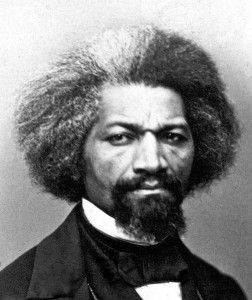
One African-American who used language, discourse and power to rip the church the proverbial “new one,” was Frederick Douglass. Douglass (1818-95), a prominent American abolitionist, author and orator, launched a critique at the American Christianity of his day the comprehensiveness of which has scarcely been equaled. The intensity, analysis and truth shames many an attempt that have followed.

My friend Alan Cross, who blogs at Downshore Drift, recently made me aware of an excerpt from Douglass’ autobiography, Narrative of the Life of Frederick Douglass, an American Slave. In it the former slave writes:

I love the pure, peaceable, and impartial Christianity of Christ: I therefore hate the corrupt, slaveholding, women-whipping, cradle-plundering, partial and hypocritical Christianity of the land. Indeed, I can see no reason, but the most deceitful one, for calling the religion of this land Christianity. I look upon

frederick douglass

Frederick Douglass

as the climax of all misnomers, the boldest of all frauds, and the grossest of all libels. Never was there a clearer case of ‘stealing the livery of the court of heaven to serve the devil in.’ I am filled with unutterable loathing when I contemplate the religious pomp and show, together with the horrible inconsistencies, which everywhere surround me. We have men-stealers for ministers, women-whippers for missionaries, and cradle-plunderers for church members. The man who wields the blood-clotted cowskin during the week fills the pulpit on Sunday, and claims to be a minister of the meek and lowly Jesus. . . . The slave auctioneer’s bell and the church-going bell chime in with each other, and the bitter cries of the heart-broken slave are drowned in the religious shouts of his pious master. Revivals of religion and revivals in the slave-trade go hand in hand together. The slave prison and the church stand near each other. The clanking of fetters and the rattling of chains in the prison, and the pious psalm and solemn prayer in the church, may be heard at the same time. The dealers in the bodies and souls of men erect their stand in the presence of the pulpit, and they mutually help each other. The dealer gives his blood-stained gold to support the pulpit, and the pulpit, in return, covers his infernal business with the garb of Christianity. Here we have religion and robbery the allies of each other—devils dressed in angels’ robes, and hell presenting the semblance of paradise.

Thoughts?

The Kindle version of Narrative of the Life of Frederick Douglass is available free below. Just click the Amazon link.

Touch not God’s anointed?

December brought another frustrating, heartbreaking story of a multiple pastors guilty of sexual sins ranging from adultery to child molestation to rape. The influence of two successive pastors at one church were the focal point of a lengthy essay in Chicago Magazine. Entitled, “Let Us Prey: Big Trouble at First Baptist Church,” writer Bryan Smith chronicles both accusations and admissions of Jack Hyles and Jack Schaap, both former pastors at the storied and fabled First Baptist Church of Hammond, Indiana.


The Chicago Magazine expose reveals a cult-like organization in which members are never to question the pastor, allowing for the most offensive and egregious actions to be swept under the rug. Or, equally as bad, allows them to be propagated for years. Writes Smith:

[Former pastor, Jack] Schaap is not simply one of those rogue evangelists who thunders against the evils of forbidden sex while indulging in it himself. According to dozens of current and former church members, religion experts, and historians interviewed by Chicago—plus a review of thousands of pages of court documents—he is part of what some call a deeply embedded culture of misogyny and sexual and physical abuse at one of the nation’s largest churches. Multiple websites tracking the First Baptist Church of Hammond have identified more than a dozen men with ties to the church—many of whom graduated from its college, Hyles-Anderson, or its annual Pastors’ Schools—who fanned out around the country, preaching at their own churches and racking up a string of arrests and civil lawsuits, including physical abuse of minors, sexual molestation, and rape.

The article also recounts some of the extreme teachings of the leadership, in particular the immensely influential former pastor Jack Hyles.

Virtually no one would marry without Hyles’s blessing, several former church members say. He soon took it upon himself to arrange marriages. According to Kaifetz, “When a guy like Hyles says, ‘This is God’s will for your life,’ you just say, ‘Well, I guess it is.’ ”

One area in which Hyles—a father of four—exerted particular control was child rearing. In this, his views were severe unto merciless. Using biblical passages as justification, Hyles preached that spanking was more than tolerable; it was a sacred duty. In his 1979 book How to Rear Infants, he wrote: “The parent who spanks his child keeps him from going to hell.”

Spanking “should be deliberate and last at least ten or fifteen minutes,” he continued. The blows “should be painful and should last . . . until the child is crying, not tears of anger but tears of a broken will.” They should “leave stripes” if need be. The age at which such punishment should begin? Infancy.

Several people who grew up at First Baptist recall that parents took the instruction to heart. “Beatings would last endlessly, it seemed,” says Mary Jo McGuire, 45, a corporate trainer in Colorado whose father was a deacon in the church. As a seven-year-old, she “used to count the lashes as a way to cope through the searing pain.” McGuire’s younger sister, Sherri Munger, told me she once received more than 300 lashes from a thick leather belt. When authorities were called, McGuire says, Hyles told the girls’ parents how to avoid arrest.

“What was going on [at First Baptist] was kind of like a process of hollowing out the followers and repopulating them with yourself,” says Schaap’s former editor. “[Hyles] took your voice, he took your beliefs, he took your likes and dislikes and opinions, and he gave you his own. But in the process of hollowing you out, he made you very weak.”

In her first one-on-one interview about the church, Hyles’s middle daughter, Linda Murphrey, a motivational speaker and coach in Southern California, remembers his followers as “zombies” who were “willing to believe and obey whatever he said.”

Some of my earliest memories of church harken to the influence of Jack Hyles and others in the “Independent Baptist” church movement. Sometime in my late elementary school years our church, under the leadership of a new, dynamic pastor, left our denomination and became independent. Hyles was among the most influential leaders of that movement. FBC Hammond was synonymous with the movement and Hyles with its theology. We heard a steady diet of short-hair and long skirts. Sometime after our family left they actually installed a sign forbidding any woman from entering the buildings if she was wearing pants.

On of the unmistakeable tenets of the Independent Baptist theology was that of extreme pastoral authority. This was taught as “touch not God’s anointed,” based on a verse from the Old Testament (Psalm 105:15). Pastors, we learned, if not explicitly then implicitly, were awaiting a vacancy in the Trinity.

It is with great sorrow I note how the abuse of this scripture has led to the kind of sinfulness recorded above. Unless your pastor is currently the king of Israel, that verse–indeed, that concept–does not apply. And if he is the king of Israel, he’d better be Jesus Christ.

The idea of “touch not God’s anointed” has been wielded like a light saber by many a pastor both in sinful power grabbing and in honest efforts to live according to God’s plan for His church. The Bible does teach us to learn from–even submit to–those in spiritual authority (Hebrews 13:7 & 17), but warns those leaders as well (1 Peter 5). The New Testament qualifications placed on church leadership are designed to prevent the very abuses we see all to often.

There are a few things that should send up all kinds of red flags should you see them in the pastor of your church:

1. Any claim to divine power or authority. Contrary to the “Lord’s anointed” teaching and those scary dying deacon stories the traveling evangelist told you, pastors are people, too. This is not to say we should disrespect them; we should not. Even when they do and stay dumb things. It does mean, however, that they are not God-like. The New Testament does not speak of church leaders in the same way David talked about king Saul. Pastors fill a divinely established office, but they are not divine, inerrant or infallible.

2. An insistence on unquestioning support. While some pastors act as if high school boys need more accountability than anyone else, the truth is pastors need as much accountability as anyone. Pastors need more than one person who will ask them hard questions, force them to rest, ensure they are spending enough time with their spouse, and that their own time in prayer and the Word is not suffering. Any pastor who demands or expects unflinching support has replaced God with his own ego, and is leading himself and the church down a destructive path. Such a demand often arises from his own irrational fears or sinful desires but, rather than doing the painful work of humble self-examination efforts are made to squelch any questions.

3. Excusing sin at the leadership level. In these church there is almost an obvious and ongoing double standard between the top pastor, the other leaders and the rest of the people. Those comprising the “inner circle” are often beyond criticism, having any transgression short of murder swept over the rug. This behavior has been seen in other places besides FBC Hammond.

4. Preaching the same things over and over. Preaching the whole counsel of God takes a lot of work. Avoiding the comfortable ruts of routine comes from immersing one’s heart and mind in the Word of God. Pastors who refuse accountability will soon find themselves preaching what they know. It’s all they can do. When pastors do not study, they do not learn, they are not changed. They have nothing to give. The same jokes, stories, verses and “hobby-horses” are signs of an inner breakdown.

5. A seeming obsession with a single subject matter. The Bible instructs us, “Out of the abundance of the heart the mouth speaks.” A video of Jack Schaap simulating masturbation during a youth sermons can be found online. It is so graphic even the Chicago Magazine writer was nonplussed about it. When a “man of God” refuses correction from those around him, he has already refused correction from God’s word. At that point the mind overflows with garbage. It might be sex, materialism or power, but that which is inhabiting the pastor’s heart will make its way out.

Perhaps, rather than looking for verses like “touch not God’s anointed,” pastors should look at verses addressed to their Old Testament counterparts. Today’s pastors are not equivalent to the kings of Israel. They would more likely be related to the priests as those tasked with spiritual oversight. Why are verses like Jeremiah 2:8 not referenced by more pastors:

The priests did not say, ‘Where is the LORD?’ And those who handle the law did not know Me; The rulers also transgressed against Me; The prophets prophesied by Baal, And walked afterthings that do not profit.

Or maybe Jeremiah 5:31:

The prophets prophesy falsely, And the priests rule by their ownpower; And My people love to have it so. But what will you do in the end?

(It’s worth noting the attitude of the people. They “love” their wayward prophets and priests.)

Jeremiah was not alone. Hear Ezekiel:

Her priests have violated My law and profaned My holy things; they have not distinguished between the holy and unholy, nor have they made known the difference between the unclean and the clean; and they have hidden their eyes from My Sabbaths, so that I am profaned among them.

Then this from Hosea (6:9):

As bands of robbers lie in wait for a man, So the company of priests murder on the way to Shechem; Surely they commit lewdness.

Now, I’m not saying there is a direct parallel from the New Testament pastor to the Old Testament priest or prophet. But, the roles do seem to be more closely related than that of pastor and king.

Those whose eyes are opened to the truth and attempt to leave spiritually abusive situation are often shamed and shunned. There is a biblical role for both, but it has nothing to do with power-hungry, sex-crazed pastors retaining manipulative control. If you are in one of these situations, then run with all of your might. All pastors do not exhibit cult-leaders like qualities, and all churches are not peopled by the blind and confused. For your own spiritual safety and maturity, find a church that reflects the life and teachings of Jesus, especially amongst its leadership.