Tag Archives: culture

Pastoral challenges in the next 20 years

Joel Rainey is Executive Director of the Mid-Maryland Baptist Association. He is on the adjunct faculty of two seminaries, and the author of two books: Planting Churches in the Real World and Sidestepping Landmines: Five Principles for Pastor Search Teams. Joel works closely with numerous pastors in a state not known for its evangelical values. He is a strategic thinker on many things related to the kingdom of God.


On his blog, themelios, he recently wrote on the nature of pastoral leadership in the next 20 years. Joel asked a question once posed to him, “Are we really up to this?” This post is adapted from his writing.

American society is morphing at an unprecedented rate. This means more for the church than perhaps any other area as we claim God’s unchanging truth in changing times. Rainey asks whether pastors are “up to this”? I wonder if churches are.

If Rainey’s thoughts are on target, I think three things will happen as it relates to churches (and denominations) in the United States. First is capitulation. Many will simply agree with the surrounding culture that truth is maleable, subjective and suggestive. These churches will become indistinguishable from other societal organizations whose purpose is “to make the world a better place.” They bother not with sin, judgment or a cross. Second is separation. As in every generation these are they who are not of the world, but neither are they in it. They have no actual influence and their loudly sounded trumpets of culture wars fall mostly on deaf ears. Third is contextualization as the remaining churches seek to exegete culture, relate to it and bring the uncompromised gospel to everyone in a way that both illuminates their need and introduces the remedy: Jesus Christ. For these, mercy truly triumphs over judgment.

From Joel Rainey:

Scenario One: A pastor is called to a church with the expectation that he will “help us reach the young families.” Problem is, everyone in the church is over the age of 60, and more than 50% of the community within 10 minutes of the church is also in that age range.

By 2030, it is estimated that more than half of the U.S. population will be over the age of 50. This “graying” of America is presently going almost completely unnoticed by most churches, who tend to go after the prized “young families with children” category. Yet 80% of those over 50 live in a multi-housing situation (“55 and older” apartments, duplex communities, retirement and assisted living communities), and 98% of all multi-housing residents are without a relationship to Jesus. Are you keeping pace with the generational shifts that are taking place around your church, and how your church should respond to those shifts?

Scenario Two: Multiple families visit the church who do not speak English, politely nod and smile, and never return.

By 2025, Hispanics will outnumber African Americans by 3 to 2, and will comprise approximately 40% of the U.S. population. Over a decade ago, Oscar Romo noted that America, “hardly the ‘melting pot’ described by history texts, has become a land marked more by diversity than homogeneity.” In no area is this fact more clear than in the area of language.

Scenario Three: A married homosexual couple with three adopted children visit your church.

This is one of those issues when if you are a pastor, you need to go ahead and check all your political arguments at the door. What we believe society should or shouldn’t do in this situation is of absolutely no consequence, because they are doing it anyway!

[…]

Truth is, we live in a nation and culture in which our understanding of marriage has been devolving for decades.

Now that this is a reality, how will we minister to the parents and their children? How should our children’s departments be equipped to minister to the kids? How are you equipping other couples in your church to interact with and minister to these precious souls? How can you uphold clear Biblical standards in love?

Scenario Four: A young person who has visited your church for a while repents of her sin and receives Jesus as Lord and Savior. As you prepare for her baptism, you discover through her testimony that she was born male, but had gender-reassignment surgery a few years ago.

Scripture has no category for an “androgynous Christian.” There are Christian men, and Christian women, and the discipleship models spelled out for us in the New Testament tend to be described in conjunction with one’s gender.

[…]

Are you prepared for the Biblical, moral, psychological and bioethics questions that will necessarily be part of that conversation?

Scenario Five: More and more people, it seems, are asking you to perform funeral ceremonies for their pets. You have noticed over time that the grieving process for a family losing a pet, as well as the elements of the funeral itself (pictures, memorials, poems, etc.) indicate a much greater value on animals than in the past.

We are already witnessing attitudes in our culture that betray a gravitation towards increased “equalizing” of animals and humans, and too many in the church have bought into this idea. Are you prepared to lovingly confront the false idea that “all dogs go to heaven,” and re-assert the essential distinction between human beings, who are created in God’s own image and likeness, and pets, who are not?

Scenario Six: Because of growth, your church starts a “video venue,” and begins live-streaming worship and sermons via the internet. You notice that you have a growing “online” audience, many of whom log in every Sunday, and who financially support the ministry. Through connections with these people on social media you discover that, although they may live hundreds or even thousands of miles away, they consider your church their “church home.”

Today’s advanced and inexpensive technology means that churches are asking questions that would never have been considered even 20 years ago, and one of the biggest questions today has to do with the legitimacy of the so-called “internet church.” In the future, how will your church ensure that the Biblical principles and practices commensurate with a covenant community are observed in this environment?

Scenario Seven: You discover through casual conversation that a yoga class has been started by leaders in the church, that participants freely greet one another with “namaste,” and that Christian meditation has been confused with the emptying of the mind that is endorsed in many Hindu communities.

Over the past decade, there has been a huge increase in ancient pagan practices, much like those that occurred in the days of the Old Testament. The digital age, among other things, presents opportunities for the “blending” of faiths that was unheard of even two decades ago. In what ways should you be prepared to bifurcate for your people between what can, and cannot, be part of the life of someone who follows Jesus according to Scripture?

Scenario Eight: You receive a call from a mainline church in town. The size of their congregation has dropped to less than 20 members. They are fearful for their future, and they ask for your help.

It is simply a statistical fact that theological liberalism kills churches. As such, expect the mainline protestant churches in your town to continue slowly bleeding to death. Yet, the people in those dying churches need someone to love them by ministering to their needs and reminding them of what their faith once stood for. Are you prepared to raise up leaders who can utilize those facilities to start a second campus for your church, or start a new church altogether?

Scenario Nine: Parents come to you for counseling regarding their son, who has been diagnosed with multiple “generic” disorders, but doctors have been incapable of specifying the problem, and the child has been largely un-treatable by psychiatrists. You suspect the presence of demonic activity.

I truly believe that we will see a sharp rise in obvious demonic activity in the west, and I believe it will unfortunately be mis-diagnosed as a solely medical or psychiatric problem. As a result, too many children will grow up expressing the personality of a psychotrophic drug unless wise and godly pastors in the west learn to recognize the presence of demonic activity.

Scenario Ten: In this “brave new world,” God continues to seek worshippers, and Jesus continues to save people from sin, Satan, death, and hell in miraculous ways.

What I’ve described above is a culture that is emerging, and that is filled with people Jesus died to save. And it is in this environment when I hear evangelical Christians having the dumbest arguments!

What would you add? Is Joel right in his assertions?

Fear not

Several years ago I was privileged to hear former professor Eugen Schoenfeld, a Holocaust survivor, address a north Atlanta audience. In the midst of telling a portion of his story he made a specific statement that stuck with me. Here is a paraphrase:

Always watch what your government does in times of fear. Hitler rose to power during a time of national calamity and fear in Germany: fear of the economy, fear of the impact of Versailles. In times of fear it is easy for the government to take civil liberties because we readily give them up.

Schoenfeld may have been referring to the Patriot Act, but I do not remember specifically. It would fit the bill.

The aftermath of 9/11 brought a period of uncertainty, vengefulness and fear. Our national disposition was one of disbelief. We expected a response and were rewarded.


In order to ensure 9/11 did not become the progenitor of many such events, the Department of Homeland Security was formed. Even though we should have known better, we gave away certain rights guaranteed us by the Constitution. If we did not give them away, we did little more than pout as they were take away from us. Warrantless wiretaps, secret courts, and expansive government powers have re-defined “the American Experience.” In some ways we have more commonality with banana republics of the 1970s than with the American Revolution of the 1770s.

None of this happened because we evaluated the ramifications. All of this happened because of fear. We gave up liberties enjoyed by generations of Americans before us because we feared for ourselves and the generations to follow.

If you keep up with the news at all you know that we have consistently seen the Fourth Amendment of the Constitution eroded until almost nothing remains. “Probable cause” has become the humorless punchline to an inside joke of the police state. In 2013 America it’s closer to 1984 than ever.

In addition to the governmental overreach accelerated in the last decade, we have witnessed–from a New Testament perpective–a moral shift perhaps not seen since the 1960s. Gay marriage, which was a fringe issue a decade ago, now has the support of almost all Democrats and a new crop of leading Republicans. Within the year it could be legalized in all 50 states. Homosexual behavior, once was mentioned in hushed tones, if at all, is now the theme of movies, TV shows, and sympathetic news stories. At the current pace there will soon be no closet from which to “come out.”

The Democratic National Convention cheered abortion like a drunken pep rally might cheer another keg and barely voted in the most generic mention of God in the platform. The Republicans mention God, but could not define Him in a month of Sundays. Their most openly religious presidential candidate openly advocated for pre-emptive assassinations based on an Iranian person’s occupation.

Our concept of religious liberty, indeed the concept our country has held since the first feet left the boat, has been reinterpreted. Religious thought is as widely supported as ever…as long as it only affects your personal life. Try to bring it into the public square and voila it is branded “hate speech.”

These are times of extreme change, and nearly unbelievable societal morphing. The result seems to be a lot of fear and worry among Christ followers.

It is for times like these multiple scriptures were written. The Old Testament addresses fearful times: “Do not fear, for I am with you; do not be afraid, for I am your God. I will strengthen you; I will help you; I will hold on to you with My righteous right hand.” Isaiah 41:10

As does Jesus: “Do not be afraid, little flock, because your Father delights to give you the kingdom.” Luke 12:32

“Don’t fear those who kill the body but are not able to kill the soul; rather, fear Him who is able to destroy both soul and body in hell.” Matthew 10:28

As does Paul: “For God has not given us a spirit of fearfulness, but one of power, love and sound judgment.” 2 Timothy 1:7

As did an angel: “‘Don’t be afraid, Paul. You must stand before Caesar.'” Acts 27:24 (Note the governmental aspect.)

As did Peter: “But even if you should suffer for righteousness, you are blessed. Do not fear what they fear or be disturbed, but honor the Messiah as Lord in your hearts. Always be ready to give a defense to anyone who asks you for a reason for the hope that is in you.” 1 Peter 3:14, 15

So, in the familiar refrain of the King James Version: “fear not.”

Fear not is most applicable when fear is most actual.

Fear not means little when there is little to fear.

Fear not is most personal when fear is most probable.

Even though there may be much we can fear, we are still commanded to have no fear. I mean, really, what is the worst thing that can happen? Total economic and societal collapse ending in death. For followers of Christ death is a doorway to the presence of our savior, so what is to fear?

What might be worse? Jail? Torture? Suffering? All–ALL–of these things have been suffered by our brothers and sisters in Christ since He ascended to heaven. Not only that, for centuries Christians have learned to rejoice in that suffering.

The worst thing that could happen to me in all the universe would be something God could do to me. And the worst thing God can ever do to me, because of Jesus Christ, is show me mercy. An Paul asked:

Who can separate us from the love of Christ? Can affliction or anguish or persecution or famine or nakedness or danger or sword? As it is written: Because of You we are being put to death all day long; we are counted as sheep to be slaughtered. No, in all these things we are more than victorious through Him who loved us. For I am persuaded that not even death or life, angels or rulers, things present or things to come, hostile powers, height or depth, or any other created thing will have the power to separate us from the love of God that is in Christ Jesus our Lord! [Romans 8:35-39]

Who knows? We might even begin to live like the church again rather than cogs in political machinery.

All scripture from the Holman Christian Standard Bible.

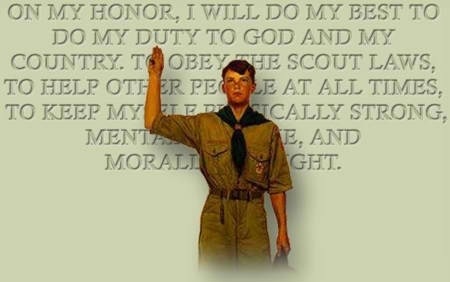
The Boy Scouts of America and a few questions

For the first time in its history the Boy Scouts of America is considering allowing gay scout masters and members. This comes on the heels of a doubling down on the issue just a few months ago.

Attempts to break the Scouts’ no-gay policy are not new, nor were they waning. If anything they were gaining steam as corporate sponsors like Merck and UPS had begun to bail. WND’s David Kupelian believes concern over finances is the driving factor in the decision.

My involvement with the Scouts is limited. I was in Cub Scouts for about a year. We met at Tony Wingate’s house down the street. He had a room full of styrofoam building blocks which were used to pummel one poor cub at the end of each meeting. Our “den mothers” were hopelessly outmatched.

I have known a few Eagle Scouts over the years including my uncle and a young man for whom I was honored to write a recommendation. Without question the Scouts have helped to create good citizens, teach skills, and allow older men to influence younger men. In many instances churches have been able to influence scout troops with believers involved at leadership levels.

My critique, it should be noted, is not toward the BSA’s decision as much as toward how followers of Christ might understand it.

One evangelical leader expressed concern the organization which “has always stood for biblical principles” was being forced to abandon them by political correctness.
boy scouts
The health of the BSA was already being challenged via lawsuits, and as revelations of pedophiles in the Scouts have become more broadly known. From WND again

In fact, the examination of sex abuse in Scouting reveals a long-standing paradox for the nation’s most revered youth group: For 80 years the Boy Scouts of America have given boys some of the best experiences of their lives, but for 80 years some men have used the Boy Scouts of America to have sexual relations with those boys.

“That’s been an issue since the Boy Scouts began,” said James Tarr, the nation’s chief Scout executive from 1979 through 1984.

More than 1,100 Scouts reported being molested by Scout workers over a single 19 year period.

Reflecting on these facts raises a few questions:

Where were the “end-of-the-world” pronouncements when the Boy Scouts of America’s “perversion files” were made public last year?

Why is it morally problematic for the Scouts to welcome gays, but not problematic for them to hide a multi-decade history of keeping molestation out of the public eye?

If the two are equally problematic, why not equally speedy and earnest responses to each?

Why is it problematic for churches to host a gay-friendly organization, but not problematic when the organization was “only” hiding child abuse for nearly a century?

Are we seeing the reaction of people for whom gay-rights is the last domino standing, after which there are no more culture wars to fight?

Is their sense of loss greater than their sense of truth?

Why have Scout leaders not been called to repentance by evangelical leaders, especially those who are decrying the recent announcement?

Why do we not emphasize that the Boy Scouts are now–and always have been–a moral organization focused on good citizenship not a gospel organization focused on discipleship?

Do we even recognize the two are not the same?

Why are some fighting to save moralism, rather than drawing a distinction between moralism and the saving grace of God?

Why do evangelical leaders not acknowledge the words “morally straight” are ambiguous, open to interpretation, malleable, and not scripturally moored?

Are some evangelical leaders not blurring the truth when they gloss over this reality: the Scouts’ generic “God” is not necessarily the God of the Bible?

Which God is it that both evangelicals and Mormons can affirm without qualification?

How is one God the same for Buddhists, followers of Native American religions, Muslims, Jews, Christians, those who define their own spirituality, Baha’i, Zoroastrianism, Hinduism, and more all of whom are included in the BSA’s definition of “God”?

If the Scouts are a Judeo-Christian organization why are more troops hosted by the Mormons than any other other single group?

Does our reaction to this announcement reveal confusion over biblical Christianity and civil religion?

Why would most Christians have no problem with this statement, “We have all the American values: the values of hard work, the values of integrity, the values of fairness and respect,” even though uttered by Bill Marriott explaining why his faith (Mormonism) does not interfere with his business?

Are we more concerned about the loss of Americanism than finding an authentic expression of a Christ-bought church?

If we are more concerned with an authentic expression of the church, why are we so afraid of a faltering culture since the church has usually shone brightest in the rubble?

Will we ever grasp that “reclaiming America” is not the same as “revival”?

Will we ever grasp there is no biblical mandate–or even a suggestion–that “reclaiming America” is a call on God’s people?

Have we misinterpreted the fall of Christendom as the work of Satan, rather than considering it could be God destroying our most grand, safe, and preferred idol?