Category Archives: Featured

Parallels between abortion and the Holocaust, Part 1

In the early days of the Internet, before what we now know as social media, people exchanged ideas in forums and Usenet groups. After observing many such discussions an attorney named Mike Godwin postulated an argument that has become one of my favorite things to spring from the entire online enterprise. He said, “As an online discussion grows longer, the probability of a comparison involving Nazis or Hitler approaches 1.” In other words, the longer an online discussion goes–regardless of topic or scope–someone at some point will bring up a comparison to Hitler or the Nazis.

This statement is now known as Godwin’s Law, sometimes called Godwin’s Law of Nazi Analogies.

The problem Godwin highlights is most comparisons are glib involving neither a valid historical nor philosophical basis. Godwin himself says he wants people “to think a bit harder about the Holocaust.” If you have spent any time at all online you know Godwin’s Law to be true. At times I’ve seen a non-participant jump into a rapidly fraying thread with the single word “Hitler” or “Nazis.” By skipping ahead to the inevitable they demonstrate the degeneration taking place in the discussion.

But, what happens when a comparison to the Third Reich is warranted? Should it be ignored? Because the comparison has been worn out are there never appropriate parallels? So recklessly and mindlessly has Hitler been invoked to use the comparison almost automatically invalidates one’s argument. It is seen as an admission of a weak, unsupportable point of view. This knee-jerk reaction speaks both to the shallow analysis of the over-user and the intellectual laziness of the person who would dismiss the argument out of hand.

The very nature of the Holocaust demands earnestness of thought. Our concept of genocide, indeed the coining of the term, has arisen as a result of Hitler’s Final Solution. Raphael Lemkin, in his work Axis Rule in Occupied Europe (1944), coined the term by combining Greek genos (γένος; race, people) and Latin cīdere (to kill). Though other genocides have taken place in the last 100 years (i.e., Armenians, the Rwandan Genocide, and Srebrenica Genocide), “Holocaust” is generally reserved for the attempted total extinguishing of European Jewry by Hitler’s Third Reich.

One area of clear parallels with the Third Reich is the abortion-on-demand mindset in America. Children have been linguistically reengineered in ways that would make Orwell seem positively straightforward. Since January 1972 some 50 million lives have been artificially and often violently ended before birth in the United States. Comparison to the Nazis are real, valid and ongoing. These articles are only intended to start your own thinking process, not to raise every conceivable point. However, on this 4oth anniversary of Roe v Wade these ideas are worth our consideration.

Introduction

More than three decades ago Notre Dame professor James T. Burtchaell published a series of essays on abortion. Compiled into the book, Rachel Weeping: The Case Against Abortion, it remains a blistering assault on national pro-abortion policy. No less than the Los Angeles Times called it “a searing, impeccable documentation,” while the Library Journal said it offered “extensive information and profound reflection.” “Unassailable” and “unequaled” could easily be added.

Each is worth reading (the book itself should be added to every personal library), but the two historical essays comparing abortion to American slavery and the Holocaust should not be missed. I cannot emphasize strongly enough the power in these writings. Today we will look at abortion and the Holocaust.

Burtchaell is careful to distinguish arguments and process used by the Nazis from the Nazis themselves. In other words, he does not equate pro-abortion advocations to the Nazis in a direct parallel. He does, however, draw clear comparisons to the arguments and mindsets used in both cases to introduce scenarios beforehand thought improbable, impossible or unthinkable.

Ponder the Germanic scenario. There must be an answer as to why millions and millions of human beings died without hearing or trials. There were no hearing or trials because no victims were accused of any crime; they simply were not wanted. Burtchaell asks and answers.

Who did this to them? The SS, the Gestapo, the German Wehrmacht, military and civilian medical and hospital personnel, conscripts from subject countries like Lithuania and the Ukraine, the police of Germany and its tributaries, the governments of cooperative regimes, and the German government in its many ministries: military, Reichsbank, Propaganda, Interior, Transport, Economy, Food and Agriculture, Finance, Labor, Security, Foreign Affairs, and Justice. Many tens of thousands of people–mostly but not exclusively Germans–merged their wits and their efforts that many millions of their fellow humans–not as soldiers nor as criminals–might be destroyed. (pgs. 144, 145)

In Burtchaell’s mind there were “seven factors in the Holocaust which may help us to understand it as an archetype of massacre that is acknowledged only after the fact.” [Emphasis mine.] We will look at five of these in brief–two today and three in the next post.

1. Depersonalization of the victims.
Germany did not simply awaken one day to find its citizenry acquiescent to a genocidal culture. Many years of treating certain groups as sub-human or not human prepared the normal German to view Slavs, Jews and others as life not worthy of life.

When Dr. Eugen Haagen, professor of hygiene at Strassburg University, was receiving prison inmates in batches of two hundred to be injected with typhus, a question was raised whether some of the experimental subjects might be Alsatians. Haagen’s assistant explained reassuringly that “the experiments would not be conducted with prisoner but only with Poles” as “Poles really are not human beings.” Slavs, in the National Socialist racial scale, were classed as subhumans, Untermenschen, only one grade above Jews. (p. 145) Emphasis in original.

Also,

Himmler once cautioned his SS generals not to tolerate the stealing of property which had belonged to dead Jews. “Just because we exterminated a dead bacterium,” he said, “we do not want, in the end, to be infected by that bacterium and die of it.” (p. 147)

There are endless examples of dogmatic racial superiority and eugenics in Nazi Germany and well before. It was all over medical texts, psychiatry and psychology teachings, propaganda, and even math books.

Below is a list of words and phrases used in the “transformation of nomenclature for the unborn.”

The unborn has been designated as “protoplasmic rubbish,” “a gobbet of meat protruding from a human womb” (Philip Wylie); “a child-to-be” (Glanville Williams); “the fetal-placental unit” (A. I. Csapo); “gametic materials,” “fallopian and uterine cell matter” (Joseph Fletcher); “a part of the mother” (Oliver Wendell Holmes); or “a part of the mother’s body” (Thomas Szasz); “unwanted fetal tissue” (Ellen Frankfort); “the products of pregnancy” or “the product of conception” (HEW); “sub-human non-personhood” (F. Raymond Marks); “child Who-Might-Have-Been” (James Kidd); “so much garbage” (Peter Stanley)…”a collection of cells” (Malcolm Potts)…”potential life” (Mr. Justice Blackmun)…and “a non-viable fetus ex-utero” by the National Commission for the Protection of Human Subjects of Biomedical and Behavioral Research. (p. 196, 197)

nazi propaganda sign

Two people read Nazi propaganda. The left column reads, “The Jews are our misfortune.” [Image credit]


2. Euphemistic language to cover torment
Speaking of language and the end result, Burtchaell notes, “The most common outcome was death, but, to avoid all open mention of death and its violent forms, official documents developed an elaborate, almost elegant, euphemy” (p. 152). Think Orwellian and you will get the idea.

I’ll forego the German and list only some English translations:

evacuation, resettlement, clean-up, labor in the East, cleansing, disinfection, special treatment, return undesirable, departed, special actions, forwarded for special measures, inoculated off, separately quartered, transit camp, bath houses, clean-up of the Jewish question. (pg. 152, 153)

And most well known of all the “final solution to the Jewish question.”

This pastel colored language of the grave–this whitewashing of tombs–did not appear only in words and phrases. It was found in the corridors of official life.

There was the 1933 Law for the Prevention of Hereditarily Diseased Posterity (which affected prevention through sterilization or death); the Reich Committee for Children (which destroyed them); the Reich Committee for Research on Hereditary Diseases and Constitutional Susceptibility to Severe Diseases (which identified those to be eliminated); the Non-Profit Patient Transport Corporation (which conveyed them to the clinics where they would die); the Charitable Foundation for Institutional Care (which paid for it); and there was “euthanasia” and “mercy death” (which was what it was all about). (p. 153)

The Nazis, of course, addressed all issues of potential dilution to the master race including the crippled, retarded and infirm. “These victims were characterized as ‘useless eaters’ and ‘socially unfit.’ Their treatment, as one book described it, posed ‘The Problem of Abbreviation for Worthless Lives'” (pg. 154). Death as abbreviation; how lovely.

The same euphemistic obfuscation was present in the move toward legalized abortion and continues to this day.

“termination of potential life,” “termination of pregnancy,” “therapeutic abortion,” “treatment,” “life-rationing,” “post-conception planning,” “menstrual extraction,” “insure non-pregnancy,” “non-meaningful life,” “unwanted child” (pgs. 202, 204, 205)

Since publication of Rachel Weeping we can add others: “women’s health and reproductive freedom,” “private family matters,” “ensuring fetal demise,” “women’s rights,” and perhaps the most Orwellian of all: “choice.”

And where, exactly, might one go for “post-conception planning”? At the time of Burtchaell’s writing he knew of at least these:

In Pittsburgh there is Women’s Health Services, where the services have little or nothing to do with women’s health. In Florida there is the Orlando Birthing Center, which will handle second-trimester abortions but no births. In Leiden one finds the Center for Human Reproduction, which is concerned to arrest reproduction, as also the Water Tower Reproductive Center in Chicago. In Missouri, Parents Aid aids women to avoid being parents, while in Chicago “Family Guidance” guides people to prevent families. Pre-Term and Pre-Birth in Chicago preclude full-term births. (p. 204)

Be reminded: he is not saying these people are Nazis. He is saying the same “language as smoke screen to the truth” was used in both instances. Any convincing disproval is unlikely.

Next up: 3. Disavowed malicious intent, 4. Once initiated, killed indiscriminately, and 5. Found it an occasion to acquire wealth.


What is the big deal about Pinterest?

Over the last year the social media site Pinterest has grown at an exponential rate. The site has more recipes, home decor, home remodeling, and how-to’s than Ted Turner has bison patties. Since its inception it has consumed more women’s time than Anonymous has spent hacking government databases.

Users of Pinterest “pin” web pages links on “boards.” These boards can be themed to most any interest. “Following” others on Pinterest allows you to see what they pin to their board. If you like a particular item on another person’s board, you can “repin” it to your board. Influence on Pinterest is measured by the number of followers and numbers of repins.

For many, many years Sonya (my wife) crammed recipes into notebooks. Reading through various magazines inevitably led to pages ripped out and put into binders. Those were the “one day I’m doing this in our house” binders.

Recently I realized, for her, Pinterest is a visual, organized, readily accessible, virtual binder. The pages that once filled our laundry room are still there, but few have been added since she joined Pinterest.

But that was not the most unusual thing. Last week Sonya told me if Pinterest began charging she would pay to keep her account. If you know anything at all about social media you know that “how shall we monetize” is the billion dollar question. ($64,000 was just way too cheap.) Facebook users threaten armed revolt every time the idea makes the rounds. Twitter has banner ads and “sponsored” tweets. That is just a polite way of saying someone I do not follow paid to force themselves onto my feed.

pinterest screenshot

Click to see Sonya’s Pinterest pinboard. She recently passed 9,000 pins and nearly 400 followers.


So the idea of someone who would willingly and unhesitatingly pay to use a particular social media really caught my attention.

I had already begun to think through how Pinterest is different from other types of social media. I have settled on this for one primary difference: Pinterest serves as a repository of information people access again and again. It’s combination virtual bulletin board, notebook and file cabinet all in one online stop. As my wife said, “I don’t want to lose all of that; I’ve worked too hard to get it together.”

If that is the case with a large percentage of users, Pinterest may find a way to become profitable where other social media have not been successful, or have feared to try.

If you are on Pinterest, please leave me a comment stating why you are drawn to it. If you are a “power user,” would you pay to keep all the pins you have? Do you have a board for blog posts?

Take a second to pass this post along to friends who love Pinterest and ask them to leave an answer.

Obama surrounds himself with children just like…

A meme circulating heavily this morning has to do with President Obama’s scheduled speech on gun control. According to White House Press Secretary, Jay Carney,

[T]he president will be joined by Vice President Joe Biden as well as children who wrote to the president after the Newtown shootings.
“They will be joined by children around the country expressing their concerns about gun violence and school safety, along with their parents,”

Both passions and accusations have run high since the Newtown, CT massacre as Sandy Hook Elementary School. The image below is one.
obama dictators children

I mean, seriously, if Hitler, Mao, and Stalin had their pictures made with children does that not make Obama equal to them?

I drink bottled water. I’m sure every president in recent memory drinks bottled water. That does not mean I am or have been the president. We will forego the old putting pants on one leg at a time saw.

The stupid thing about the meme is, like many of the same genre, there is no context at all. They are simply pictures of a known leader and kids. Except for Stalin. That’s a drawing. He had probably already killed those kids. Or, maybe they were happy to get another potato. [UPDATE: A missionary friend of mine had this to say about the Stalin poster: “What’s ironic is that the Stalin poster is actually a parody. It says, ‘Thank you dear Stalin for shooting our parents.'”]

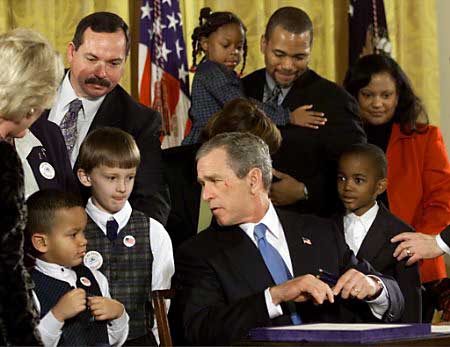
But, since we are on the subject, here is another well known dictator with a bunch of kids:
bush and kids

And another (in fairness he did not get the chance to be dictator, but would have):
rfk with children

And another:
Clinton with children

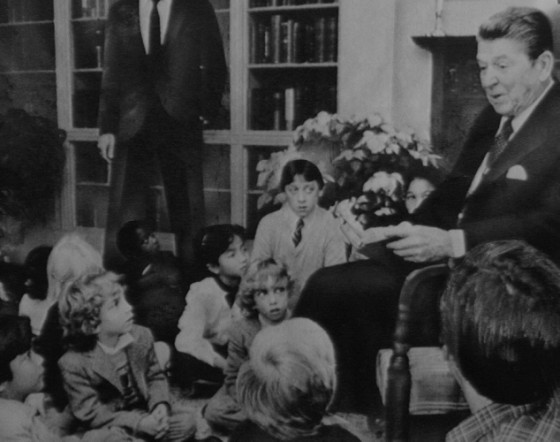
And another:
ronald reagan with children

Please don’t fall for these things. Guilt by association is not the domain of truth seekers. Besides that, easily disproven assertions weakens your argument and your credibility.

Oh, and that thing about Hitler taking away all the guns in Germany before the Holocaust? You might want to check again. It is not true. And here is a solid explanation of the Hitler “For the first time, a civilized nation has full gun registration” quote. Hint: He did not say it.

Touch not God’s anointed?

December brought another frustrating, heartbreaking story of a multiple pastors guilty of sexual sins ranging from adultery to child molestation to rape. The influence of two successive pastors at one church were the focal point of a lengthy essay in Chicago Magazine. Entitled, “Let Us Prey: Big Trouble at First Baptist Church,” writer Bryan Smith chronicles both accusations and admissions of Jack Hyles and Jack Schaap, both former pastors at the storied and fabled First Baptist Church of Hammond, Indiana.


The Chicago Magazine expose reveals a cult-like organization in which members are never to question the pastor, allowing for the most offensive and egregious actions to be swept under the rug. Or, equally as bad, allows them to be propagated for years. Writes Smith:

[Former pastor, Jack] Schaap is not simply one of those rogue evangelists who thunders against the evils of forbidden sex while indulging in it himself. According to dozens of current and former church members, religion experts, and historians interviewed by Chicago—plus a review of thousands of pages of court documents—he is part of what some call a deeply embedded culture of misogyny and sexual and physical abuse at one of the nation’s largest churches. Multiple websites tracking the First Baptist Church of Hammond have identified more than a dozen men with ties to the church—many of whom graduated from its college, Hyles-Anderson, or its annual Pastors’ Schools—who fanned out around the country, preaching at their own churches and racking up a string of arrests and civil lawsuits, including physical abuse of minors, sexual molestation, and rape.

The article also recounts some of the extreme teachings of the leadership, in particular the immensely influential former pastor Jack Hyles.

Virtually no one would marry without Hyles’s blessing, several former church members say. He soon took it upon himself to arrange marriages. According to Kaifetz, “When a guy like Hyles says, ‘This is God’s will for your life,’ you just say, ‘Well, I guess it is.’ ”

One area in which Hyles—a father of four—exerted particular control was child rearing. In this, his views were severe unto merciless. Using biblical passages as justification, Hyles preached that spanking was more than tolerable; it was a sacred duty. In his 1979 book How to Rear Infants, he wrote: “The parent who spanks his child keeps him from going to hell.”

Spanking “should be deliberate and last at least ten or fifteen minutes,” he continued. The blows “should be painful and should last . . . until the child is crying, not tears of anger but tears of a broken will.” They should “leave stripes” if need be. The age at which such punishment should begin? Infancy.

Several people who grew up at First Baptist recall that parents took the instruction to heart. “Beatings would last endlessly, it seemed,” says Mary Jo McGuire, 45, a corporate trainer in Colorado whose father was a deacon in the church. As a seven-year-old, she “used to count the lashes as a way to cope through the searing pain.” McGuire’s younger sister, Sherri Munger, told me she once received more than 300 lashes from a thick leather belt. When authorities were called, McGuire says, Hyles told the girls’ parents how to avoid arrest.

“What was going on [at First Baptist] was kind of like a process of hollowing out the followers and repopulating them with yourself,” says Schaap’s former editor. “[Hyles] took your voice, he took your beliefs, he took your likes and dislikes and opinions, and he gave you his own. But in the process of hollowing you out, he made you very weak.”

In her first one-on-one interview about the church, Hyles’s middle daughter, Linda Murphrey, a motivational speaker and coach in Southern California, remembers his followers as “zombies” who were “willing to believe and obey whatever he said.”

Some of my earliest memories of church harken to the influence of Jack Hyles and others in the “Independent Baptist” church movement. Sometime in my late elementary school years our church, under the leadership of a new, dynamic pastor, left our denomination and became independent. Hyles was among the most influential leaders of that movement. FBC Hammond was synonymous with the movement and Hyles with its theology. We heard a steady diet of short-hair and long skirts. Sometime after our family left they actually installed a sign forbidding any woman from entering the buildings if she was wearing pants.

On of the unmistakeable tenets of the Independent Baptist theology was that of extreme pastoral authority. This was taught as “touch not God’s anointed,” based on a verse from the Old Testament (Psalm 105:15). Pastors, we learned, if not explicitly then implicitly, were awaiting a vacancy in the Trinity.

It is with great sorrow I note how the abuse of this scripture has led to the kind of sinfulness recorded above. Unless your pastor is currently the king of Israel, that verse–indeed, that concept–does not apply. And if he is the king of Israel, he’d better be Jesus Christ.

The idea of “touch not God’s anointed” has been wielded like a light saber by many a pastor both in sinful power grabbing and in honest efforts to live according to God’s plan for His church. The Bible does teach us to learn from–even submit to–those in spiritual authority (Hebrews 13:7 & 17), but warns those leaders as well (1 Peter 5). The New Testament qualifications placed on church leadership are designed to prevent the very abuses we see all to often.

There are a few things that should send up all kinds of red flags should you see them in the pastor of your church:

1. Any claim to divine power or authority. Contrary to the “Lord’s anointed” teaching and those scary dying deacon stories the traveling evangelist told you, pastors are people, too. This is not to say we should disrespect them; we should not. Even when they do and stay dumb things. It does mean, however, that they are not God-like. The New Testament does not speak of church leaders in the same way David talked about king Saul. Pastors fill a divinely established office, but they are not divine, inerrant or infallible.

2. An insistence on unquestioning support. While some pastors act as if high school boys need more accountability than anyone else, the truth is pastors need as much accountability as anyone. Pastors need more than one person who will ask them hard questions, force them to rest, ensure they are spending enough time with their spouse, and that their own time in prayer and the Word is not suffering. Any pastor who demands or expects unflinching support has replaced God with his own ego, and is leading himself and the church down a destructive path. Such a demand often arises from his own irrational fears or sinful desires but, rather than doing the painful work of humble self-examination efforts are made to squelch any questions.

3. Excusing sin at the leadership level. In these church there is almost an obvious and ongoing double standard between the top pastor, the other leaders and the rest of the people. Those comprising the “inner circle” are often beyond criticism, having any transgression short of murder swept over the rug. This behavior has been seen in other places besides FBC Hammond.

4. Preaching the same things over and over. Preaching the whole counsel of God takes a lot of work. Avoiding the comfortable ruts of routine comes from immersing one’s heart and mind in the Word of God. Pastors who refuse accountability will soon find themselves preaching what they know. It’s all they can do. When pastors do not study, they do not learn, they are not changed. They have nothing to give. The same jokes, stories, verses and “hobby-horses” are signs of an inner breakdown.

5. A seeming obsession with a single subject matter. The Bible instructs us, “Out of the abundance of the heart the mouth speaks.” A video of Jack Schaap simulating masturbation during a youth sermons can be found online. It is so graphic even the Chicago Magazine writer was nonplussed about it. When a “man of God” refuses correction from those around him, he has already refused correction from God’s word. At that point the mind overflows with garbage. It might be sex, materialism or power, but that which is inhabiting the pastor’s heart will make its way out.

Perhaps, rather than looking for verses like “touch not God’s anointed,” pastors should look at verses addressed to their Old Testament counterparts. Today’s pastors are not equivalent to the kings of Israel. They would more likely be related to the priests as those tasked with spiritual oversight. Why are verses like Jeremiah 2:8 not referenced by more pastors:

The priests did not say, ‘Where is the LORD?’ And those who handle the law did not know Me; The rulers also transgressed against Me; The prophets prophesied by Baal, And walked afterthings that do not profit.

Or maybe Jeremiah 5:31:

The prophets prophesy falsely, And the priests rule by their ownpower; And My people love to have it so. But what will you do in the end?

(It’s worth noting the attitude of the people. They “love” their wayward prophets and priests.)

Jeremiah was not alone. Hear Ezekiel:

Her priests have violated My law and profaned My holy things; they have not distinguished between the holy and unholy, nor have they made known the difference between the unclean and the clean; and they have hidden their eyes from My Sabbaths, so that I am profaned among them.

Then this from Hosea (6:9):

As bands of robbers lie in wait for a man, So the company of priests murder on the way to Shechem; Surely they commit lewdness.

Now, I’m not saying there is a direct parallel from the New Testament pastor to the Old Testament priest or prophet. But, the roles do seem to be more closely related than that of pastor and king.

Those whose eyes are opened to the truth and attempt to leave spiritually abusive situation are often shamed and shunned. There is a biblical role for both, but it has nothing to do with power-hungry, sex-crazed pastors retaining manipulative control. If you are in one of these situations, then run with all of your might. All pastors do not exhibit cult-leaders like qualities, and all churches are not peopled by the blind and confused. For your own spiritual safety and maturity, find a church that reflects the life and teachings of Jesus, especially amongst its leadership.

Eight reasons you should start or restart a blog in 2013

Circa 2006 blogging was all the rage. You could head over to Blogger.com, Typepad.com or WordPress.com, sign up and join in the burgeoning movement. Books were already being written about this new version of the printing press. “Official” news sources worried over losing readership to blogs. Real news stories–not just opinion pieces and rants–were regularly broken by bloggers.


A blog, initially an abbreviated form of “web-log,” is a website that allows for interaction, rather than a one-way broadcast of information. Interaction takes place in the comment thread, where, hopefully, additional information is shared. As it tend to happen, depending on the size of the readership, the content of the post is addressed for about three comments. After three comments the comments tend to run off the rails until, invariably, someone brings up Hitler or the Nazis. (See Godwin’s Law.) A good blog owner is also a good moderator, keeping out the trolls and keeping the conversation on topic.

Eventually mainstream media outlets threw in their respective towels and joined the fun. Many major news organizations now have a blog section to their main websites. CNN and the Washington Post are two featuring multiple blogs.

With the advent of Facebook and Twitter blogs and blogging seemed to take a lesser role in the social media space. The ease of connecting with so many friends and family (Facebook) and the brevity of microblogging (Twitter) caused many to lose interest in the longer form writing of the blog. Or maybe it was just a bum-rush to the new trend.

After this interlude blogging is making somewhat of a comeback. I’ve seen a number of new blogs started in the last few months by my friends, while others are resurrecting dormant blogs with new material.

If you do not have a blog, should you start one? If you have a dead blog should you breath into it the breath of life in 2013? I think the answer to both questions is an unequivocal “yes” and here are eight reasons why:

1. Blogs are searchable. For all the fun and benefit of other social media, nothing is more searchable than blog content. When using a search engine like Bing or Google to find content, you will notice that Tweets and Facebook status updates do not lead the way. Blogs and websites do. This means your blogged thoughts will be searchable to people all over the world

2. Blogs allow for fuller development of ideas. As much as I love tweeting there is a limit to how much one can develop and express a distinct philosophy of government or religious belief in 140 characters. Even if you choose the terrible multi-tweet method (1/6, 2/6, etc) the fulness of a blog post cannot be captured.

3. Thought leaders depend on blogs for idea sharing. Seth Godin, Thom Rainer, John Maxwell, Tom Peters, and Mary Jo Asmus are not feeding the flock, as it were, on Facebook. While some will give pithy saying in other social media, their blogs are where ideas are shared in full.

4. Blogging hones the craft of writing. A goal of 2-3 posts per week forces you to give thought and effort to writing. The more you write, the better you tend to get. (Especially if you ask for feedback.)

5. Blogging helps release your creative side. Through this practice I have uncovered a desire to be a better, more creative writer. I am not looking to conquer the world of science fiction or fantasy, but I do want better turns of phrase. I want to be more precise, to be more descriptive. I want my writing to be memorable. I doubt I would ever have written a book had I not blogged first.

6. Connection with people of like interests. “Mommy bloggers,” “Foodies” and political junkies are examples of this. Blogging allows you to connect with other people who have the same interests as you.

7. To make money. Most bloggers do not make money. Many will make less than $100 during the entire life of their blog. If you intend to blog for money, be prepared to put in many, many hours of content creation and link building. Only a few make it to the rarified air of living from blog advertising, but that does not mean you cannot! Google offers advertising based on ad clicks. Beacon Ads pairs websites with advertisers who pay a flat rate based on traffic. Commission Junction represents many, many advertisers. Amazon.com has a fantastic affiliate program.

8. Educating yourself and others. Blogging provides the opportunity to learn. If you write about news related topics–whether firsthand reporting or opinion–you will need to study, gather facts, double check information, write, and, sometimes, provide corrections. Information you post will be learned by others. It can be a great process.

The books below will be helpful if you are interested in more information. You will get the same low Amazon.com price and I get a small commission.

A review of “Les Miserables” for the non-fan

Since the opening of Les Miserables on Christmas day, I have read no shortage of reviews from the professional critic and lay person alike. People on social media have talked about weeping and wailing, taking boxes of tissue, it being the best movie they have ever seen and the like. Viewers and reviewers seem to fall into one of these categories: 1) those who are admitted fans who think the movie version is the greatest thing ever filmed, 2) those who are admitted fans who think it was ok, but well short of the greatest thing ever filmed, 3) those who are not fans and did not care for it, and 4) those who are not fans and really do not get it.

If you are in the first three groups well and good. In this post I want to address the fourth group because I have sympathy for them. I’m guessing it would be like coming into the 14th episode of the fifth season of Lost or any episode of Dr. Who. Here is a summary that might help if you are unfamiliar with Les Miserables but intend to see the movie.

Hugh Jackman Isabelle Allen

Cosette (Isabelle Allen) and Jean Valjean (Hugh Jackman) in the 2012 movie musical Les Miserables


First, the movie is based on the book of the same name. Les Miserables was written by a Frenchman named Victor Hugo who apparently did not have anything else to do other than write for a long, long time, as the book is a million pages long. Several Parisian forests were leveled for its first printing. The story begins after the French Revolution and culminates with the 1832 June Rebellion, neither of which means anything to most Americans. One might as well say the action began during the first phase of the moon and ended during the penguin mating season. Same interest level, same knowledge level.

It is estimated that only five people have ever read Les Mis in its entirety. It is the literary equivalent of a Claxton fruitcake. One of the five is Trevin Wax. Two of the others are Alain Boubill and Claude-Michel Schonberg. Or, maybe one of them read it and summarized it for the other.

Regardless, these two had the idea that a story about an escaped convict, a dogged police officer, a bunch of hookers, street people, an orphan, a love-triangle and French social unrest–all based on a million page novel–would make a bang-up musical.

Against all odds they were right. Les Miserables has truly become a worldwide phenomenon. The musical, as well as the current movie, are “sung-through” meaning that the entirety of the dialogue, save a hundred words or so, are rendered in song. The story is related in sweeping anthems, solos, duets, trios and heart breaking soliloquies.

Contains spoilers

Les Mis centers around a man named Jean Valjean. (For all you Duck Dynasty fans it is not “Gene Valgene.” It is pronounced something like “zhan valzhan.”) He is serving a 19 year prison sentence for stealing a loaf of bread in an attempt to feed his starving relatives. Police inspector Javert dutifully reminds Valjean he was sentenced to five years for stealing the bread and 14 years for trying to escape.

What a relief.

At the end of the 19 years he is issued a “yellow-ticket of leave,” which is basically a parole card. After a futile attempt to find work, Valjean takes refuge in the home of a priest whom he promptly relieves of the church’s silver place settings. The priest forgives Valjean and claims him for God. After a heartfelt soul searching, a contrite Valjean repents and vows to be a changed man.

The problem is Valjean feels himself so changed that he is no longer Jean Valjean and will begin a new life, complete with running away from his parole and parole office, Javert. Javert does not overlook such an act, nor believe such a conversion.

Years later we find Valjean, using the assumed name Monsieur Madeleine, in another town, a successful business man who is currently mayor. He has found wealth and success in the days of social upheaval, a time not unlike Dickens’ A Tale of Two Cities or A Christmas Carol. Owing to bad timing and a misunderstanding a factory woman, Fantine–an employee of Valjean’s–is fired and due to the failed economy must turn to prostitution to support her daughter.

Valjean later realizes what has happened and tries to make amends, but Fantine has become ill and will not escape death. Out of a sense of guilt and responsibility he promises to find her daughter, Cosette, and raise her as his own. This he does after paying off the French innkeeper and his wife, the Thenardiers, two wretched people so crooked they probably had to be screwed into their caskets. These are they to whom Fantine had naively entrusted the welfare of Cosette.

Valjean returns to Paris (I think) to raise Cosette in anonymity. Years later they find themselves caught up in the June Rebellion (apparently these things were monthly) when a student rebel named Marius spies Cosette, finds out where she lives and pursues a forbidden relationship–forbidden by Valjean who does not trust anyone else to protect her.

A would-be love triangle is formed between Marius, Cosette and Eponine the daughter of the Thenardiers who is the same age as Cosette, now a young adult. Eponine’s love for Marius is unrequited as he sees her, basically, as one of the guys. Nonetheless her love is real and is demonstrated as she rescues Cosette from a band of robbers led by the former innkeeper, Msr. Thenardier, and rescues Marius twice. The second time is at a barricade when Eponine takes a bullet intended for Marius.

When the French army finally breaks through the barricade all of the student revolutionaries are killed with the exception of Marius. Vajean, who has joined the students, steals away the unconscious Marius and carries him through the vile sewers of Paris to freedom. Later, after recovering from his wounds, Marius returns to the cafe where the revolution had been planned. There he sings a song of remembrance that is powerful and touching.

The movie draws to a close with Valjean in old age near death. Marius and Cosette, who have just married, track him down in hiding in time to see him a final time. He joins Fantine in heaven, along with, it would seem, everyone who fought with the students in the revolt. Or opposed the king. Or drank an espresso.

The eschatology is a little sketchy, okay?

Maybe some of you are wondering, “You’ve got to be kidding me. People who have already seen this in live musical theater are shelling out more bucks to see a movie musical two hours and 40 minutes long??” Indeed. And many will more than once.

Here’s why: The music, almost to a song, is exceptional. Lyrically intelligent, insightful and melodic. People can and do sing these songs and listen to them over and over.

The story, though filled with enough characters to give the casting director a 9 month migraine, has powerful, clear themes. Mercy, redemption, justice, law, revenge, love, sacrifice. Seriously, we may not always want to give mercy but who among us does not want to receive it? Do we not admire those who give their lives for others? The New Testament in the Bible says there is no greater sign of love. A clearer picture of grace is not to be found.

Unlike many stories, the themes are not merely present they are embodied. Valjean is the embodiment of the mercy and grace of God. It so affects his life that it ultimately affects all of those around him. Javert is the embodiment of legalism, the idea that you can earn your way into God’s grace. As it does with us, it leads him to ultimate frustration as he can neither forgive Valjean nor accept God’s forgiveness. (His role is substantial and recurring, though I barely mentioned him above.) The Thenardiers are the embodiment of wickedness. There is nothing honest nor admirable about them. The songs of which they are a part are bawdy and ribald. Fantine is the embodiment of the person who receives the worst of life. She is the recipient of judgment on sins she did not commit. Her life is the one where people ask, “Where was God for her?” She asks the same question. Marius and Cosette are the embodiment of love. Eponine is the embodiment of one who give all for nothing in return. The revolutionary students, though not claiming a biblical mandate, are the embodiment of those who would seek justice in an unjust world.

The themes are universal and undeniably Christian.

As for the movie itself, I thought it incredibly powerful. Parts are hard to watch (Fantine’s descent into prostitution set to the garish faces of another bawdy song, “Lovely Ladies,” for example), but are reminders of the hell on earth people live through each and every day. And that in real life.

If you are wondering about taking children, I would not take children under middle school. There are a few gutter scenes you might want them to avoid. And, I’ll never look at Santa Claus the same way again.

Thanks for a great year

That would be last year, not this year…yet. But, I am expecting great, aren’t you??

For all readers of Kingdom in the Midst: please accept this great big “THANK YOU” for frequenting this blog in 2012. After an off year in 2011 (which saw a mere 22 posts), this blog was sort of resurrected in January of last year. Last year there were 233 posts on Kingdom in the Midst with many thousands of page views and visitors. My visitor numbers were skewed lower than my analytics recorded as I did not get re-started until the middle January. Another reason is my stat counter inexplicably stopped working for about six weeks at one point. That’s my story and I’m sticking with it.

Overall, I’m very happy with last year and hopefully will provide meaningful content and host helpful conversations in 2013. On that note, some of you may have noticed I have installed a new commenting system called Disqus (pronounced “Disqus”). After trying Facebook comments for a while, and doing a brief trial of Livefyre comment service, I settled on Disqus. This is the same commenting system used by sites like NPR, Fast Company, CNN, The ATLANTIC, The Telegraph, Time.com and more. Having a Disqus account is not necessary to comment. You can comment using your Facebook, Google+ or Twitter accounts or just with your name and email (in normal WordPress style). Disqus, however, allows you to see your comments from various sites on your Disqus dashboard. The account is free.

No matter you login method, I invite your comments and conversation.

Maintaining consist posting is always a challenge. Now that I’m in a routine of sorts I hope to pass 250 posts in 2013. A continued focus on justice issues and exploring the multifaceted relationships between Christ’s followers and culture is another goal. I also hope to critique those areas of government that seem to contravene a Kingdom mentality. Book, music and movie reviews will continue, but I’ll also begin to do monthly “One Minute Reviews” of 3-5 books in a single post. I hope this will offset my tendency toward writing essay length reviews.

Last year was the first year I attempted social sharing on a large scale. In my earliest blogging days, “social sharing” consisted of word of mouth or sending a link via email. I’m very appreciative for everyone who has shared my writing via social media. I had several posts that were shared hundreds of times. Please continue when I write something worth sharing! And, if you have not already, do not forget to “like” Kingdom in the Midst on Facebook. (It’s simple to click “Like” in the sidebar widget.)

As always thank you for reading and recommending. Thank you for all who have supported Kingdom in the Midst in 2012. And remember you support this blog when you start your Amazon.com purchase by using the search box in my sidebar.

Here’s to a God honoring 2013.

Are you ready?

And a Merry Christmas to all

Fa la la la la, la la la la…

I love the season of Christmas, the giving and receiving of gifts, the awareness in society that things should be different than they are even if many cannot say why. I love spending time with family. I love having time off work. I love the food, mostly baked goodies, around every turn.


Most of all I love the reflection of God becoming human in order to redeem me from sin. This descending to the earth = mind blown for me. The first necessary step on the way to Jesus dying on the cross, Bethlehem’s manger has always captured me entirely.

Perhaps because I am human I can at least imagine the idea of dying for another. I have run such scenarios over in my mind many times.

Perhaps because I know people who have lost children I can at least imagine the pain of having a child die.

But, being holy, omnipotent, and distinct from an entire universe I had created, I cannot imagine. Creating a race upon whom I could bestow love and grace then for those beings turn against me, I cannot imagine. Then leaving aside my privilege, my throne, my universal vantage point, my safety, to become one of the created race as an infant, I cannot imagine. There just is no point of reference for it.

Think for a moment about that. Unlimited power traded for powerlessness. Eyes that oversaw all of creation, now fuzzy, blurry and unfocused. Hands that could weigh the world, barely large enough to wrap around his mother’s finger. The king of angels born in a nondescript, unknown Jewish stall.

The incarnation is the greatest miracle of all. Josh Howerton calls the Incarnation “by far – the most shocking, glorious, mysterious miracle in Redemptive History.” I agree.

We are always warned to not lose Christ in the trappings of Christmas. Let that warning sink in deeply.

Now allow me to wish you a “merry Christmas.” And, rejoice over what that means.

Thank you for your faithful reading of my blog. I will be taking the rest of the year off from writing and doing very little other social media, so Happy New Year as well.

Can we have a civil gun discussion or not?

The Daily Beast thinks so.

The well known site asked its readers to weigh-in on the issue. Gun owners and non-owners alike responded with over 600 reasonable comments (DB discarded an unknown number considered “misguided attempts at humor—from both sides of the fence. Others were downright puerile”).

Comments included:

Readers from rural areas said that they own guns for practical concerns, like personal safety in homes located far from law enforcement, or as a necessary tool for their livelihoods.

“We target shoot. We live in a rural area with livestock,” LP from Colorado said. “We have to be able to defend ourselves from aggressive wildlife, put an animal out of its misery if it is severely injured, and defend ourselves in our isolated environment. People are responsible with their guns here.”

A respondent from New Mexico said he or she owns a “.22 pistol to shoot rattlesnakes only in my yard.”

Hunters, not surprisingly, represented a good number of gun owners who responded to our survey. “I grew up in a family that hunted and fished,” said Jeff from Minnesota. “However, I do believe that private ownership of semi-automatic and automatic guns and handguns should be totally prohibited. I am perfectly willing to give up all of my guns for the greater good.”

A third group of gun owners was made up of hobbyists. An anonymous reader from Minnesota wrote that he or she owns a gun “because the hunting and shooting culture I grew up in taught me to respect life, my elders, and firearms. The relationship between me and my father that developed out of firearms and hunting is incredibly meaningful and the most positive one in my life.”

[…]

“Shooting sports are fun, and legitimate,” Andy from Texas wrote of why he chooses not to own a gun. “But the anxieties of the self-defense crowd are just too much for me. I refuse to believe there are that many bogeymen in the world.”

“I don’t need one today, but would want the option to buy one if I change my mind. I could agree with special, renewable permits/licenses and required annual safety training for owners,” wrote one anonymous reader.

Other respondents wrote that they see no need to put the fearsome power of a firearm in the hands of civilians, outside of controlled circumstances like hunting. Christina from California wrote that “the purpose of a gun is to kill someone or something. God is the judge of people’s actions, not me. You don’t need an assault weapon to kill a deer or pheasant. If your life feels threatened, you are in the wrong place.”

“I have curious kids,” wrote Matt from Maryland in a post that summed up many respondents’ feelings about the unreliable hands even a legally purchased weapon might fall in to. “I might lose my job or my wife and have a nervous breakdown.”

If this anywhere resembles a cross-section it appears most Americans are not opposed to gun ownership, but support more restrictions than are currently in place.

I was raised in a gun owning family and am a gun owner. My wife and kids are familiar with firearm use. They will soon become even more proficient.

Personally, I have never seen or felt the need for owning a hundred round ammo drum. I do not know of anyone who hunts with them either. It is true assault-style rifles are not used for hunting quail; but neither are .22s or a .40 Glock. And neither is a chef’s knife or a baseball bat.

I have been to firing ranges with and without someone in charge. Danger never felt near even though every other person was unknown to me. Pay attention when the range is hot and keep your gun pointed toward your target. I have been hunting when the person who knew the least about what was going on was me. Made it through.

I’ve known of one person who was killed because he did not unload his gun before he started to clean it. If fell off the table, discharged and fatally wounded him. I also read of a woman who turned around in her kitchen while holding a knife and fatally wounded a family member. I went to the home of a man whose car had slid of the jack stands and crushed him to death in his own yard. Accidents do happen and they involve guns, knives, cars, rocks, construction, the old and the young.

People even die having sex. I’ll move to Canada when someone tries to outlaw that.

If you are a complete pacifist and refuse to engage violence in any way, then it really should not matter to you whether I choose to defend myself with a firearm, a length of 2×4 or 3 feet of tire chain. I respect your right to allow yourself to be killed. I even respect your right to allow your family to be brutalized while you do nothing. I will defend mine with every ounce of strength and by all available means. Defending the defenseless is not only about abortion.

(As an aside, it amuses me when people decry gun ownership, yet when faced with violence themselves, call the police who come to the rescue…with billy-clubs, pistols, body armor and, if need be, assault weapons. As an aside within an aside, it is a little-known fact that a large number of accidental shootings come from…wait for it…the police shooting themselves and each other. Also, waiting for the police is not recommended in the face of evil people with guns. Check these interesting stats.)

As I perceive the issue of guns, a few things jump out to me. First, if there is a problem with mentally imbalanced people going on rampages it could be a different discussion than the gun discussion. Frankly, we cannot say of every person who goes on a rampage they are mentally challenged or emotionally damaged. This is the easy, lazy way out and is an insult to the millions of mentally challenge or depressed people who never commit a crime.

That said, if weapons that allow for mass or spree murders are falling into the hands of the mentally ill tightening a few processes is the least we can do to protect our friends, family and ourselves until we can get the other issues in society addressed. As a gun owner I confess it makes little sense that I must pass an eye test every time a driver’s license renewal is needed, but have to pass a range test only once.

Second, while the Second Amendment provides the right to keep and bear (“carry”) arms, it does not necessitate the right to own any armament the mind of man can create. I’m not in favor of my next door neighbor having a cache of white phosphorous rounds in his basement. Even if we are attacked by aliens. (Anyone whose ever seen Independence Day knows we need a nerdy code-writer before any weapons will do any good anyway.)

The flip side of this is the musket argument, and that being a poorly conceived one. The 2nd was written during a time that our arms were equal to or superior to those of our enemies. That they were single shot rifles and manual reloads is completely irrelevant. If the constitution was being written today with the same intent we still would be addressing a situation where our choices should be what allows for practical defensibility. As weapons became more advanced–and that before the NRA–the 2nd Amendment was not modified.

Third, the problem of evil is real. Demonic possession is real. The hearts of people are blackened with hurt, hate, cruelty and violence. I do not expect our congress to engage this part of the conversation, but followers of Christ must do so. We cannot legislate away evil but we can recognize and give ministry to those who are being overcome by it. Jesus changes hearts and lives.

Fourth, lawbreakers do not need permission or permits. One reason we have drive-by shooting deaths is gangsters are apparently bad shots while in moving vehicles. Why should they not be? When you are under-aged, have an illegal firearm, and are intending to kill people, you cannot exactly go to a range and practice. (“Hey Harold, how much to access the urban setting firing range for some practice today? Could you set some cardboard kid cutouts on front porches and such? I hit too many last time.”)

Many gun deaths are a result of not one, but a large number of accumulated broken laws. Though an old axiom, “If guns are outlawed only outlaws will have guns,” is very true. Gun crime is again on the rise in England where citizens do not own or carry. Things have degenerated in some areas to the point *gasp* the police have once again started packing.

In a free country law abiding people should be able to defend themselves against aggression, point for point. Those who abide by the law should never be faced with defending themselves against a 9MM using a rolled up magazine. I’m not Jason Bourne. Neither is anyone I know.

Will we be able to have a rational discourse on this? Given that my definition of rational my differ from yours and everyone else’s?

One Christ follower thinks about Gaza, Israel and Palestinians, Part 3

In the first two installments of this series we looked at some of the history of the Conflict between Israel and the Palestinian people. We also considered the current condition of Palestinians who are in Gaza and the West Bank. Those and this post are aiming to consider not whether Israel is always right or wrong, not whether the Palestinian people are completely without fault. I accept there is fault on all sides.

The purpose in this exercise is to consider whether Bible believers must support any action taken by the government of Israel. To put it in the form of a question, must followers of Christ affirm every political or military action taken by national Israel? Or, can the actions of Israel be critiqued biblically just like every other geo-political entity on Earth, including the United States?

The uniqueness of Israel throughout biblical history can hardly be overstated. Birthed from the beyond-her-prime-wife of a former pagan, Abram (then, Abraham), the descendants of Jacob (then, Israel) were the apple of God’s eye. Chosen to be a light to the nations and form the cultural cradle for the Savior of the world, God’s people–His wife–were unique among all ancient people.

With that privilege was a responsibility they often shirked in favor of more attractive, available, temporal gods, even those “requiring” acts of adherence the true God expressly forbade. A cycle of obedience, sin, enslavement and deliverance became the title page, closing comments and every chapter of the chosen nation. This lasted for centuries.
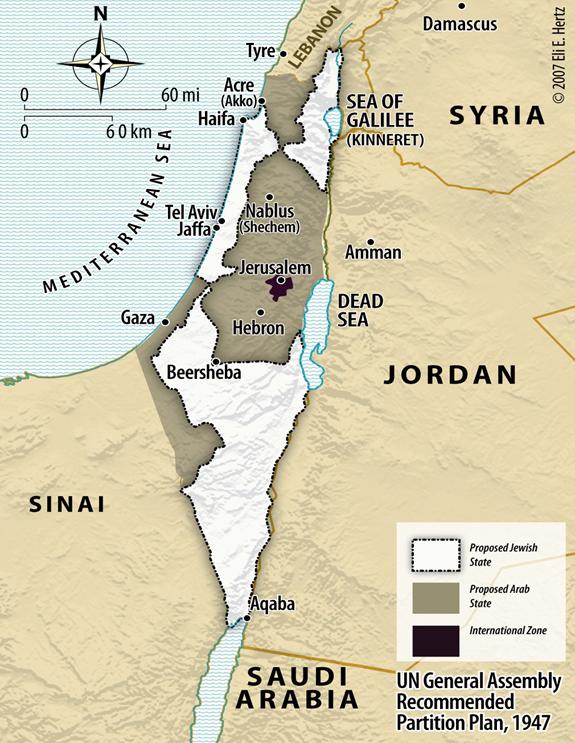
1947 UN partition map of palestine gaza west bank
The New Testament narrative opens with Israel enduring the occupation of a foreign army. That idea about carrying a cloak two miles after being asked to carry it only one? It was related to the occupying Roman army. That centurion at the foot of the cross? A member of the occupying Roman army. Even Jesus crucifixion needed the approval of the Roman procurator, Pontius Pilate. Israel had a measure of freedom, but the Jews were not free people.

Enter the Messiah, meek and lowly and riding on a donkey. Instead of a chariot, a four legged beast of burden. Rather than a cannonade, followers waved palm branches. Replacing the shout of the conqueror, we hear, “Hosanna! Blessed is He who comes in the name of The Lord!” Substituted for a victory over Rome was a mysterious kingdom “not of this world.”

There was nothing humanly militaristic about the coming of Christ. It was completely upside down from the expectation of His day.

When His disciples tried to pin Him down on Israel’s return to power, He shrugged off their concerns insisting that God knew, it was in His control and that was all that mattered. Then He went back to heaven and we have been awaiting His return ever since.

Before Jesus left, however, He pulled off a pretty major celestial coup de tat. Eternal, you could say. He destroyed death, and him who had previously held the power of death–Satan–dishing him a mortal blow, from the cross no less. Jesus most significant point of defeat was only apparent defeat. Turns out it was actual victory over sin, death and hell. Immediate, progressive and ultimate.

By this victory Jesus instituted a different group, called the church. His words were that the church would be of His own construction, empowered by His Spirit, commissioned to carry the gospel to all nations. In other words, the church–which would be transnational, transcultural, transgenerational, and timeless–would assume the assignment that once belonged to national Israel. An assignment they finally and thoroughly rejected with the cry, “Let the blood of this man be on us and our children!”

All the descriptions bestowed upon Israel in the Old Testament–chosen, washed, righteous, holy–were bestowed upon Christ’s followers in the New Testament. Additionally, the book of Hebrews makes it clear the priesthood unique to Old Testament Israel (still functioning at the time of Christ) was inferior to the new priesthood Jesus Himself introduced and headed. This was and is a priesthood inclusive of all believers.

I do not plan to argue the Replacement view of Israel and the church. These thoughts are being introduced primarily to demonstrate our dominant, accepted view is not the only biblical way of viewing Israel’s role in modern times.

For the sake of argument, though, let’s assume pre-tribulation, pre-mill, dispensational theology is correct. Let’s assume the church will be raptured at some point and God’s gospel spreading work will return to national Israel.

Would this mean the current government of Israel is beyond criticism and critique? I submit it does not.

If Christ followers do not demand from Israel the same justice we demand for Israel, we are being hypocritical. This hypocrisy will not only be tragic it will be noticeable. We will appear double-minded and unstable because we will be double-minded and unstable. The church does not receive its instruction from the descendants of Abraham; she receives instruction from the God of Abraham.

The history of the Old Testament is a chronicle of the critique and rebuke of Israel’s sinful behavior. Why should we believe this to have changed in an era when Israel has rejected her Messiah? The church is to be the voice of God’s kingdom, the light of truth to the world! Shall we hush our mouths from witness to His truth and justice simply because Israel would be rebuked?

Such biblically warranted correction is not bruising the apple of God’s eye; if anything, it is polishing it.