Tag Archives: movie review

A review of “Les Miserables” for the non-fan

Since the opening of Les Miserables on Christmas day, I have read no shortage of reviews from the professional critic and lay person alike. People on social media have talked about weeping and wailing, taking boxes of tissue, it being the best movie they have ever seen and the like. Viewers and reviewers seem to fall into one of these categories: 1) those who are admitted fans who think the movie version is the greatest thing ever filmed, 2) those who are admitted fans who think it was ok, but well short of the greatest thing ever filmed, 3) those who are not fans and did not care for it, and 4) those who are not fans and really do not get it.

If you are in the first three groups well and good. In this post I want to address the fourth group because I have sympathy for them. I’m guessing it would be like coming into the 14th episode of the fifth season of Lost or any episode of Dr. Who. Here is a summary that might help if you are unfamiliar with Les Miserables but intend to see the movie.
Hugh Jackman Isabelle Allen

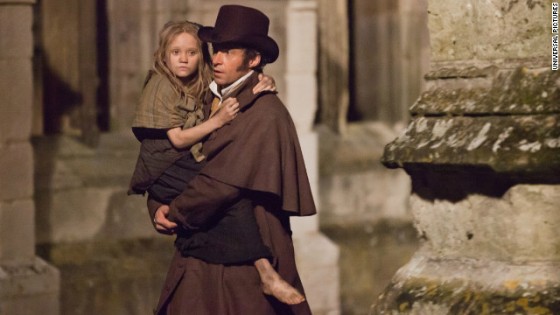
Cosette (Isabelle Allen) and Jean Valjean (Hugh Jackman) in the 2012 movie musical Les Miserables


First, the movie is based on the book of the same name. Les Miserables was written by a Frenchman named Victor Hugo who apparently did not have anything else to do other than write for a long, long time, as the book is a million pages long. Several Parisian forests were leveled for its first printing. The story begins after the French Revolution and culminates with the 1832 June Rebellion, neither of which means anything to most Americans. One might as well say the action began during the first phase of the moon and ended during the penguin mating season. Same interest level, same knowledge level.

It is estimated that only five people have ever read Les Mis in its entirety. It is the literary equivalent of a Claxton fruitcake. One of the five is Trevin Wax. Two of the others are Alain Boubill and Claude-Michel Schonberg. Or, maybe one of them read it and summarized it for the other.

Regardless, these two had the idea that a story about an escaped convict, a dogged police officer, a bunch of hookers, street people, an orphan, a love-triangle and French social unrest–all based on a million page novel–would make a bang-up musical.

Against all odds they were right. Les Miserables has truly become a worldwide phenomenon. The musical, as well as the current movie, are “sung-through” meaning that the entirety of the dialogue, save a hundred words or so, are rendered in song. The story is related in sweeping anthems, solos, duets, trios and heart breaking soliloquies.

Contains spoilers

Les Mis centers around a man named Jean Valjean. (For all you Duck Dynasty fans it is not “Gene Valgene.” It is pronounced something like “zhan valzhan.”) He is serving a 19 year prison sentence for stealing a loaf of bread in an attempt to feed his starving relatives. Police inspector Javert dutifully reminds Valjean he was sentenced to five years for stealing the bread and 14 years for trying to escape.

What a relief.

At the end of the 19 years he is issued a “yellow-ticket of leave,” which is basically a parole card. After a futile attempt to find work, Valjean takes refuge in the home of a priest whom he promptly relieves of the church’s silver place settings. The priest forgives Valjean and claims him for God. After a heartfelt soul searching, a contrite Valjean repents and vows to be a changed man.

The problem is Valjean feels himself so changed that he is no longer Jean Valjean and will begin a new life, complete with running away from his parole and parole office, Javert. Javert does not overlook such an act, nor believe such a conversion.

Years later we find Valjean, using the assumed name Monsieur Madeleine, in another town, a successful business man who is currently mayor. He has found wealth and success in the days of social upheaval, a time not unlike Dickens’ A Tale of Two Cities or A Christmas Carol. Owing to bad timing and a misunderstanding a factory woman, Fantine–an employee of Valjean’s–is fired and due to the failed economy must turn to prostitution to support her daughter.

Valjean later realizes what has happened and tries to make amends, but Fantine has become ill and will not escape death. Out of a sense of guilt and responsibility he promises to find her daughter, Cosette, and raise her as his own. This he does after paying off the French innkeeper and his wife, the Thenardiers, two wretched people so crooked they probably had to be screwed into their caskets. These are they to whom Fantine had naively entrusted the welfare of Cosette.

Valjean returns to Paris (I think) to raise Cosette in anonymity. Years later they find themselves caught up in the June Rebellion (apparently these things were monthly) when a student rebel named Marius spies Cosette, finds out where she lives and pursues a forbidden relationship–forbidden by Valjean who does not trust anyone else to protect her.

A would-be love triangle is formed between Marius, Cosette and Eponine the daughter of the Thenardiers who is the same age as Cosette, now a young adult. Eponine’s love for Marius is unrequited as he sees her, basically, as one of the guys. Nonetheless her love is real and is demonstrated as she rescues Cosette from a band of robbers led by the former innkeeper, Msr. Thenardier, and rescues Marius twice. The second time is at a barricade when Eponine takes a bullet intended for Marius.

When the French army finally breaks through the barricade all of the student revolutionaries are killed with the exception of Marius. Vajean, who has joined the students, steals away the unconscious Marius and carries him through the vile sewers of Paris to freedom. Later, after recovering from his wounds, Marius returns to the cafe where the revolution had been planned. There he sings a song of remembrance that is powerful and touching.

The movie draws to a close with Valjean in old age near death. Marius and Cosette, who have just married, track him down in hiding in time to see him a final time. He joins Fantine in heaven, along with, it would seem, everyone who fought with the students in the revolt. Or opposed the king. Or drank an espresso.

The eschatology is a little sketchy, okay?

Maybe some of you are wondering, “You’ve got to be kidding me. People who have already seen this in live musical theater are shelling out more bucks to see a movie musical two hours and 40 minutes long??” Indeed. And many will more than once.

Here’s why: The music, almost to a song, is exceptional. Lyrically intelligent, insightful and melodic. People can and do sing these songs and listen to them over and over.

The story, though filled with enough characters to give the casting director a 9 month migraine, has powerful, clear themes. Mercy, redemption, justice, law, revenge, love, sacrifice. Seriously, we may not always want to give mercy but who among us does not want to receive it? Do we not admire those who give their lives for others? The New Testament in the Bible says there is no greater sign of love. A clearer picture of grace is not to be found.

Unlike many stories, the themes are not merely present they are embodied. Valjean is the embodiment of the mercy and grace of God. It so affects his life that it ultimately affects all of those around him. Javert is the embodiment of legalism, the idea that you can earn your way into God’s grace. As it does with us, it leads him to ultimate frustration as he can neither forgive Valjean nor accept God’s forgiveness. (His role is substantial and recurring, though I barely mentioned him above.) The Thenardiers are the embodiment of wickedness. There is nothing honest nor admirable about them. The songs of which they are a part are bawdy and ribald. Fantine is the embodiment of the person who receives the worst of life. She is the recipient of judgment on sins she did not commit. Her life is the one where people ask, “Where was God for her?” She asks the same question. Marius and Cosette are the embodiment of love. Eponine is the embodiment of one who give all for nothing in return. The revolutionary students, though not claiming a biblical mandate, are the embodiment of those who would seek justice in an unjust world.

The themes are universal and undeniably Christian.

As for the movie itself, I thought it incredibly powerful. Parts are hard to watch (Fantine’s descent into prostitution set to the garish faces of another bawdy song, “Lovely Ladies,” for example), but are reminders of the hell on earth people live through each and every day. And that in real life.

If you are wondering about taking children, I would not take children under middle school. There are a few gutter scenes you might want them to avoid. And, I’ll never look at Santa Claus the same way again.


‘Avatar,’ movie review

Neytiri (Zoe Saldana) and Jake Sully (Sam Worthington) in Avatar  Image: 20th Century Fox

Neytiri (Zoe Saldana) and Jake Sully (Sam Worthington) in Avatar Image: 20th Century Fox

The long awaited James Cameron (Titanic) CGI fest, Avatar, has hit a screen near you. Boasting a new generation of effects, the film, 5 years in the making, cost a reported half-billion dollars to make and features live action along with the special effects extravaganza.

Moviegoers looking for deep meaning will likely be disappointed; this story has been told a thousand times in a hundred ways: underdogs win the day. Sam Worthington plays Jake Scully, a paraplegic, ex-Marine who, upon the death of his identical twin brother, finds himself on a five light-year mission from earth as part of a diplomatic effort. Diplomacy was needed on the distant planet of Pandora, where an abundance of “Unobtainium” (or that’s what it sounded like they were saying) is needed to power Earth which has been stripped of her own natural resources. A few humans had “avatars” developed which mixed their own DNA with that of the host race, the Na’vi, then, through a cerebral link, a la “The Matrix,” the human is able to control their avatar in the toxic atmosphere of Pandora.

Trained by Dr. Grace Augustine (Sigourney Weaver, Alien Series), for working with his avatar, Scully is simultaneously recruited by the corporate security chief, Colonel Miles Quaritch (Stephen Lang, Public Enemies), to infiltrate the Na’vi and attempt to move them from their dwelling place, Hometree, underneath which lies the largest deposit of Unobtainium for “200 cliques.” Predictably, Scully falls in love with one of the natives, Neytiri (Zoe Saldana, Star Trek), and ends up rallying the troops to fight the invading bulldozers, tractors and other pillaging equipment.

Scully (Worthington) and Quaritch (Lang) takes a look at a schematic of the Na'vi Hometree  Image: 20th Century Fox

Scully (Worthington) and Quaritch (Lang) takes a look at a schematic of the Na'vi Hometree Image: 20th Century Fox

The Na’vi themselves are twelve or so feet tall with long tails, carbon fiber skin and feline agility. In fact, they look like the cross-bred offspring of a jamboree of jaguars with The Blue Man Group. Culturally, they are African complete with Shamans, communication with dead ancestors, bows and arrows, adulthood rituals and loin cloths. Similar to Tolkein’s Elvish language for LOTR, an entire language system was developed for the Na’vi and it sounds like an African dialect. At its core the Na’vi could be any people whose land has ever been taken by a stronger people and exploited for the availability of some natural resource, whether that be the land itself (the American Indians), oil (Nigeria) or diamonds (Sierra Leone).

Generally the movie is anti-imperialistic and pro-environment; be forewarned, when you see the ultra-lush, spectacularly rendered vistas of Pandora, you’ll be pro-environment, too. Otherwise the human acting is nothing outstanding (other than Lang, who is the best of the bunch) and the storyline was obviously a vehicle for the special effects, rather than the effects carrying the story.

Also, I think it important to note that there is a very heavy pantheistic bent and open promotion of goddess worship. This is not an undertone; it makes up the central spiritual thread of the movie. Though Cameron may not believe these things himself, their presence mitigates against any real biblically redemptive quality.

(Lang is a largely under appreciated actor having played Stonewall Jackson in Gods and Generals but is better known for a significant part in one of the most quoted movies of the 1990’s. See if you can figure it out by his voice and features. I’ll put it on the first comment, so don’t look if you don’t want to know.)

Avatar, from 20th Century Fox, is rated PG-13 for language, violence, and scant CGI clothing on some most Na’vi.

Blindsided by ‘The Blind Side’

Image: Alcon Entertainment

Image: Alcon Entertainment

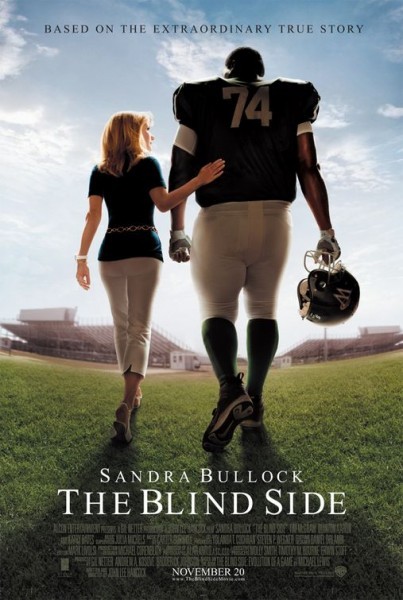
As a rule, I do not go to a theater to see a sports movie. Still have not seen Glory Road or We Are Marshall and I’m sure I did not see Remember the Titans until it was sitting on the shelf at Blockbuster. So, even though I thought the new Sandra Bullock film, The Blind Side, looked promising I was willing to wait. Thankfully, my daughter, aged 13 and no fan of football, was not. (Though when it opened with some drone and the unknowns really screwing up a cover of Nick Drake’s, “The Cello Song,” I got antsy.)

Having opened November 20, The Blind Side has already grossed nearly $150M in telling the story of Baltimore Ravens left tackle, Michael Oher (pronounced “oar,” Quinton Aaron), a former homeless high school kid from the projects of Memphis, who is brought into a family of a rich white people, the Tuohys (pronounced, “Two-ee”) and given a home. If that were the extent of this movie, then it would have easily and inevitably veered off into a sappy, Hallmark Channel vehicle, capturing only the attention of some bored kids on Saturday afternoon. But this is not a movie about white guilt or Republican racial angst. In the end, it’s a movie about the gospel.

The movie begins with a dozen or so replays of the Monday Night Football Lawrence Taylor hit on Joe Theismann that shattered the leg of and ended the career of the latter. This wince inducing video (I did not watch the replays then and I do not watch them now) is necessary to explain why Oher’s eventual football position, left tackle on the offensive line, is so important: it protects the quarterback’s blind side. Thus, the movie reasons, since the quarterback is generally the highest payed player on the team, the left tackle is the second most important player on the team.

We are quickly introduced to “Big Mike” as a hulking, but gentle presence whose worldly belongings are a light blue golf shirt, a pair of shorts and some old high top sneakers. His other shirt is kept in a grocery bag. He “borrows” dryer time at a local laundromat after washing his shirt in the sink for free. In another scene Big Mike is seen picking up leftover popcorn after the school volleyball game. He’s been away from his crack addicted mother since he cannot remember how old and ran away from every foster home he had ever called home. His case worker calls him “a runner.”

Bullock as Leigh Anne Tuohy in 'The Blind Side'  Image: Alcon Entertainment

Bullock as Leigh Anne Tuohy in 'The Blind Side' Image: Alcon Entertainment

The only person in the Tuohy family who knows anything about Big Mike is the pre-teen son, SJ (played with regular hilarity by Jae Head), but on their way home one cold, rainy night the family happens upon Oher walking down the road on his way to the school gym, planning to stay the night because “it’s warm there,” and, after a brief road-side interview, Leigh Anne Tuohy (Bullock) decides to bring him home for the night. This decision, while generous, is not portrayed as necessarily righteous. She puts some sheets and blankets on the couch for their guest, then heads downstairs in the morning with some expectation that, like an inner city Jean Valjean, Oher had stolen away carrying the silverware in his grocery bag.

Interestingly, nearly the entire first half of the movie is devoted to telling the story of the relationship between the Tuohy’s and Oher: Thanksgiving dinner shared around the table instead of in front of the TV, being the only black kid in an all white Christian school (“the fly in the milk” as he is called at one point) while dealing with both his social and learning struggles. When the football portion of the movie comes to the fore, it does so well-the relationship story is not jettisoned for a bunch of hitting and grunting. On the contrary it works to strengthen it. (I will say that many of the real life coaches, Nick Saban especially, are woefully stiff on camera making Mark Richt’s turn in Facing the Giants seem downright Oscar worthy.)

It’s as Leigh Anne is drawn into Michael’s life, trying to peel back the layers of the onion that the movie becomes a picture of the gospel. She’s simply unwilling to be a bystander on the edge of his life. She drives him to the projects where he grew up in a vain attempt to find his mother, then endeavors to find her without him at another time. The end of that encounter says more without words than many scenes say with pages of dialogue. Instead of cutting to another scene when it would be easy, the director stays with it allowing it to reach a poignant climax.

The ministry of the gospel is so real in this movie that it does not depend on it being preached. It truly is an effort at Assisi’s, “Preach the gospel at all times and, when necessary, use words.” This is not a story specifically aimed at the death, burial and resurrection of Christ, but whether the results of those momentous events can be lived out and how. In those words of Jesus that we love to proclaim, yet are usually loath to live, “For I was hungry and you gave Me food; I was thirsty and you gave Me drink; I was a stranger and you took me in; I was naked and you clothed me” (Matthew 25:35, 36).

When we exited the theater, Abigail and I were discussing the movie itself, that this is what a “Christian movie” should be, people in all their flaws. This is not the silly, shallow “the wind stops blowing so my kid can make a field goal” type of spirituality of Facing the Giants where “God’s in control” and everything works out in the end. While Oher is rescued and makes the NFL in real life (a fact saved almost until the credits), that revelation is preceded immediately by vivid reminders that many do not make it out of violent, gang related lives. It is the triumph and the challenge. The Tuohy’s both swear; not incessantly, but some. Leigh Anne wears skirts so tight you wonder how she gets any circulation in her butt. These are realities that make some Christians very uncomfortable, but it’s where people are–even believers. People are a mess–even believers. But, as Tuohy notes, reaching out to Michael changed her. Her family and Oher are alternately being the presence of Jesus and receiving His presence, which, I think, is why Jesus said, “Give expecting nothing in return.” It is not in the changing of another person that we are changed, it is in being like Christ that we are changed.

The Blind Side, by Alcon Entertainment, stars Sandra Bullock, Tim McGraw, Quinton Aaron, Jae Head, Lilly Collins, Kathy Bates, and Ray McKinion. It is rated PG-13 for one scene involving brief violence, drug and sexual references.