Since the opening of Les Miserables on Christmas day, I have read no shortage of reviews from the professional critic and lay person alike. People on social media have talked about weeping and wailing, taking boxes of tissue, it being the best movie they have ever seen and the like. Viewers and reviewers seem to fall into one of these categories: 1) those who are admitted fans who think the movie version is the greatest thing ever filmed, 2) those who are admitted fans who think it was ok, but well short of the greatest thing ever filmed, 3) those who are not fans and did not care for it, and 4) those who are not fans and really do not get it.
If you are in the first three groups well and good. In this post I want to address the fourth group because I have sympathy for them. I’m guessing it would be like coming into the 14th episode of the fifth season of Lost or any episode of Dr. Who. Here is a summary that might help if you are unfamiliar with Les Miserables but intend to see the movie.
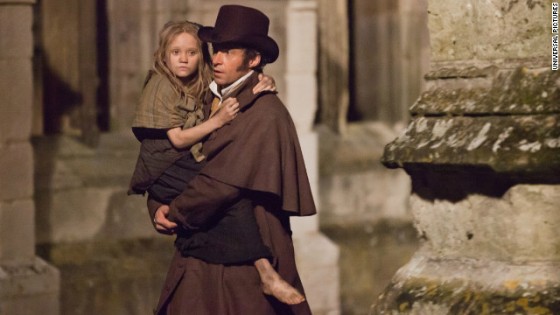
Cosette (Isabelle Allen) and Jean Valjean (Hugh Jackman) in the 2012 movie musical Les Miserables
First, the movie is based on the book of the same name. Les Miserables was written by a Frenchman named Victor Hugo who apparently did not have anything else to do other than write for a long, long time, as the book is a million pages long. Several Parisian forests were leveled for its first printing. The story begins after the French Revolution and culminates with the 1832 June Rebellion, neither of which means anything to most Americans. One might as well say the action began during the first phase of the moon and ended during the penguin mating season. Same interest level, same knowledge level.
It is estimated that only five people have ever read Les Mis in its entirety. It is the literary equivalent of a Claxton fruitcake. One of the five is Trevin Wax. Two of the others are Alain Boubill and Claude-Michel Schonberg. Or, maybe one of them read it and summarized it for the other.
Regardless, these two had the idea that a story about an escaped convict, a dogged police officer, a bunch of hookers, street people, an orphan, a love-triangle and French social unrest–all based on a million page novel–would make a bang-up musical.
Against all odds they were right. Les Miserables has truly become a worldwide phenomenon. The musical, as well as the current movie, are “sung-through” meaning that the entirety of the dialogue, save a hundred words or so, are rendered in song. The story is related in sweeping anthems, solos, duets, trios and heart breaking soliloquies.
Contains spoilers
Les Mis centers around a man named Jean Valjean. (For all you Duck Dynasty fans it is not “Gene Valgene.” It is pronounced something like “zhan valzhan.”) He is serving a 19 year prison sentence for stealing a loaf of bread in an attempt to feed his starving relatives. Police inspector Javert dutifully reminds Valjean he was sentenced to five years for stealing the bread and 14 years for trying to escape.
What a relief.
At the end of the 19 years he is issued a “yellow-ticket of leave,” which is basically a parole card. After a futile attempt to find work, Valjean takes refuge in the home of a priest whom he promptly relieves of the church’s silver place settings. The priest forgives Valjean and claims him for God. After a heartfelt soul searching, a contrite Valjean repents and vows to be a changed man.
The problem is Valjean feels himself so changed that he is no longer Jean Valjean and will begin a new life, complete with running away from his parole and parole office, Javert. Javert does not overlook such an act, nor believe such a conversion.
Years later we find Valjean, using the assumed name Monsieur Madeleine, in another town, a successful business man who is currently mayor. He has found wealth and success in the days of social upheaval, a time not unlike Dickens’ A Tale of Two Cities or A Christmas Carol. Owing to bad timing and a misunderstanding a factory woman, Fantine–an employee of Valjean’s–is fired and due to the failed economy must turn to prostitution to support her daughter.
Valjean later realizes what has happened and tries to make amends, but Fantine has become ill and will not escape death. Out of a sense of guilt and responsibility he promises to find her daughter, Cosette, and raise her as his own. This he does after paying off the French innkeeper and his wife, the Thenardiers, two wretched people so crooked they probably had to be screwed into their caskets. These are they to whom Fantine had naively entrusted the welfare of Cosette.
Valjean returns to Paris (I think) to raise Cosette in anonymity. Years later they find themselves caught up in the June Rebellion (apparently these things were monthly) when a student rebel named Marius spies Cosette, finds out where she lives and pursues a forbidden relationship–forbidden by Valjean who does not trust anyone else to protect her.
A would-be love triangle is formed between Marius, Cosette and Eponine the daughter of the Thenardiers who is the same age as Cosette, now a young adult. Eponine’s love for Marius is unrequited as he sees her, basically, as one of the guys. Nonetheless her love is real and is demonstrated as she rescues Cosette from a band of robbers led by the former innkeeper, Msr. Thenardier, and rescues Marius twice. The second time is at a barricade when Eponine takes a bullet intended for Marius.
When the French army finally breaks through the barricade all of the student revolutionaries are killed with the exception of Marius. Vajean, who has joined the students, steals away the unconscious Marius and carries him through the vile sewers of Paris to freedom. Later, after recovering from his wounds, Marius returns to the cafe where the revolution had been planned. There he sings a song of remembrance that is powerful and touching.
The movie draws to a close with Valjean in old age near death. Marius and Cosette, who have just married, track him down in hiding in time to see him a final time. He joins Fantine in heaven, along with, it would seem, everyone who fought with the students in the revolt. Or opposed the king. Or drank an espresso.
The eschatology is a little sketchy, okay?
Maybe some of you are wondering, “You’ve got to be kidding me. People who have already seen this in live musical theater are shelling out more bucks to see a movie musical two hours and 40 minutes long??” Indeed. And many will more than once.
Here’s why: The music, almost to a song, is exceptional. Lyrically intelligent, insightful and melodic. People can and do sing these songs and listen to them over and over.
The story, though filled with enough characters to give the casting director a 9 month migraine, has powerful, clear themes. Mercy, redemption, justice, law, revenge, love, sacrifice. Seriously, we may not always want to give mercy but who among us does not want to receive it? Do we not admire those who give their lives for others? The New Testament in the Bible says there is no greater sign of love. A clearer picture of grace is not to be found.
Unlike many stories, the themes are not merely present they are embodied. Valjean is the embodiment of the mercy and grace of God. It so affects his life that it ultimately affects all of those around him. Javert is the embodiment of legalism, the idea that you can earn your way into God’s grace. As it does with us, it leads him to ultimate frustration as he can neither forgive Valjean nor accept God’s forgiveness. (His role is substantial and recurring, though I barely mentioned him above.) The Thenardiers are the embodiment of wickedness. There is nothing honest nor admirable about them. The songs of which they are a part are bawdy and ribald. Fantine is the embodiment of the person who receives the worst of life. She is the recipient of judgment on sins she did not commit. Her life is the one where people ask, “Where was God for her?” She asks the same question. Marius and Cosette are the embodiment of love. Eponine is the embodiment of one who give all for nothing in return. The revolutionary students, though not claiming a biblical mandate, are the embodiment of those who would seek justice in an unjust world.
The themes are universal and undeniably Christian.
As for the movie itself, I thought it incredibly powerful. Parts are hard to watch (Fantine’s descent into prostitution set to the garish faces of another bawdy song, “Lovely Ladies,” for example), but are reminders of the hell on earth people live through each and every day. And that in real life.
If you are wondering about taking children, I would not take children under middle school. There are a few gutter scenes you might want them to avoid. And, I’ll never look at Santa Claus the same way again.