Tag Archives: Social Media

What is the big deal about Pinterest?

Over the last year the social media site Pinterest has grown at an exponential rate. The site has more recipes, home decor, home remodeling, and how-to’s than Ted Turner has bison patties. Since its inception it has consumed more women’s time than Anonymous has spent hacking government databases.

Users of Pinterest “pin” web pages links on “boards.” These boards can be themed to most any interest. “Following” others on Pinterest allows you to see what they pin to their board. If you like a particular item on another person’s board, you can “repin” it to your board. Influence on Pinterest is measured by the number of followers and numbers of repins.

For many, many years Sonya (my wife) crammed recipes into notebooks. Reading through various magazines inevitably led to pages ripped out and put into binders. Those were the “one day I’m doing this in our house” binders.

Recently I realized, for her, Pinterest is a visual, organized, readily accessible, virtual binder. The pages that once filled our laundry room are still there, but few have been added since she joined Pinterest.

But that was not the most unusual thing. Last week Sonya told me if Pinterest began charging she would pay to keep her account. If you know anything at all about social media you know that “how shall we monetize” is the billion dollar question. ($64,000 was just way too cheap.) Facebook users threaten armed revolt every time the idea makes the rounds. Twitter has banner ads and “sponsored” tweets. That is just a polite way of saying someone I do not follow paid to force themselves onto my feed.
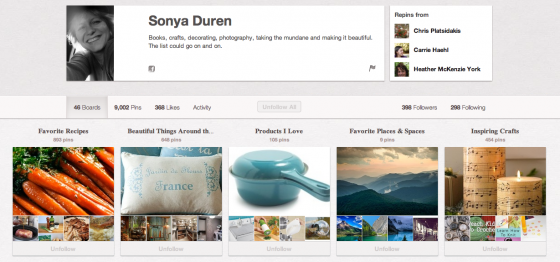
pinterest screenshot

Click to see Sonya’s Pinterest pinboard. She recently passed 9,000 pins and nearly 400 followers.


So the idea of someone who would willingly and unhesitatingly pay to use a particular social media really caught my attention.

I had already begun to think through how Pinterest is different from other types of social media. I have settled on this for one primary difference: Pinterest serves as a repository of information people access again and again. It’s combination virtual bulletin board, notebook and file cabinet all in one online stop. As my wife said, “I don’t want to lose all of that; I’ve worked too hard to get it together.”

If that is the case with a large percentage of users, Pinterest may find a way to become profitable where other social media have not been successful, or have feared to try.

If you are on Pinterest, please leave me a comment stating why you are drawn to it. If you are a “power user,” would you pay to keep all the pins you have? Do you have a board for blog posts?

Take a second to pass this post along to friends who love Pinterest and ask them to leave an answer.
Eight reasons you should start or restart a blog in 2013

Circa 2006 blogging was all the rage. You could head over to Blogger.com, Typepad.com or WordPress.com, sign up and join in the burgeoning movement. Books were already being written about this new version of the printing press. “Official” news sources worried over losing readership to blogs. Real news stories–not just opinion pieces and rants–were regularly broken by bloggers.


A blog, initially an abbreviated form of “web-log,” is a website that allows for interaction, rather than a one-way broadcast of information. Interaction takes place in the comment thread, where, hopefully, additional information is shared. As it tend to happen, depending on the size of the readership, the content of the post is addressed for about three comments. After three comments the comments tend to run off the rails until, invariably, someone brings up Hitler or the Nazis. (See Godwin’s Law.) A good blog owner is also a good moderator, keeping out the trolls and keeping the conversation on topic.

Eventually mainstream media outlets threw in their respective towels and joined the fun. Many major news organizations now have a blog section to their main websites. CNN and the Washington Post are two featuring multiple blogs.

With the advent of Facebook and Twitter blogs and blogging seemed to take a lesser role in the social media space. The ease of connecting with so many friends and family (Facebook) and the brevity of microblogging (Twitter) caused many to lose interest in the longer form writing of the blog. Or maybe it was just a bum-rush to the new trend.

After this interlude blogging is making somewhat of a comeback. I’ve seen a number of new blogs started in the last few months by my friends, while others are resurrecting dormant blogs with new material.

If you do not have a blog, should you start one? If you have a dead blog should you breath into it the breath of life in 2013? I think the answer to both questions is an unequivocal “yes” and here are eight reasons why:

1. Blogs are searchable. For all the fun and benefit of other social media, nothing is more searchable than blog content. When using a search engine like Bing or Google to find content, you will notice that Tweets and Facebook status updates do not lead the way. Blogs and websites do. This means your blogged thoughts will be searchable to people all over the world

2. Blogs allow for fuller development of ideas. As much as I love tweeting there is a limit to how much one can develop and express a distinct philosophy of government or religious belief in 140 characters. Even if you choose the terrible multi-tweet method (1/6, 2/6, etc) the fulness of a blog post cannot be captured.

3. Thought leaders depend on blogs for idea sharing. Seth Godin, Thom Rainer, John Maxwell, Tom Peters, and Mary Jo Asmus are not feeding the flock, as it were, on Facebook. While some will give pithy saying in other social media, their blogs are where ideas are shared in full.

4. Blogging hones the craft of writing. A goal of 2-3 posts per week forces you to give thought and effort to writing. The more you write, the better you tend to get. (Especially if you ask for feedback.)

5. Blogging helps release your creative side. Through this practice I have uncovered a desire to be a better, more creative writer. I am not looking to conquer the world of science fiction or fantasy, but I do want better turns of phrase. I want to be more precise, to be more descriptive. I want my writing to be memorable. I doubt I would ever have written a book had I not blogged first.

6. Connection with people of like interests. “Mommy bloggers,” “Foodies” and political junkies are examples of this. Blogging allows you to connect with other people who have the same interests as you.

7. To make money. Most bloggers do not make money. Many will make less than $100 during the entire life of their blog. If you intend to blog for money, be prepared to put in many, many hours of content creation and link building. Only a few make it to the rarified air of living from blog advertising, but that does not mean you cannot! Google offers advertising based on ad clicks. Beacon Ads pairs websites with advertisers who pay a flat rate based on traffic. Commission Junction represents many, many advertisers. Amazon.com has a fantastic affiliate program.

8. Educating yourself and others. Blogging provides the opportunity to learn. If you write about news related topics–whether firsthand reporting or opinion–you will need to study, gather facts, double check information, write, and, sometimes, provide corrections. Information you post will be learned by others. It can be a great process.

The books below will be helpful if you are interested in more information. You will get the same low Amazon.com price and I get a small commission.