Category Archives: Blog

Newsnippets, January 12, 2013

Newsnippets, January 12, 2013
newspaper newsnippets articles

From Women Under Siege Syria: Member of opposition group confesses to rape on state TV

Syria Online TV, a state-owned news source, posted a video to YouTube on December 10, 2012, that features a confession of rape from a member of an opposition group referred to as “Abdulhadi’s gang.” The speaker is introduced as Mahmoud al-Akkari, born in 1978 in Talbiseh, a suburb of Homs. He says that he, Abdulhadi al-Akkari—to whom his relationship is not specified—and Sheikh Zakariyya al-Dakka agreed to join ongoing Talbiseh protests. He then proceeds to describe the range of crimes he and “Abdulhadi’s gang” allegedly committed, including the kidnapping of “five girls from different neighborhoods.” He goes on to say that the group “took them to the farm, where they raped and murdered them.” He does not specify where this farm is located.

From Slate: Mr. Schmidt goes to Pyongyang

On Monday, Google Chairman Eric Schmidt arrived in North Korea, a country that is almost completely cut off from the Internet. Schmidt, who is traveling with former New Mexico Gov. Bill Richardson, is part of what has been termed a private humanitarian mission. The State Department has nonetheless expressed dissatisfaction, saying that the timing of the visit is not “particularly helpful.”

[…]

But if the timing is bad for traditional diplomacy, then what about digital diplomacy? Digital diplomacy entails leveraging new connection technologies to shape international relations. The beauty of this concept is that it doesn’t have to be strictly between one government and another. It can be conducted by technology companies, NGOs, or even ordinary citizens. A visit to North Korea by the chairman of Google, even in his “private” capacity, seems to fall into this category. The trip might even indirectly further one of the State Department’s key goals, which is to promote the “freedom to connect.”

From The Guardian: U.S. attacks counter productive, former Obama security advisor claims

In his study, Boyle said Obama pledged to end the “war on terror” and to restore respect for the rule of law in US counter-terrorism policies.”Instead, he has been just as ruthless and indifferent to the rule of law as his predecessor … while President Bush issued a call to arms to defend ‘civilisation’ against the threat of terrorism, President Obama has waged his war on terror in the shadows, using drone strikes, special operations and sophisticated surveillance to fight a brutal covert war against al-Qaida and other Islamist networks.”

Boyle, who teaches at La Salle University, Philadelphia, said the government claim that drones were an effective tool that minimised civilian casualties was “based on a highly selective and partial reading of the evidence”.

He argues one of the reasons why the US has been “so successful in spinning the number of civilian casualties” is that it has reportedly adopted a controversial method for counting them: all military-age men in a strike zone are classed as militants unless clear evidence emerges to the contrary.

From the Japan Times: U.S. imagination goes wild regarding Iranian ‘threat’

When compounded with the other imagined threats of Hezbollah and Hamas, all with sinister agendas, then the time is right for Americans to return to their homes, bolt their doors and squat in shelters awaiting further instructions, for evidently, “The Iranians are coming.”

It is as comical as it is untrue. But “The Countering Iran in the Western Hemisphere Act,” which as of Dec. 28 is an official U.S. law, is not meant to be amusing. It is riddled with half-truths, but mostly complete and utter lies.

From the BBC: French forces continue to launch air strikes against Islamist militants in Mali

[Jean-Yves Le Drian, French Defense] minister said Paris had decided to act urgently to stop the Islamist offensive, which threatened to create “a terrorist state at the doorstep of France and Europe”.

He also revealed that a French pilot was killed in Friday’s fighting – during an air raid to support Mali’s ground troops in the battle for Konna.

“During this intense combat, one of our pilots… was fatally wounded,” the minister said.

Speaking on Friday, French President Francois Hollande said the intervention complied with international law and had been agreed with Malian interim President Dioncounda Traore.

It would last “as long as necessary”, Mr Hollande said.

From CNN Asia: Study finds the world wastes half its food

Up to half of the world’s food is wasted, according to a new report that found production inefficiencies in developing countries and market and consumer waste in more advanced societies.

The British-based independent Institution of Mechanical Engineerssaid about 4.4 billion tons of food is produced annually and roughly half of it is never eaten.

Some of it is lost to inefficient harvesting, storage and transportation, while the rest is wasted by markets or consumers. The group also said food waste also impacts land, energy and water use.

“This level of wastage is a tragedy that cannot continue if we are to succeed in the challenge of sustainably meeting our future food demands,” the group said in its report.

From Popehat: All you ever wanted to know about the “trillion dollar coin”

As keen observers of the national conversation know, deep thinkers have floated the idea of minting a trillion dollar coin for deposit into the United States treasury to cure the nation’s deficit. This bold plan, endorsed by luminaries including New York Congressman Jerrold Nadler, Nobel laureate economist Paul Krugman, and Kai Ryssdal, host of public radio’s award-winning Marketplace program, has the potential to solve America’s fiscal crisis overnight, with no partisan bickering and no repercussions for world currency markets.

But can the coin (or sixteen of the coins, to be precise) be struck?

For the answer to this question, we turned to legal, numismatic, and political experts. Their answers were discouraging.

From The Edge of the Inside: Thoughts from the Brent Musburger/Kathleen Webb discussion

When Christians claim human beings are made in the Image of God, then it stands that to consider the identity of one human as derivative through another is objectification at best, and idolatry at worst. The philosophical turn that suggests we shift the subject helps us open up the possibilities that are other people. Or, when we work to recognize the other, other persons as human subjects, we open up the possibility of both deeper and challenging relationships. If I cannot, or will not, objectify you then I must be ready for you. And that means I must be ready to get outside of my expectations bound up in my former objectification of you as a human being and realize there might be something for me to learn, experience, and grow from rather than use our relationship built on the object I made of you.

From the Washington Times: No assault weapon ban coming, NRA confidently predicts

One day after gun ownership groups met with Vice President Joseph R. Biden as part of his ongoing talks on gun violence prevention, the president of the National Rifle Association predicted that Congress will not pass a ban on military-style, so-called “assault weapons” in the wake of the school shootings last month in Newtown, Conn.
“I do not think that there’s going to be a ban on so-called assault weapons passed by the Congress,” David Keene said Friday on NBC’s “Today” show.

Why and how to verify Google authorship

For more than a year Google has been working toward an initiative to begin attributing content to the original authors. This is a very beneficial step to assist content producers. It seems to me to be a protection against the practice of “scraping” in which the contents of a post are lifted from the base html and reposted on another site.

As Brian Clark at Copyblogger.com has noticed about Google authorship:

Google made talented writers more important with the Panda and Penguin updates. Instead of weak content and “unnatural” link building, now sites need strong content that attracts links organically.
But it hasn’t stopped there. Now who creates the content, and who does the linking out matters – which is why Google wants to know who you are via your Google+ authorship profile. What’s been dubbed Author Rank has the potential to be the biggest algorithmic signal for SEO since the hyperlink itself.

The days of lame anonymous content are over. Even better, rock star writers with demonstrated success and strong social followings will command the highest compensation and equity positions.

Think about that.

Here’s how Google itself describes the benefit:

The name of the writer can be used to influence the ranking of web search results by indicating the writer responsible for a particular content piece … Assuming that a given writer has a high reputational score, representing an established reputation for authoring valuable content, then additional content authored and signed by that writer will be promoted relative to unsigned content or content from less reputable writers in search results.

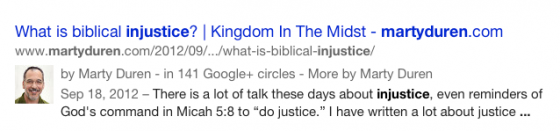
Google Authorship is linked to your Google+ profile and verifies you and the author of content you produce. Your G+ profile appears in some search results. See the screenshot below for an example.

Google author Marty Duren

The word on the street is Google authorship will be combined with Google’s Page Rank as a means of better reporting search results. This is important for blog owners and contributing writers to collaborative websites. When you are searched by name or name and a topic (“I can’t remember the website, but the guy was something “Duren” and the article was about social justice.”) verified authorship can help in that kind of search.

Also, as you gain influence on certain subjects, you will rise in search results on those subjects.

So, how does one become a verified Google author? Here are two ways, one of which is very simple. The second requires more effort but worked better for me.

First, you must have a Google+ account. This is a closed eco-system, so a Facebook account alone will not work with it. Make sure you have a headshot as your photo, not a mountain range or a picture of Foghorn Leghorn.

With a G+ account you should be able to verify authorship by using your email address. Go to plus.google.com/authorship and follow the directions. You will receive an email from Google. Click on the included link and verification should take place.

Please note: You must have an email that matches the top level domain of your website. In other words, if your website is ireallylikegoogleplus.com you must have an email on that domain like mail@ireallylikegoogleplus.com or jedimaster@ireallylikegoogleplus.com. A Yahoo or Hotmail address will not suffice. (Gmail used in conjunction with a POP3 mail account worked for me.)

One thing of note: I tried the email registration method a week ago and received a response email from Google. Subsequently my Google+ account indicated the email was verified. However, I never received any indication from Google that authorship had been verified. When I used the step below my Google Authorship status was verified in a matter of hours.

The graphic below is a screen grab from this page. Follow the directions step-by-step. The link on step on was place on the “About” page of my blog. I chose to use “Google+” as the hyperlink word rather than “Google.”

Google author

After completing this process you should receive an email confirmation from Google. It took several hours for me to receive the email. (If you need further information, this article by Rick DeJarnette breaks the process down even more.)

I would suggest additionally to add to your G+ profile any other social media accounts that use the same name you are attempting to register with Google Authorship. I registered my Twitter, Facebook, LinkedIn, Flickr and Myspace accounts.

What are your thoughts on Google authorship? How did the registration attempt work for you? Anyone become a verified author using only the email confirmation method?

Touch not God’s anointed?

December brought another frustrating, heartbreaking story of a multiple pastors guilty of sexual sins ranging from adultery to child molestation to rape. The influence of two successive pastors at one church were the focal point of a lengthy essay in Chicago Magazine. Entitled, “Let Us Prey: Big Trouble at First Baptist Church,” writer Bryan Smith chronicles both accusations and admissions of Jack Hyles and Jack Schaap, both former pastors at the storied and fabled First Baptist Church of Hammond, Indiana.


The Chicago Magazine expose reveals a cult-like organization in which members are never to question the pastor, allowing for the most offensive and egregious actions to be swept under the rug. Or, equally as bad, allows them to be propagated for years. Writes Smith:

[Former pastor, Jack] Schaap is not simply one of those rogue evangelists who thunders against the evils of forbidden sex while indulging in it himself. According to dozens of current and former church members, religion experts, and historians interviewed by Chicago—plus a review of thousands of pages of court documents—he is part of what some call a deeply embedded culture of misogyny and sexual and physical abuse at one of the nation’s largest churches. Multiple websites tracking the First Baptist Church of Hammond have identified more than a dozen men with ties to the church—many of whom graduated from its college, Hyles-Anderson, or its annual Pastors’ Schools—who fanned out around the country, preaching at their own churches and racking up a string of arrests and civil lawsuits, including physical abuse of minors, sexual molestation, and rape.

The article also recounts some of the extreme teachings of the leadership, in particular the immensely influential former pastor Jack Hyles.

Virtually no one would marry without Hyles’s blessing, several former church members say. He soon took it upon himself to arrange marriages. According to Kaifetz, “When a guy like Hyles says, ‘This is God’s will for your life,’ you just say, ‘Well, I guess it is.’ ”

One area in which Hyles—a father of four—exerted particular control was child rearing. In this, his views were severe unto merciless. Using biblical passages as justification, Hyles preached that spanking was more than tolerable; it was a sacred duty. In his 1979 book How to Rear Infants, he wrote: “The parent who spanks his child keeps him from going to hell.”

Spanking “should be deliberate and last at least ten or fifteen minutes,” he continued. The blows “should be painful and should last . . . until the child is crying, not tears of anger but tears of a broken will.” They should “leave stripes” if need be. The age at which such punishment should begin? Infancy.

Several people who grew up at First Baptist recall that parents took the instruction to heart. “Beatings would last endlessly, it seemed,” says Mary Jo McGuire, 45, a corporate trainer in Colorado whose father was a deacon in the church. As a seven-year-old, she “used to count the lashes as a way to cope through the searing pain.” McGuire’s younger sister, Sherri Munger, told me she once received more than 300 lashes from a thick leather belt. When authorities were called, McGuire says, Hyles told the girls’ parents how to avoid arrest.

“What was going on [at First Baptist] was kind of like a process of hollowing out the followers and repopulating them with yourself,” says Schaap’s former editor. “[Hyles] took your voice, he took your beliefs, he took your likes and dislikes and opinions, and he gave you his own. But in the process of hollowing you out, he made you very weak.”

In her first one-on-one interview about the church, Hyles’s middle daughter, Linda Murphrey, a motivational speaker and coach in Southern California, remembers his followers as “zombies” who were “willing to believe and obey whatever he said.”

Some of my earliest memories of church harken to the influence of Jack Hyles and others in the “Independent Baptist” church movement. Sometime in my late elementary school years our church, under the leadership of a new, dynamic pastor, left our denomination and became independent. Hyles was among the most influential leaders of that movement. FBC Hammond was synonymous with the movement and Hyles with its theology. We heard a steady diet of short-hair and long skirts. Sometime after our family left they actually installed a sign forbidding any woman from entering the buildings if she was wearing pants.

On of the unmistakeable tenets of the Independent Baptist theology was that of extreme pastoral authority. This was taught as “touch not God’s anointed,” based on a verse from the Old Testament (Psalm 105:15). Pastors, we learned, if not explicitly then implicitly, were awaiting a vacancy in the Trinity.

It is with great sorrow I note how the abuse of this scripture has led to the kind of sinfulness recorded above. Unless your pastor is currently the king of Israel, that verse–indeed, that concept–does not apply. And if he is the king of Israel, he’d better be Jesus Christ.

The idea of “touch not God’s anointed” has been wielded like a light saber by many a pastor both in sinful power grabbing and in honest efforts to live according to God’s plan for His church. The Bible does teach us to learn from–even submit to–those in spiritual authority (Hebrews 13:7 & 17), but warns those leaders as well (1 Peter 5). The New Testament qualifications placed on church leadership are designed to prevent the very abuses we see all to often.

There are a few things that should send up all kinds of red flags should you see them in the pastor of your church:

1. Any claim to divine power or authority. Contrary to the “Lord’s anointed” teaching and those scary dying deacon stories the traveling evangelist told you, pastors are people, too. This is not to say we should disrespect them; we should not. Even when they do and stay dumb things. It does mean, however, that they are not God-like. The New Testament does not speak of church leaders in the same way David talked about king Saul. Pastors fill a divinely established office, but they are not divine, inerrant or infallible.

2. An insistence on unquestioning support. While some pastors act as if high school boys need more accountability than anyone else, the truth is pastors need as much accountability as anyone. Pastors need more than one person who will ask them hard questions, force them to rest, ensure they are spending enough time with their spouse, and that their own time in prayer and the Word is not suffering. Any pastor who demands or expects unflinching support has replaced God with his own ego, and is leading himself and the church down a destructive path. Such a demand often arises from his own irrational fears or sinful desires but, rather than doing the painful work of humble self-examination efforts are made to squelch any questions.

3. Excusing sin at the leadership level. In these church there is almost an obvious and ongoing double standard between the top pastor, the other leaders and the rest of the people. Those comprising the “inner circle” are often beyond criticism, having any transgression short of murder swept over the rug. This behavior has been seen in other places besides FBC Hammond.

4. Preaching the same things over and over. Preaching the whole counsel of God takes a lot of work. Avoiding the comfortable ruts of routine comes from immersing one’s heart and mind in the Word of God. Pastors who refuse accountability will soon find themselves preaching what they know. It’s all they can do. When pastors do not study, they do not learn, they are not changed. They have nothing to give. The same jokes, stories, verses and “hobby-horses” are signs of an inner breakdown.

5. A seeming obsession with a single subject matter. The Bible instructs us, “Out of the abundance of the heart the mouth speaks.” A video of Jack Schaap simulating masturbation during a youth sermons can be found online. It is so graphic even the Chicago Magazine writer was nonplussed about it. When a “man of God” refuses correction from those around him, he has already refused correction from God’s word. At that point the mind overflows with garbage. It might be sex, materialism or power, but that which is inhabiting the pastor’s heart will make its way out.

Perhaps, rather than looking for verses like “touch not God’s anointed,” pastors should look at verses addressed to their Old Testament counterparts. Today’s pastors are not equivalent to the kings of Israel. They would more likely be related to the priests as those tasked with spiritual oversight. Why are verses like Jeremiah 2:8 not referenced by more pastors:

The priests did not say, ‘Where is the LORD?’ And those who handle the law did not know Me; The rulers also transgressed against Me; The prophets prophesied by Baal, And walked afterthings that do not profit.

Or maybe Jeremiah 5:31:

The prophets prophesy falsely, And the priests rule by their ownpower; And My people love to have it so. But what will you do in the end?

(It’s worth noting the attitude of the people. They “love” their wayward prophets and priests.)

Jeremiah was not alone. Hear Ezekiel:

Her priests have violated My law and profaned My holy things; they have not distinguished between the holy and unholy, nor have they made known the difference between the unclean and the clean; and they have hidden their eyes from My Sabbaths, so that I am profaned among them.

Then this from Hosea (6:9):

As bands of robbers lie in wait for a man, So the company of priests murder on the way to Shechem; Surely they commit lewdness.

Now, I’m not saying there is a direct parallel from the New Testament pastor to the Old Testament priest or prophet. But, the roles do seem to be more closely related than that of pastor and king.

Those whose eyes are opened to the truth and attempt to leave spiritually abusive situation are often shamed and shunned. There is a biblical role for both, but it has nothing to do with power-hungry, sex-crazed pastors retaining manipulative control. If you are in one of these situations, then run with all of your might. All pastors do not exhibit cult-leaders like qualities, and all churches are not peopled by the blind and confused. For your own spiritual safety and maturity, find a church that reflects the life and teachings of Jesus, especially amongst its leadership.

Eight reasons you should start or restart a blog in 2013

Circa 2006 blogging was all the rage. You could head over to Blogger.com, Typepad.com or WordPress.com, sign up and join in the burgeoning movement. Books were already being written about this new version of the printing press. “Official” news sources worried over losing readership to blogs. Real news stories–not just opinion pieces and rants–were regularly broken by bloggers.


A blog, initially an abbreviated form of “web-log,” is a website that allows for interaction, rather than a one-way broadcast of information. Interaction takes place in the comment thread, where, hopefully, additional information is shared. As it tend to happen, depending on the size of the readership, the content of the post is addressed for about three comments. After three comments the comments tend to run off the rails until, invariably, someone brings up Hitler or the Nazis. (See Godwin’s Law.) A good blog owner is also a good moderator, keeping out the trolls and keeping the conversation on topic.

Eventually mainstream media outlets threw in their respective towels and joined the fun. Many major news organizations now have a blog section to their main websites. CNN and the Washington Post are two featuring multiple blogs.

With the advent of Facebook and Twitter blogs and blogging seemed to take a lesser role in the social media space. The ease of connecting with so many friends and family (Facebook) and the brevity of microblogging (Twitter) caused many to lose interest in the longer form writing of the blog. Or maybe it was just a bum-rush to the new trend.

After this interlude blogging is making somewhat of a comeback. I’ve seen a number of new blogs started in the last few months by my friends, while others are resurrecting dormant blogs with new material.

If you do not have a blog, should you start one? If you have a dead blog should you breath into it the breath of life in 2013? I think the answer to both questions is an unequivocal “yes” and here are eight reasons why:

1. Blogs are searchable. For all the fun and benefit of other social media, nothing is more searchable than blog content. When using a search engine like Bing or Google to find content, you will notice that Tweets and Facebook status updates do not lead the way. Blogs and websites do. This means your blogged thoughts will be searchable to people all over the world

2. Blogs allow for fuller development of ideas. As much as I love tweeting there is a limit to how much one can develop and express a distinct philosophy of government or religious belief in 140 characters. Even if you choose the terrible multi-tweet method (1/6, 2/6, etc) the fulness of a blog post cannot be captured.

3. Thought leaders depend on blogs for idea sharing. Seth Godin, Thom Rainer, John Maxwell, Tom Peters, and Mary Jo Asmus are not feeding the flock, as it were, on Facebook. While some will give pithy saying in other social media, their blogs are where ideas are shared in full.

4. Blogging hones the craft of writing. A goal of 2-3 posts per week forces you to give thought and effort to writing. The more you write, the better you tend to get. (Especially if you ask for feedback.)

5. Blogging helps release your creative side. Through this practice I have uncovered a desire to be a better, more creative writer. I am not looking to conquer the world of science fiction or fantasy, but I do want better turns of phrase. I want to be more precise, to be more descriptive. I want my writing to be memorable. I doubt I would ever have written a book had I not blogged first.

6. Connection with people of like interests. “Mommy bloggers,” “Foodies” and political junkies are examples of this. Blogging allows you to connect with other people who have the same interests as you.

7. To make money. Most bloggers do not make money. Many will make less than $100 during the entire life of their blog. If you intend to blog for money, be prepared to put in many, many hours of content creation and link building. Only a few make it to the rarified air of living from blog advertising, but that does not mean you cannot! Google offers advertising based on ad clicks. Beacon Ads pairs websites with advertisers who pay a flat rate based on traffic. Commission Junction represents many, many advertisers. Amazon.com has a fantastic affiliate program.

8. Educating yourself and others. Blogging provides the opportunity to learn. If you write about news related topics–whether firsthand reporting or opinion–you will need to study, gather facts, double check information, write, and, sometimes, provide corrections. Information you post will be learned by others. It can be a great process.

The books below will be helpful if you are interested in more information. You will get the same low Amazon.com price and I get a small commission.

Test post number 3

Everywhere you turn people are talking about social media. Whether Facebook, Twitter, Google +, Pinterest, Path or any of the others, these services are now foundational to the social landscape. Facebook claims over 1 billion users worldwide, while Twitter claims some 200 million. I read just today that Google +, which is sometimes scorned, claims more than 100 million unique users a month. Not too shabby.

A primary reason social media has taken of is the breadth of usability. Do you want to reconnect with old friends? You can. Create work relationships? You can. Report breaking news? You can. Let complete strangers have the recipe you tried for dinner (and your opinion of it)? You can. Build your business, run a sales campaign, complain about bad service, call out someone in front of God and everybody, compliment your spouse publicly, show photos of Junior’s first haircut?

Test, test, test.

All that and more.

Ultimately social media is about influence. What you write can influence the decision of one or many. Where you shop, your thoughts on the crab legs at your local restaurant, the traffic heading to the big game. Your comments on these sometimes mundane events may affect anyone or everyone who sees them.

With that in mind, here are a few books on the subject of social media. Most are in some way related to business, but even those refer to principles of influence that could benefit a casual blogger, for instance.

The title of each is a link to Amazon.com. All purchases help support this blog, though you pay the same low price.

Renegades Write the Rules: How the Digital Royalty Use Social Media to Innovate

If an earlier adopter or power user of social media exists than Amy Jo Martin, let them speak now. A former employee of the NBA’s Phoenix Suns, this self-proclaimed “renegade” is responsible for bringing Shaquille O’Neal, Dwayne “The Rock” Johnson, and UFC guy into the fold of social media users. This easy to read and understand book is filled with personal stories and helpful hints.

Platform: Get Noticed in a Noisy World

There are few if any CEOs who have the blogging inluence to match, much less surpass, that of former Thomas Nelson CEO, Michael Hyatt. This is the thought leaders’s blog that is read by other thought leaders. His book, Platform, made the NYT Bestseller List almost before it was released. It is a thorough manual for building an influential presence (platform) in a world filled with competing voices.

Socialnomics: How Social Media Transforms the Way We Live and Do Business

Now in its secon edition…

Return On Influence

I received this book free as a Klout perk. Schaefer uses Klout as an example of return on influence. Positing a thesis that social media is still too new to worry about return on investment, he offers ideas to help understand return on influence instead.

Optimize: How to Attract and Engage More Customers by Integrating SEO, Social Media, and Content Marketing

A huge name in social media and marketing is Lee Odden. In Optimize he shows how and why your social media, online content and search engine optimization can work together to increase you brand’s visibility and, ultimately, your bottom line.

PyroMarketing: The Four-Step Strategy to Ignite Customer Evangelists and Keep Them for Life

Recommended by my co-worker, John Cade, Pyromarketing looks at marketing efforts through the scientific filter of what makes and fuels fire.

Newsnippets, January 5, 2013 [VIDEO]

newspaper newsnippets articles

The real story of the Syrian civil war

We watched the TV, fascinated.

We had been in Maraa for days, waiting for a driver who would take us further into the interior of the country. Not a single government soldier had been seen in this small city north of Aleppo in quite a while. Not even the artillery cannons in Aleppo were capable of reaching the town. Someone called an acquaintance living near the cultural center, and learned that everything was quiet there too. And the multi-story apartment buildings? There aren’t any in Maraa.

The entire report, several minutes long and related in a breathless tone, was fiction. This time we ourselves were witnesses and knew the truth.

More Pakistani aid workers murdered

Six women and a man, working for a health and education charity, have been shot dead in a drive-by shooting after they left a community centre in northwest Pakistan, police say.

The victims of Tuesday’s attack were all Pakistanis attached to the community centre in a Swabi village.

2012 was not a good year for FOX News

In a discussion of the role of women in the military, Fox News contributor Liz Trotta expressed an opinion about new rules from the Pentagon that would permit women to serve closer to the front lines. Trotta’s take on this centered on the problems faced by servicewomen who are sexually assaulted by fellow soldiers whom she regards as whiners because they won’t shut up and accept the fact that if they work closely with men they should expect to be assaulted. And if that weren’t bad enough, Trotta went on to complain about the expensive military bureaucracy set up to “support women in the military who are now being raped too much.” I would really like to know precisely how much rape is acceptable before it crosses Trotta’s line. Is there any context in which she might have meant that that isn’t unfathomably repulsive?

Pope Benedict XVI condemns “unregulated capitalism” for contributing to world tension

The Pope also thanked the world’s peacemakers and said humanity had “an innate vocation for peace”

[…]

He deplored “hotbeds of tension and conflict caused by growing instances of inequality between rich and poor”.
Those “hotbeds” also grew out of “the prevalence of a selfish and individualistic mindset which also finds expression in an unregulated financial capitalism”, as well as “various forms of terrorism and crime”, he said.

Settlers leave illegal West Bank outpost ahead of eviction

The unauthorized West Bank outpost of Oz Tzion was nearly empty on Saturday night, after the 200 or so young people who came on Friday with the intention of stopping the community’s evacuation by the Israel Defense Forces left voluntarily.
The few permanent residents of the outpost still remain in the site situated between Jerusalem and Ramallah, near the Givat Assaf outpost. Its founder is Daniela Weiss, the former head of the Kedumim Local Council. It includes a few wooden structures, which the IDF says it will demolish at a time it sees fit.

Why mostly men protesting rape in India?

There are women out on the streets, some from India’s long-suppressed women’s movement, to fight for stronger rape laws and other legal protections. But those women risk being groped by fellow protesters or shouted down. And the men on these same streets seem to be operating just as much from a revenge instinct as from any desire for meaningful social, political and legal changes.

A plea to report violence-related statistics thoroughly and honestly from AmidsTheNoise

A review of “Les Miserables” for the non-fan

Since the opening of Les Miserables on Christmas day, I have read no shortage of reviews from the professional critic and lay person alike. People on social media have talked about weeping and wailing, taking boxes of tissue, it being the best movie they have ever seen and the like. Viewers and reviewers seem to fall into one of these categories: 1) those who are admitted fans who think the movie version is the greatest thing ever filmed, 2) those who are admitted fans who think it was ok, but well short of the greatest thing ever filmed, 3) those who are not fans and did not care for it, and 4) those who are not fans and really do not get it.

If you are in the first three groups well and good. In this post I want to address the fourth group because I have sympathy for them. I’m guessing it would be like coming into the 14th episode of the fifth season of Lost or any episode of Dr. Who. Here is a summary that might help if you are unfamiliar with Les Miserables but intend to see the movie.

Hugh Jackman Isabelle Allen

Cosette (Isabelle Allen) and Jean Valjean (Hugh Jackman) in the 2012 movie musical Les Miserables


First, the movie is based on the book of the same name. Les Miserables was written by a Frenchman named Victor Hugo who apparently did not have anything else to do other than write for a long, long time, as the book is a million pages long. Several Parisian forests were leveled for its first printing. The story begins after the French Revolution and culminates with the 1832 June Rebellion, neither of which means anything to most Americans. One might as well say the action began during the first phase of the moon and ended during the penguin mating season. Same interest level, same knowledge level.

It is estimated that only five people have ever read Les Mis in its entirety. It is the literary equivalent of a Claxton fruitcake. One of the five is Trevin Wax. Two of the others are Alain Boubill and Claude-Michel Schonberg. Or, maybe one of them read it and summarized it for the other.

Regardless, these two had the idea that a story about an escaped convict, a dogged police officer, a bunch of hookers, street people, an orphan, a love-triangle and French social unrest–all based on a million page novel–would make a bang-up musical.

Against all odds they were right. Les Miserables has truly become a worldwide phenomenon. The musical, as well as the current movie, are “sung-through” meaning that the entirety of the dialogue, save a hundred words or so, are rendered in song. The story is related in sweeping anthems, solos, duets, trios and heart breaking soliloquies.

Contains spoilers

Les Mis centers around a man named Jean Valjean. (For all you Duck Dynasty fans it is not “Gene Valgene.” It is pronounced something like “zhan valzhan.”) He is serving a 19 year prison sentence for stealing a loaf of bread in an attempt to feed his starving relatives. Police inspector Javert dutifully reminds Valjean he was sentenced to five years for stealing the bread and 14 years for trying to escape.

What a relief.

At the end of the 19 years he is issued a “yellow-ticket of leave,” which is basically a parole card. After a futile attempt to find work, Valjean takes refuge in the home of a priest whom he promptly relieves of the church’s silver place settings. The priest forgives Valjean and claims him for God. After a heartfelt soul searching, a contrite Valjean repents and vows to be a changed man.

The problem is Valjean feels himself so changed that he is no longer Jean Valjean and will begin a new life, complete with running away from his parole and parole office, Javert. Javert does not overlook such an act, nor believe such a conversion.

Years later we find Valjean, using the assumed name Monsieur Madeleine, in another town, a successful business man who is currently mayor. He has found wealth and success in the days of social upheaval, a time not unlike Dickens’ A Tale of Two Cities or A Christmas Carol. Owing to bad timing and a misunderstanding a factory woman, Fantine–an employee of Valjean’s–is fired and due to the failed economy must turn to prostitution to support her daughter.

Valjean later realizes what has happened and tries to make amends, but Fantine has become ill and will not escape death. Out of a sense of guilt and responsibility he promises to find her daughter, Cosette, and raise her as his own. This he does after paying off the French innkeeper and his wife, the Thenardiers, two wretched people so crooked they probably had to be screwed into their caskets. These are they to whom Fantine had naively entrusted the welfare of Cosette.

Valjean returns to Paris (I think) to raise Cosette in anonymity. Years later they find themselves caught up in the June Rebellion (apparently these things were monthly) when a student rebel named Marius spies Cosette, finds out where she lives and pursues a forbidden relationship–forbidden by Valjean who does not trust anyone else to protect her.

A would-be love triangle is formed between Marius, Cosette and Eponine the daughter of the Thenardiers who is the same age as Cosette, now a young adult. Eponine’s love for Marius is unrequited as he sees her, basically, as one of the guys. Nonetheless her love is real and is demonstrated as she rescues Cosette from a band of robbers led by the former innkeeper, Msr. Thenardier, and rescues Marius twice. The second time is at a barricade when Eponine takes a bullet intended for Marius.

When the French army finally breaks through the barricade all of the student revolutionaries are killed with the exception of Marius. Vajean, who has joined the students, steals away the unconscious Marius and carries him through the vile sewers of Paris to freedom. Later, after recovering from his wounds, Marius returns to the cafe where the revolution had been planned. There he sings a song of remembrance that is powerful and touching.

The movie draws to a close with Valjean in old age near death. Marius and Cosette, who have just married, track him down in hiding in time to see him a final time. He joins Fantine in heaven, along with, it would seem, everyone who fought with the students in the revolt. Or opposed the king. Or drank an espresso.

The eschatology is a little sketchy, okay?

Maybe some of you are wondering, “You’ve got to be kidding me. People who have already seen this in live musical theater are shelling out more bucks to see a movie musical two hours and 40 minutes long??” Indeed. And many will more than once.

Here’s why: The music, almost to a song, is exceptional. Lyrically intelligent, insightful and melodic. People can and do sing these songs and listen to them over and over.

The story, though filled with enough characters to give the casting director a 9 month migraine, has powerful, clear themes. Mercy, redemption, justice, law, revenge, love, sacrifice. Seriously, we may not always want to give mercy but who among us does not want to receive it? Do we not admire those who give their lives for others? The New Testament in the Bible says there is no greater sign of love. A clearer picture of grace is not to be found.

Unlike many stories, the themes are not merely present they are embodied. Valjean is the embodiment of the mercy and grace of God. It so affects his life that it ultimately affects all of those around him. Javert is the embodiment of legalism, the idea that you can earn your way into God’s grace. As it does with us, it leads him to ultimate frustration as he can neither forgive Valjean nor accept God’s forgiveness. (His role is substantial and recurring, though I barely mentioned him above.) The Thenardiers are the embodiment of wickedness. There is nothing honest nor admirable about them. The songs of which they are a part are bawdy and ribald. Fantine is the embodiment of the person who receives the worst of life. She is the recipient of judgment on sins she did not commit. Her life is the one where people ask, “Where was God for her?” She asks the same question. Marius and Cosette are the embodiment of love. Eponine is the embodiment of one who give all for nothing in return. The revolutionary students, though not claiming a biblical mandate, are the embodiment of those who would seek justice in an unjust world.

The themes are universal and undeniably Christian.

As for the movie itself, I thought it incredibly powerful. Parts are hard to watch (Fantine’s descent into prostitution set to the garish faces of another bawdy song, “Lovely Ladies,” for example), but are reminders of the hell on earth people live through each and every day. And that in real life.

If you are wondering about taking children, I would not take children under middle school. There are a few gutter scenes you might want them to avoid. And, I’ll never look at Santa Claus the same way again.

Thanks for a great year

That would be last year, not this year…yet. But, I am expecting great, aren’t you??

For all readers of Kingdom in the Midst: please accept this great big “THANK YOU” for frequenting this blog in 2012. After an off year in 2011 (which saw a mere 22 posts), this blog was sort of resurrected in January of last year. Last year there were 233 posts on Kingdom in the Midst with many thousands of page views and visitors. My visitor numbers were skewed lower than my analytics recorded as I did not get re-started until the middle January. Another reason is my stat counter inexplicably stopped working for about six weeks at one point. That’s my story and I’m sticking with it.

Overall, I’m very happy with last year and hopefully will provide meaningful content and host helpful conversations in 2013. On that note, some of you may have noticed I have installed a new commenting system called Disqus (pronounced “Disqus”). After trying Facebook comments for a while, and doing a brief trial of Livefyre comment service, I settled on Disqus. This is the same commenting system used by sites like NPR, Fast Company, CNN, The ATLANTIC, The Telegraph, Time.com and more. Having a Disqus account is not necessary to comment. You can comment using your Facebook, Google+ or Twitter accounts or just with your name and email (in normal WordPress style). Disqus, however, allows you to see your comments from various sites on your Disqus dashboard. The account is free.

No matter you login method, I invite your comments and conversation.

Maintaining consist posting is always a challenge. Now that I’m in a routine of sorts I hope to pass 250 posts in 2013. A continued focus on justice issues and exploring the multifaceted relationships between Christ’s followers and culture is another goal. I also hope to critique those areas of government that seem to contravene a Kingdom mentality. Book, music and movie reviews will continue, but I’ll also begin to do monthly “One Minute Reviews” of 3-5 books in a single post. I hope this will offset my tendency toward writing essay length reviews.

Last year was the first year I attempted social sharing on a large scale. In my earliest blogging days, “social sharing” consisted of word of mouth or sending a link via email. I’m very appreciative for everyone who has shared my writing via social media. I had several posts that were shared hundreds of times. Please continue when I write something worth sharing! And, if you have not already, do not forget to “like” Kingdom in the Midst on Facebook. (It’s simple to click “Like” in the sidebar widget.)

As always thank you for reading and recommending. Thank you for all who have supported Kingdom in the Midst in 2012. And remember you support this blog when you start your Amazon.com purchase by using the search box in my sidebar.

Here’s to a God honoring 2013.

Are you ready?

The New Jim Crow, by Michelle Alexander, book review [VIDEO]

What do you get when you add American slavery, the convict-lease system, the Jim Crow era, and the “War on Drugs”?

Give up? You get 150+ years of nearly uninterrupted mistreatment of young, African American men at the hands of businesses, individuals and various governmental agencies in the United States.


We in hallowed suburbia who see the brutality of slavery and the lynchings and “coloreds only” water fountains of Jim Crow only in an ever dustier rear-view mirror are perhaps ignorant of the current realities. Those who are ignorant of the multi-decade convict lease system in the South are in our own good company: we know little and most of our friends know less. (I interviewed Douglas Blackmon, Pulitzer prize-winning author of Slavery by Another Name, in this series: Part 1, Part 2, Part 3, and Part 4.)

Subtitled “Mass Incarceration in the Age of Colorblindness”, The New Jim Crow takes its name from the condition author Alexander sees exemplified, for instance, in the massive government effort knows as the War on Drugs. This “war” has been so disproportionately prosecuted that a disproportionately large percentage of one specific demographic section of the U.S. population is either imprisoned, on probation or parole: African-American men.

Alexander’s case is built brick-by-brick as she examines policing, the court system, laws like Civil Asset Forfeiture, abuses of the Constitution and the favoritism shown to white defendants. She writes:

The United States imprisons a larger percentage of its black population than South Africa did at the height of apartheid. In Washington, D.C., our nation’s capitol, it is estimated that three out of four young black men (and nearly all those in the poorest neighborhoods) can expect to serve time in prison. Similar rates of incarceration can be found in black communities across America.

These stark racial disparities cannot be explained by rates of drug crime. Studies show that people of all colors use and sell illegal drugs at remarkably similar rates. If there are significant differences in the surveys to be found, they frequently suggest that whites, particularly white youth, are more likely to engage in drug crime than people of color. That is not what one would guess, however, when entering our nation’s prisons and jails, which are overflowing with black and brown drug offenders. In some states, black men have been admitted to prison on drug charges at rates twenty to fifty times greater than those of white men. And in major cities wracked by the drug war, as many as 80 percent of young African American men now have criminal records and are thus subject to legalized discrimination for the rest of their lives. (pgs. 6, 7)

Aiding and abetting this treatment are prosecution and sentencing requirements mandated by War on Drugs styled legislation like “Three Strikes and You’re Out.”

In 1986, Congress passed The Anti-Drug Abuse Act, which established extremely long mandatory minimum prison terms for low-level drug dealing and possession of crack cocaine. The typical mandatory sentence for a first-time offense in federal court is five or ten years. By contrast, in other developed countries around the world, a first-time offense would merit no more than six months in jail, if jail time is imposed at all.

[…]

Now, simply by charging someone with an offense carrying a mandatory sentence of ten to fifteen years or life, prosecutors are able to force people to plead guilty rather than risk a decade or more in prison…They “load up” defendants with charges than carry extremely harsh sentences in order to force them to plead guilty to lesser offenses and–here’s the kicker–to obtain testimony for a related case. Harsh sentencing laws encourage people to snitch.

[…]

In fact, under federal sentencing guidelines, providing “substantial assistance” [ie, “snitching”] is often the only way defendants can hope to obtain a sentence below the mandatory minimum. The “assistance” provided by snitches is notoriously unreliable, as studies have documented countless informants who have fabricated stories about drug-related and other criminal activity in exchange for money or leniency in their pending criminal cases. (pgs. 87, 88)

Add to this unholy mix laws that increase federal assistance based on number of drug-related arrests, inadequate representation from the public defender’s office, warrantless searches and the like, and you have a never ending pool of “violators” into which to cast the net. (For additional contributing factors like race and the Prison Industrial Complex, see my series Our comfortable injustice Part 1 and Part 2.)

Alexander’s chapter “The Color of Justice” is particularly disturbing. In a passage on the New York Police Department’s use of “stop-and-frisk” tactics–which should be unconstitutional–she quotes the Center for Constitutional Rights’ Darius Chaney, “[W]e have been saying for the last 10 or 11 years…that with stop-and-frisk patterns–it really is race, not crime, that is driving this.” Alexander concludes,

Ultimately, these stop-and-frisk operations amount to much more than humiliating, demeaning rituals for young men of color, who must raise their arms and spread their legs, always careful not to make a sudden move or gesture that could provide an excuse for brutal–even lethal–force. Like the days when black men were expected to step off the sidewalk and cast their eyes downward when a white woman passed, young black men know the drill when they see the police crossing the street toward them; it is a ritual of dominance and submission played out hundred of thousands of times each year. (p. 136)

It should raise concerns for followers of Christ not only because of the actual injustices faced by African-Americans but for the mindsets Americans have about such injustices. From page 106:

A survey was conducted in 1995 asking the following question: “Would you close your eyes for a second, envision a drug user, and describe that person to me?” The startling results were published in the Journal of Alcohol and Drug Education. Ninety-five percent of respondents picture a black drug user, while only 5 percent imagined other racial groups. These results contrast sharply with the reality of drug crime in America. African Americans constituted only 15 percent of current drug users in 1995, and they constitute roughly the same percentage today. Whites constituted the vast majority of drug users then (and now), but almost no one pictured a white person when asked to imagine what a drug user looks like. The same group of respondents also perceived the typical drug trafficker as black. [Emphasis mine.]

One sentencing issue reversed in 2010 by Congress and President Obama had to do with the differences in punishments for possession of crack cocaine (more common among blacks) and powder cocaine (more common among whites). “A conviction for the sale of five hundred grams of powder cocaine triggers a five-year mandatory sentence,” notes Alexander, “while only five grams of crack triggers the same sentence.” The sentencing disparity was reduced to from a 100:1 to an 18:1 ratio. Why there is any disparity at all remains unexplained.

According to Alexander the same kind of race-based disparity can be seen in the differences between drug use and drunk driving.

At the close of the [1980s], drunk drivers were responsible for approximately 22,000 deaths annually, while overall alcohol-related deaths were close to 100,000 a year. By contrast, during the same time period, there were no prevalence statistics at all on crack, much less crack-related deaths. In fact, the number of deaths related to all illegal drugs combined was tiny compared to the number of deaths caused by drunk drivers. The total of all drug-related deaths due to AIDS, drug overdose, or the violence associated with the illegal drug trade, was estimated at 21,000 annually.

In response to growing concern–fueled by advocacy groups such as MADD and by the media coverage of drunk-driving fatalities–most states adopted tougher laws to punish drunk driving. Numerous states now have some type of mandatory sentencing for this offense–typically two days in jail for a first offense and two to ten days for a second offense.

[…]

The vastly different sentences afforded drunk drivers and drug offenders speaks volumes regarding who is viewed as disposable–someone to be purged from the body politic–and who is not. Drunk drivers are predominantly white and male. White men comprised 78 percent of the arrests for this offense in 1990 when new mandatory minimums governing drunk driving were being adopted. (pgs. 206, 207) [Emphasis in original]

Alexander concludes that the result of this embedded racism throughout these multiple levels of the legal system is a new caste system. It is into this caste a permanent underclass of young black men are thrown.

The New Jim Crow is well worth the read even if you do not come to all the same conclusions as its author. The preponderance of evidence on the misuse of our legal system alone justifies the time spent.

Below the video of Michelle Alexander are several resources about race, mass incarceration, and the War on Drugs. I’d love to hear your thoughts in the comments.
[youtube http://www.youtube.com/watch?v=RYgxkt6-JNc?rel=0&w=560&h=420]

And a Merry Christmas to all

Fa la la la la, la la la la…

I love the season of Christmas, the giving and receiving of gifts, the awareness in society that things should be different than they are even if many cannot say why. I love spending time with family. I love having time off work. I love the food, mostly baked goodies, around every turn.


Most of all I love the reflection of God becoming human in order to redeem me from sin. This descending to the earth = mind blown for me. The first necessary step on the way to Jesus dying on the cross, Bethlehem’s manger has always captured me entirely.

Perhaps because I am human I can at least imagine the idea of dying for another. I have run such scenarios over in my mind many times.

Perhaps because I know people who have lost children I can at least imagine the pain of having a child die.

But, being holy, omnipotent, and distinct from an entire universe I had created, I cannot imagine. Creating a race upon whom I could bestow love and grace then for those beings turn against me, I cannot imagine. Then leaving aside my privilege, my throne, my universal vantage point, my safety, to become one of the created race as an infant, I cannot imagine. There just is no point of reference for it.

Think for a moment about that. Unlimited power traded for powerlessness. Eyes that oversaw all of creation, now fuzzy, blurry and unfocused. Hands that could weigh the world, barely large enough to wrap around his mother’s finger. The king of angels born in a nondescript, unknown Jewish stall.

The incarnation is the greatest miracle of all. Josh Howerton calls the Incarnation “by far – the most shocking, glorious, mysterious miracle in Redemptive History.” I agree.

We are always warned to not lose Christ in the trappings of Christmas. Let that warning sink in deeply.

Now allow me to wish you a “merry Christmas.” And, rejoice over what that means.

Thank you for your faithful reading of my blog. I will be taking the rest of the year off from writing and doing very little other social media, so Happy New Year as well.