A week or so ago results from a recent in-depth investigative report on America’s drone war were released. Despite horrid reviews for President Obama’s involvement in it, several “mainstream” news outlets reported the findings.
A CNN report entitled Drone strikes kill, maim and traumatize too many civilians, U.S. study says states
The report accuses Washington of misrepresenting drone strikes as “a surgically precise and effective tool that makes the U.S. safer,” saying that in reality, “there is significant evidence that U.S. drone strikes have injured and killed civilians.”
It also casts doubts on Washington’s claims that drone strikes produce zero to few civilian casualties and alleges that the United States makes “efforts to shield the drone program from democratic accountability.”
When I wrote about drones in September (“One former British soldier talks about drone warfare”) a linked Washington Post story revealed 92 U.S. drone attacks from January 2011-June 2012 resulted in only five Al Queda leaders being killed. That is 87 misses out of 92 tries.
“Misses” being qualified by saying many people have been killed or injured, just not so much the actual enemy. The surgical precision about which our government likes to brag is akin to using a chainsaw to take out an appendix. The scars being about equal.
In the second of his two broadsides on why he will not vote for either major party candidate, Atlantic staff writer, Conor Friedersdorf, notes this about drone warfare:
Obama terrorizes innocent Pakistanis on an almost daily basis. The drone war he is waging in North Waziristan isn’t “precise” or “surgical” as he would have Americans believe. It kills hundreds of innocents, including children. And for thousands of more innocents who live in the targeted communities, the drone war makes their lives into a nightmare worthy of dystopian novels.
Forgive me, but the word “terrorizes” is tellingly ironic.
Mitt Romney, the Republican nominee, can be expected to dial up the hubris meter during the election approach. He may even hit 11. To fire up his base he must demonstrate he is even tougher on terrorism than Obama, which, following the most recent 9/11, should not be difficult. But Romney has offered no indication he would scale back the targeted killing program Predators provides.
Just yesterday, October 1, 2012, a Washington, DC, CBC affiliate reported drones will soon be able to seek and destroy on the battlefield without human input.
Ronald Arkin, a professor at the Georgia Institute of Technology, believes that drones will soon be able to kill enemies on their own independently.
“It is not my belief that an unmanned system will be able to be perfectly ethical in the battlefield, but I am convinced that they can perform more ethically than human soldiers are capable of,” Arkin told AFP.
Arkin added that robotic weapons should be designed as “ethical” warriors and that these type of robots could wage war in a more “humane” way.
And we thought Skynet was so far in the future.
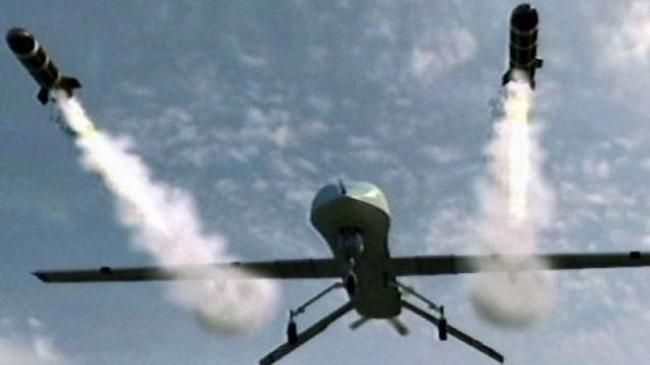
A Predator drone fires two Hellfire missiles
Dutifully the military asserts humans will remain involved in drone manipulation, that they will not be autonomous. And we are expected to to believe the military without question. Because the military never lies and the government never participates in cover-ups.
Right.
This post, however, is not primarily concerned with the politics involved with the drone war. My concern is the relationship of its effects to the kingdom of God.
We have been told that drone warfare provides safety to American troops and provides for less collateral damage than other types bombing. Drones are able to provide visuals clearer than a set of latitude and longitude coordinates, I suppose. A Hellfire missile launched from a drone should cause fewer casualties than a Tomahawk fired from a ship. Cleaner shots, better identification, direct hits. All of this adds up to more dead terrorists and a better protected homeland.
Except it doesn’t.
The Bureau of Investigative Journalism in London, reports,
from June 2004 through mid-September 2012, available data indicate that drone strikes killed 2,562-3,325 people in Pakistan, of whom 474-881 were civilians, including 176 children. TBIJ reports that these strikes also injured an additional 1,228-1,362 individuals. Where media accounts do report civilian casualties, rarely is any information provided about the victims or the communities they leave behind. This report includes the harrowing narratives of many survivors, witnesses, and family members who provided evidence of civilian injuries and deaths in drone strikes to our research team. It also presents detailed accounts of three separate strikes, for which there is evidence of civilian deaths and injuries, including a March 2011 strike on a meeting of tribal elders that killed some 40 individuals.
Also noted in the report is whenever men of fighting age are killed, even if they are completely unknown, and even if their activity is undefined, they are classified as combatants. That is, if a Hellfire missile lands in the middle of 20 sixteen to eighteen year olds playing soccer, they are classified as enemy combatants. Why? Because we killed them in the course of prosecuting a war. Not because they have been or are in a training camp or have plans to join Al Queda.
A quick review: How do we know they were enemy combatants? Because the government said so. How does the government know they were enemy combatants? Because we killed them.
They might as well be since, as the NYT reports, “some in the Obama administration joke that when the CIA sees ‘three guys doing jumping jacks,’ they think it is a terrorist training camp.” Very funny.
The drone war in Asia and the Middle East has become the “War on Terror” equivalent of the bombing of Laos and Cambodia during the Vietnam War.
As if this were not enough our drone strategy includes the very behaviors for which we would condemn terrorists: double strikes.
Drones hover twenty-four hours a day over communities in northwest Pakistan, striking homes, vehicles, and public spaces without warning. Their presence terrorizes men, women, and children, giving rise to anxiety and psychological trauma among civilian communities. Those living under drones have to face the constant worry that a deadly strike may be fired at any moment, and the knowledge that they are powerless to protect themselves. These fears have affected behavior. The US practice of striking one area multiple times, and evidence that it has killed rescuers, makes both community members and humanitarian workers afraid or unwilling to assist injured victims. Some community members shy away from gathering in groups, including important tribal dispute-resolution bodies, out of fear that they may attract the attention of drone operators. Some parents choose to keep their children home, and children injured or traumatized by strikes have dropped out of school. Waziris told our researchers that the strikes have undermined cultural and religious practices related to burial, and made family members afraid to attend funerals. In addition, families who lost loved ones or their homes in drone strikes now struggle to support themselves. Emphasis mine
One report has a drone striking a funeral where mourners had gathered to remember the victims of a previous drone strike.
Additionally the
FATA [Federally Administered Tribal Area] suffers from one of highest poverty rates in the world. The per capita income is approximately US$250 per year, with 60 percent of the population living below the national poverty line. Undeveloped infrastructure and low per capita public development expenditure have resulted in an overall literacy rate of only 17 percent. Most of the population depends on subsistence agriculture, manual labor, small-scale local business, or remittances from relatives working abroad or in other regions of Pakistan for survival. In North Waziristan, chromite mining operations also provide limited contract jobs near the Afghan border. There are only 41 hospitals in the region, and an estimated one doctor for every 6,762 residents.
Who lives there?
FATA is inhabited almost entirely by Pashtuns, a group of tribes that first settled in the area more than 1,000 years ago. The various Pashtun tribes live not only in FATA, but also in large parts of south and east Afghanistan. Altogether, there are some 25 million Pashtuns worldwide, making it one of the largest tribal groups in the world.
Who are the Pashtuns? They are virtually all Muslims who span the border between Afghanistan and northwestern Pakistan. This means they are not followers of Christ. This means they are being bombed into a Christless eternity.
As a follower of Christ it disturbs me to know my government is randomly, regularly, inefficiently, deceptively, and erroneously killing people with whom we are not at war; targeting first responders and mourners for missile strikes; creating an ongoing situation where bearers of the gospel cannot enter with eternal good news. Why do we who give money for missions, pray for the fulfillment of the Great Commission, long for the day when some from every nation tribe and tongue sing praises to our great God seem so content to have one of those tribes bombed into oblivion? Have we bought so thoroughly into a kingdom of this world it has priority over the kingdom of God? Are we so fearful of what might happen to us we are willing to overlook anything that is happening to people around the world?
My friend Emily said today in a Facebook conversation, “I think we should do our best not to have these conversations in a theoretical moral and ethical sphere that is separate from the Christian narrative. The crucifixion and resurrection of Christ should be the basis for thinking through all of these things, IMHO.” If we are to call ourselves “followers of the Way,” then, I believe, it must thus be.
You can read or download the entire report pdf from Stanford-NYU here.