Category Archives: Slider

Looking to give this Christmas?

AClogodesignStamp2 If you are looking for a gift that has lasting meaning this Christmas, you might want to check out Advent Conspiracy where we are being encouraged to “give presence.” The [AC] website explains:

People are dying from the lack of clean water. In fact, it’s the leading cause of death in under resourced countries. 1.8 million people die every year from water born illnesses. That includes 3,900 children a day. The solution to this problem is directly beneath our feet. Drilling a fresh water well is a relatively inexpensive, yet permanent solution to this epidemic. $10 will give a child clean water for life. That’s not an estimate. It’s a fact. And here’s another fact: Solving this water problem once and for all will cost about $10 billion. Not bad considering Americans spent $450 billion on Christmas last year. Our hope is that, by celebrating Christ in a new way at Christmas, the church can serve as the leading movement behind ending the water crisis once and for all.

Advent Conspiracy has partnered with Living Water International in the well drilling project. LWI has a great and unique gift card program; I encourage you to check it out.

‘Avatar,’ movie review

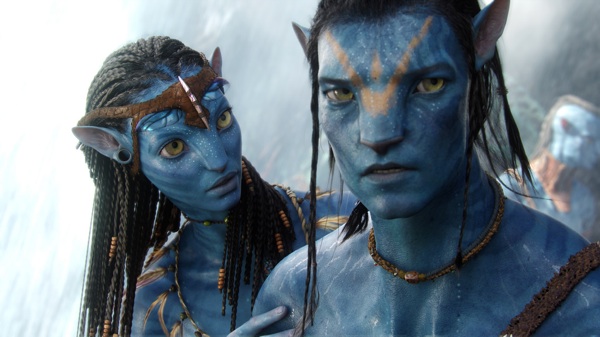
Neytiri (Zoe Saldana) and Jake Sully (Sam Worthington) in Avatar  Image: 20th Century Fox

Neytiri (Zoe Saldana) and Jake Sully (Sam Worthington) in Avatar Image: 20th Century Fox

The long awaited James Cameron (Titanic) CGI fest, Avatar, has hit a screen near you. Boasting a new generation of effects, the film, 5 years in the making, cost a reported half-billion dollars to make and features live action along with the special effects extravaganza.

Moviegoers looking for deep meaning will likely be disappointed; this story has been told a thousand times in a hundred ways: underdogs win the day. Sam Worthington plays Jake Scully, a paraplegic, ex-Marine who, upon the death of his identical twin brother, finds himself on a five light-year mission from earth as part of a diplomatic effort. Diplomacy was needed on the distant planet of Pandora, where an abundance of “Unobtainium” (or that’s what it sounded like they were saying) is needed to power Earth which has been stripped of her own natural resources. A few humans had “avatars” developed which mixed their own DNA with that of the host race, the Na’vi, then, through a cerebral link, a la “The Matrix,” the human is able to control their avatar in the toxic atmosphere of Pandora.

Trained by Dr. Grace Augustine (Sigourney Weaver, Alien Series), for working with his avatar, Scully is simultaneously recruited by the corporate security chief, Colonel Miles Quaritch (Stephen Lang, Public Enemies), to infiltrate the Na’vi and attempt to move them from their dwelling place, Hometree, underneath which lies the largest deposit of Unobtainium for “200 cliques.” Predictably, Scully falls in love with one of the natives, Neytiri (Zoe Saldana, Star Trek), and ends up rallying the troops to fight the invading bulldozers, tractors and other pillaging equipment.

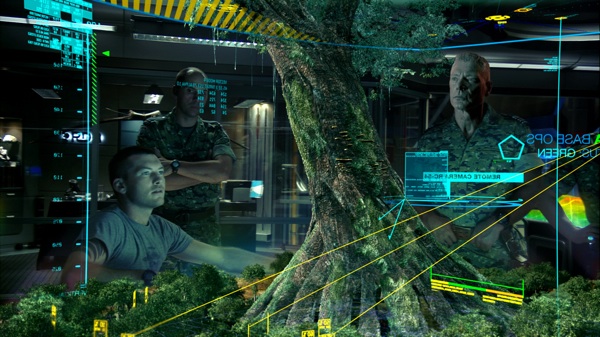
Scully (Worthington) and Quaritch (Lang) takes a look at a schematic of the Na'vi Hometree  Image: 20th Century Fox

Scully (Worthington) and Quaritch (Lang) takes a look at a schematic of the Na'vi Hometree Image: 20th Century Fox

The Na’vi themselves are twelve or so feet tall with long tails, carbon fiber skin and feline agility. In fact, they look like the cross-bred offspring of a jamboree of jaguars with The Blue Man Group. Culturally, they are African complete with Shamans, communication with dead ancestors, bows and arrows, adulthood rituals and loin cloths. Similar to Tolkein’s Elvish language for LOTR, an entire language system was developed for the Na’vi and it sounds like an African dialect. At its core the Na’vi could be any people whose land has ever been taken by a stronger people and exploited for the availability of some natural resource, whether that be the land itself (the American Indians), oil (Nigeria) or diamonds (Sierra Leone).

Generally the movie is anti-imperialistic and pro-environment; be forewarned, when you see the ultra-lush, spectacularly rendered vistas of Pandora, you’ll be pro-environment, too. Otherwise the human acting is nothing outstanding (other than Lang, who is the best of the bunch) and the storyline was obviously a vehicle for the special effects, rather than the effects carrying the story.

Also, I think it important to note that there is a very heavy pantheistic bent and open promotion of goddess worship. This is not an undertone; it makes up the central spiritual thread of the movie. Though Cameron may not believe these things himself, their presence mitigates against any real biblically redemptive quality.

(Lang is a largely under appreciated actor having played Stonewall Jackson in Gods and Generals but is better known for a significant part in one of the most quoted movies of the 1990’s. See if you can figure it out by his voice and features. I’ll put it on the first comment, so don’t look if you don’t want to know.)

Avatar, from 20th Century Fox, is rated PG-13 for language, violence, and scant CGI clothing on some most Na’vi.

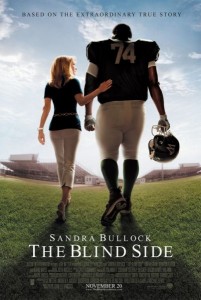
Blindsided by ‘The Blind Side’

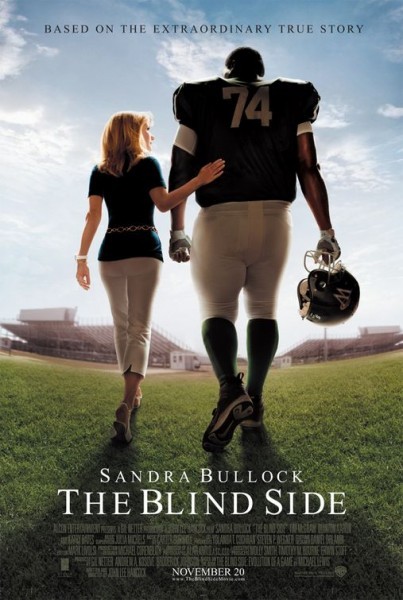
Image: Alcon Entertainment

Image: Alcon Entertainment

As a rule, I do not go to a theater to see a sports movie. Still have not seen Glory Road or We Are Marshall and I’m sure I did not see Remember the Titans until it was sitting on the shelf at Blockbuster. So, even though I thought the new Sandra Bullock film, The Blind Side, looked promising I was willing to wait. Thankfully, my daughter, aged 13 and no fan of football, was not. (Though when it opened with some drone and the unknowns really screwing up a cover of Nick Drake’s, “The Cello Song,” I got antsy.)

Having opened November 20, The Blind Side has already grossed nearly $150M in telling the story of Baltimore Ravens left tackle, Michael Oher (pronounced “oar,” Quinton Aaron), a former homeless high school kid from the projects of Memphis, who is brought into a family of a rich white people, the Tuohys (pronounced, “Two-ee”) and given a home. If that were the extent of this movie, then it would have easily and inevitably veered off into a sappy, Hallmark Channel vehicle, capturing only the attention of some bored kids on Saturday afternoon. But this is not a movie about white guilt or Republican racial angst. In the end, it’s a movie about the gospel.

The movie begins with a dozen or so replays of the Monday Night Football Lawrence Taylor hit on Joe Theismann that shattered the leg of and ended the career of the latter. This wince inducing video (I did not watch the replays then and I do not watch them now) is necessary to explain why Oher’s eventual football position, left tackle on the offensive line, is so important: it protects the quarterback’s blind side. Thus, the movie reasons, since the quarterback is generally the highest payed player on the team, the left tackle is the second most important player on the team.

We are quickly introduced to “Big Mike” as a hulking, but gentle presence whose worldly belongings are a light blue golf shirt, a pair of shorts and some old high top sneakers. His other shirt is kept in a grocery bag. He “borrows” dryer time at a local laundromat after washing his shirt in the sink for free. In another scene Big Mike is seen picking up leftover popcorn after the school volleyball game. He’s been away from his crack addicted mother since he cannot remember how old and ran away from every foster home he had ever called home. His case worker calls him “a runner.”
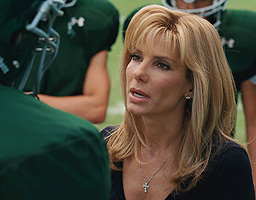
Bullock as Leigh Anne Tuohy in 'The Blind Side'  Image: Alcon Entertainment

Bullock as Leigh Anne Tuohy in 'The Blind Side' Image: Alcon Entertainment

The only person in the Tuohy family who knows anything about Big Mike is the pre-teen son, SJ (played with regular hilarity by Jae Head), but on their way home one cold, rainy night the family happens upon Oher walking down the road on his way to the school gym, planning to stay the night because “it’s warm there,” and, after a brief road-side interview, Leigh Anne Tuohy (Bullock) decides to bring him home for the night. This decision, while generous, is not portrayed as necessarily righteous. She puts some sheets and blankets on the couch for their guest, then heads downstairs in the morning with some expectation that, like an inner city Jean Valjean, Oher had stolen away carrying the silverware in his grocery bag.

Interestingly, nearly the entire first half of the movie is devoted to telling the story of the relationship between the Tuohy’s and Oher: Thanksgiving dinner shared around the table instead of in front of the TV, being the only black kid in an all white Christian school (“the fly in the milk” as he is called at one point) while dealing with both his social and learning struggles. When the football portion of the movie comes to the fore, it does so well-the relationship story is not jettisoned for a bunch of hitting and grunting. On the contrary it works to strengthen it. (I will say that many of the real life coaches, Nick Saban especially, are woefully stiff on camera making Mark Richt’s turn in Facing the Giants seem downright Oscar worthy.)

It’s as Leigh Anne is drawn into Michael’s life, trying to peel back the layers of the onion that the movie becomes a picture of the gospel. She’s simply unwilling to be a bystander on the edge of his life. She drives him to the projects where he grew up in a vain attempt to find his mother, then endeavors to find her without him at another time. The end of that encounter says more without words than many scenes say with pages of dialogue. Instead of cutting to another scene when it would be easy, the director stays with it allowing it to reach a poignant climax.

The ministry of the gospel is so real in this movie that it does not depend on it being preached. It truly is an effort at Assisi’s, “Preach the gospel at all times and, when necessary, use words.” This is not a story specifically aimed at the death, burial and resurrection of Christ, but whether the results of those momentous events can be lived out and how. In those words of Jesus that we love to proclaim, yet are usually loath to live, “For I was hungry and you gave Me food; I was thirsty and you gave Me drink; I was a stranger and you took me in; I was naked and you clothed me” (Matthew 25:35, 36).

When we exited the theater, Abigail and I were discussing the movie itself, that this is what a “Christian movie” should be, people in all their flaws. This is not the silly, shallow “the wind stops blowing so my kid can make a field goal” type of spirituality of Facing the Giants where “God’s in control” and everything works out in the end. While Oher is rescued and makes the NFL in real life (a fact saved almost until the credits), that revelation is preceded immediately by vivid reminders that many do not make it out of violent, gang related lives. It is the triumph and the challenge. The Tuohy’s both swear; not incessantly, but some. Leigh Anne wears skirts so tight you wonder how she gets any circulation in her butt. These are realities that make some Christians very uncomfortable, but it’s where people are–even believers. People are a mess–even believers. But, as Tuohy notes, reaching out to Michael changed her. Her family and Oher are alternately being the presence of Jesus and receiving His presence, which, I think, is why Jesus said, “Give expecting nothing in return.” It is not in the changing of another person that we are changed, it is in being like Christ that we are changed.

The Blind Side, by Alcon Entertainment, stars Sandra Bullock, Tim McGraw, Quinton Aaron, Jae Head, Lilly Collins, Kathy Bates, and Ray McKinion. It is rated PG-13 for one scene involving brief violence, drug and sexual references.
On Gettysburg, war and peace

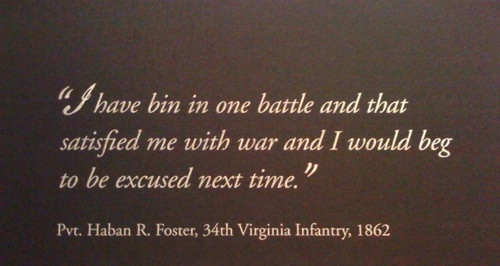
From the Gettysburg National Military Park Museum  Photo: Marty Duren

From the Gettysburg National Military Park Museum Photo: Marty Duren


The day after Thanksgiving, I was able to visit the Civil War battlefields at Gettysburg, PA. After watching a short movie about the war in general and the Battle of Gettysburg in particular, we went through the museum. To say that I was overwhelmed with information would be exercising the gift of understatement to its limit as display after display had quotations from period sources and historical players, uniforms, firearms, books and photos of farms and soldiers, crude but effective medical instruments and movies from the History channel. One rather significant item on display was a booklet entitled “Slavery Ordained Of God,” by Rev. Fred A. Ross of Huntsville, AL, demonstrating how some southern Christians defended the institution that brought wealth to both the North and the South.

We spent half an hour or so in the National Cemetery that pre-dated the war by several years and was the location of Abraham Lincoln’s Gettysburg Address, November 19, 1863. This was the cemetery referenced in Cemetery Ridge and Cemetery Hill where Union forces fell back under duress on July 1, 1863, the first day of the Battle of Gettysburg, ultimately forming the upper curve of the fishhook shaped line that ran south to Big Round Top. It was this line that was unable to be breached by Robert E. Lee’s Army of Northern Virginia, leading to heavy losses and injuries on both sides, but the retreat of the Confederates on July 3.

The battlefields at Gettysburg  Photo: Abigail Duren

The battlefields at Gettysburg seen from Little Round Top Photo: Abigail Duren


So fierce was the fighting that more than 4,000 were killed in one skirmish in “The Wheatfield,” (seen distantly in the photo above) while more than 5,000 Confederate soldiers were killed in a single hour during a maneuver famously known as “Pickett’s Charge,” an advance nearly a mile wide with soldiers. The three day battle, considered by most to be the turning point of the war, saw killed and wounded on both sides total more than 51,000 men and a few women.

Since the Civil War the United States has been involved in numerous conflicts worldwide and not a few wars. The century alone has saw World Wars 1 and 2, Korea, Vietnam, The Gulf War and this century joins with the ongoing War on Terror. (For the purposes of this writing, I’ll not include the War on the Unborn, which has claimed hundreds of millions of lives worldwide since its inception.) While Augustine argued that some war can be just (righteous), Confederate General Thomas “Stonewall” Jackson called it, “The sum of all evils.” Augustine may be theologically and philosophically right, but the problem is that wars are not fought only theoretically and philosophically, but in reality and because they are fought in reality many times we find in them the sum of all evils.

Memortial to the PA Infantry Reserves on Big Round Top  Photo: Abigail Duren

Memorial to the PA Infantry Reserves placed on Big Round Top Photo: Abigail Duren


Those evils often take place with suicides among the troops, intentional killing of civilians, rape of the defenseless and death by friendly fire. They also take the form of government cover ups to boost enthusiasm for the conflict for political means and ends. Perhaps this is the worst evil of all.

Who can forget the much publicized, though personally shunned, entrance into the Army Rangers program of Arizona Cardinals’ safety, Pat Tillman, in May 2002? Portrayed as a real American, an example of sacrifice and patriotism, Tillman refused all interviews or preferential treatment, even when he had an “Army excuse” for early discharge before the tour that eventually took his life. His entry and his death were used, against his wishes, by the Bush administration to bolster American support for the war, posits Jon Krakauer in Where Men Win Glory. Tillman’s death was due to friendly fire following a Keystone Kops episode of bad command decisions. The cause of death was hidden for months from his family, the press and the world so it could be used for political expedience. Former White House press secretary under Bush, Scott McClellan hypothesizes in his book, What Happened?, that the “permanent campaign” of politics makes it impossible for any aspect of decision making to happen without an eye to the polls and political ramifications and this includes, or, perhaps especially includes, war.

Since even a theoretically possible “just war” is often led and fought by unjust men, it would behoove Christians to be careful not to support a war simply because a liked president is “Commander-In-Chief,” or to oppose it simply because an otherwise disliked president is stopping the buck. Some Christians tend to make support for the war a test of fellowship or something as if lack of enthusiasm for an earthly military action is akin to renouncing one’s heavenly citizenship. Most seem oblivious to the fact that patriotism is a commitment to the constitution, not the ever-so-often selected first-chair occupants of 1600 Pennsylvania Ave or that our commitment to the kingdom of God supersedes both.

While it is certainly a truth that Scripture gives governments the right to wage war in certain circumstances, Scripture also records that followers of Christ are to be wagers of peace above war. I don’t think this leads inevitably to pacifism, but it cannot mean less than our striving to seek peace from the playground to the boardroom to the battlefield. I think it was George Washington who said, “Sometimes you have to have war before you can have peace,” but Lee reminded, “What a cruel thing is war; to separate and destroy families and friends, and mar the purest joys and happiness God has granted us in this world; to fill our hearts with hatred instead of love for our neighbors, and to devastate the fair face of this beautiful world!”