What is Maundy Thursday?

Many people not in Catholicism or familiar with may ask today, “What is Maundy Thursday?” Maundy Thursday is the day before Good Friday. That is the short answer.

The longer answer to “What is Maundy Thursday” is:

Maundy Thursday (also known as Holy Thursday, Covenant Thursday, Great and Holy Thursday, Sheer Thursday and Thursday of Mysteries) is the Christian feast, or holy day, falling on the Thursday before Easter. It commemorates the Maundy and Last Supper of Jesus Christ with the Apostles as described in the Canonical gospels. It is the fifth day of Holy Week, and is preceded by Spy Wednesday and followed by Good Friday.

Another explanation of Maundy Thursday:

This day, Maundy Thursday (also “Holy Thursday” or “Shire Thursday”) commemorates Christ’s Last Supper and the initiation of the Eucharist [Lord’s Supper or Communion]. Its name of “Maundy” comes from the Latin word mandatum, meaning “command.” This stems from Christ’s words in John 13:34, “A new commandment I give unto you.” It is the first of the three days known as the “Triduum,” and after the Vigil tonight, and until the Vigil of Easter, a more profoundly somber attitude prevails (most especially during the hours between Noon and 3:00 PM on Good Friday). Raucous amusements should be set aside.

What struck me from this last paragraph was the sentence “Raucous amusements should be set aside.”


Passion Week is a week overlooked by many in favor of Easter. While there is no doubt the resurrection trumps the last supper for eternal value, that supper, if it teaches us anything, teaches us the power of remembrance.

Today is Maundy Thursday, a day of remembrance. Perhaps we should set aside frivolity for a time, reflect on what the last supper meant to Christ, to His disciples and to us. This weekend again brings to our attention the victory of Christ over the grave. He secured the possibility of forgiveness at the cross and the reality of eternal life at the resurrection.

We also do well to reflect on John 13:34, “A new commandment I give to you, that you love another. Just as I have loved you, you should love one another.” How well is that going for us? Good Friday is tomorrow, the grave is Saturday, and Easter is Sunday. Remember. And love.

Blessings.

Asset forfeiture: When profit obscures justice

From a John W. Whitehead commentary:

Long before Americans charted their revolutionary course in pursuit of happiness, it was “life, liberty, and property” which constituted the golden triad of essential rights that the government was charged with respecting and protecting. To the colonists, smarting from mistreatment at the hands of the British crown, protecting their property from governmental abuse was just as critical as preserving their lives and liberties. As the colonists understood, if the government can arbitrarily take away your property, you have no true rights. You’re nothing more than a serf or a slave.


The Fifth Amendment to the U.S. Constitution was born of this need to safeguard against any attempt by the government to unlawfully deprive a citizen of the right to life, liberty, or property, without due process of law. Little could our ancestral forebears have imagined that it would take less than three centuries of so-called “independence” to once again render us brow-beaten subjects in bondage to an overlord bent on depriving us of our most inalienable and fundamental rights.

The latest governmental scheme to deprive Americans of their liberties—namely, the right to property—is being carried out under the guise of civil asset forfeiture, a government practice wherein government agents (usually the police) seize private property they “suspect” may be connected to criminal activity. Then—and here’s the kicker—whether or not any crime is actually proven to have taken place, the government keeps the citizen’s property, often divvying it up with the local police who did the initial seizure.

For example, the federal government recently attempted to confiscate Russell Caswell’s family-owned Tewksbury, Massachusetts, motel, insisting that because a small percentage of the motel’s guests had been arrested for drug crimes—15 out of 200,000 visitors in a 14-year span—the motel was a dangerous property. As Reason reports:

This cruel surprise was engineered by Vincent Kelley, a forfeiture specialist at the Drug Enforcement Administration who read about the Motel Caswell in a news report and found that the property, which the Caswells own free and clear, had an assessed value of $1.3 million. So Kelley approached the Tewksbury Police Department with an “equitable sharing” deal: The feds would seize the property and sell it, and the cops would get up to 80 percent of the proceeds.

Thankfully, with the help of a federal judge, Caswell managed to keep his motel out of the government’s clutches, but others are not so fortunate. One couple in Anaheim, Calif., is presently battling to retain ownership of their $1.5 million office building after the U.S. Drug Enforcement Administration filed an asset-forfeiture lawsuit against them because one of their tenants allegedly sold $37 in medical marijuana to an undercover agent.

Some states are actually considering expanding the use of asset forfeiture laws to include petty misdemeanors. This would mean that property could be seized in cases of minor crimes such as harassment, possession of small amounts of marijuana, and trespassing in a public park after dark.

As the Institute for Justice points out:

Civil forfeiture laws represent one of the most serious assaults on private property rights in the nation today. Under civil forfeiture, police and prosecutors can seize your car or other property, sell it and use the proceeds to fund agency budgets—all without so much as charging you with a crime. Unlike criminal forfeiture, where property is taken after its owner has been found guilty in a court of law, with civil forfeiture, owners need not be charged with or convicted of a crime to lose homes, cars, cash or other property.

Americans are supposed to be innocent until proven guilty, but civil forfeiture turns that principle on its head. With civil forfeiture, your property is guilty until you prove it innocent.

Relying on the topsy-turvy legal theory that one’s property can not only be guilty of a crime but is guilty until proven innocent, government agencies have eagerly cashed in on this revenue scheme, often under the pretext of the War on Drugs. By asserting that someone’s personal property, a building or a large of amount of cash for example, is tied to an illegal activity, the government—usually, the police—then confiscates the property for its own uses, and it’s up to the property owner to jump through a series of legal hoops to prove that the property was obtained legally.

Despite the fact that 80 percent of these asset forfeiture cases result in no charge against the property owner, challenging these “takings” in court can cost the owner more than the value of the confiscated property itself. As a result, most property owners either give up the fight or chalk the confiscation up to government corruption, leaving the police and other government officials to reap the benefits. For example, under a federal equitable sharing program, police turn cases over to federal agents who process seizures and then return 80% of the proceeds to the police.

Asset forfeitures can certainly be lucrative for cash-strapped agencies and states. In the fiscal year ending September 2012, the federal government seized $4.2 billion in assets, a dramatic increase from the $1.7 billion seized the year before. Between 2004 and 2008, police in Jim Wells County, Texas seized over $1.5 million. The Metropolitan Police Department in Washington, D.C. collected $358,000 from civil forfeiture in fiscal year 2011, and $529,000 from federal equitable sharing. The State Attorney’s Office in Madison County, Illinois, made $500,000 from asset forfeiture over the course of eight years.

Often, these governmental property grabs take the form of highway robbery (literally), where police officers extract money, jewelry, and other property from unsuspecting motorists during routine traffic stops. As Mother Jones quips, “forfeiture corridors are the new speed traps.” Indeed, states such as Texas, Tennessee, and Indiana are among the worst offenders. Mother Jones continues:

You all know what a speed trap is, right? If you have a highway running through your small town, you can make a lot of money by ticketing out-of-state drivers who are going one or two miles per hour over the speed limit. How many victims are going to waste time trying to fight it, after all? But have you heard about “forfeiture corridors”? That’s a little different — and quite a bit more lucrative. All you have to do is pull over an out-of-state driver for supposedly making an unsafe lane change, have your police dog sniff around for a bit of marijuana residue, and then use civil asset forfeiture laws to impound any cash you might find. Apparently it’s especially popular on highways leading into and out of casino towns.

In typical fashion, these police traps tend to prey on minorities and the poor, as well as undocumented immigrants and individuals who happen to have large amounts of cash on hand, even for lawful reasons. One such person is Jerome Chennault, who fell prey to Madison County, Illinois’ forfeiture corridor in September 2010. En route to Nevada after a visit with his son, Chennault was pulled over by police for allegedly following another car too closely. When police asked to sweep Chennault’s car with a drug dog, Chennault obliged, believing that he had done nothing wrong and had nothing to hide and completely unaware that he had fallen into a forfeiture trap.

During the search, the drug dog alerted on a black bag in the back seat of the car which contained about $22,000 in cash. The money, Chennault explained, was intended for a down payment on a home. The dog did not find any drugs in the car, nor was there any evidence of criminal activity. However, instead of letting Chennault go on his way with a traffic citation, the police confiscated the cash, claiming that since the drug dog alerted to it, it must have been used in the commission of a drug crime. Chennault challenged the seizure in court, after months spent traveling to and from Illinois on his own dime, and eventually succeeded in having his money returned, although the state refused to compensate him for his legal and travel expenses.

Tenaha, Texas, is a particular hotbed of highway forfeiture activity, so much so that police officers keep pre-signed, pre-notarized documents on hand so they can fill in what property they are seizing. Between 2006 and 2008, for instance, Tenaha police seized roughly $3 million.

As Roderick Daniels discovered, it doesn’t take much to get pulled over in a forfeiture corridor like Tenaha’s. Daniels was stopped in October 2007 for allegedly traveling 37 mph in a 35 mph zone. He was ordered to hand over his jewelry and the $8,500 in cash he had with him to purchase a new car. When he resisted, he was taken to jail, threatened with money-laundering charges and “persuaded” to sign a waiver forfeiting his property in order to avoid the charges.

In an even more egregious case, Jennifer Boatright and Ron Henderson, an interracial couple travelling through Tenaha, were forced to forfeit the $6,000 cash they had with them to buy another car when police threatened to turn their young children over to Child Protective Services. Another traveler, Maryland resident Amanee Busbee, was also threatened with losing her child to CPS after police stopped her, her fiancé and his business partner when they were en route to Houston with $50,000 to complete the purchase of a restaurant. Boatright and Busbee were eventually able to reclaim their money after mounting legal challenges.

Comparing police forfeiture operations to criminal shakedowns, journalist Radley Balko paints a picture of a government so corrupt as to render the Constitution null and void:

Police in some jurisdictions have run forfeiture operations that would be difficult to distinguish from criminal shakedowns. Police can pull motorists over, find some amount of cash or other property of value, claim some vague connection to illegal drug activity and then present the motorists with a choice: If they hand over the property, they can be on their way. Otherwise, they face arrest, seizure of property, a drug charge, a probable night in jail, the hassle of multiple return trips to the state or city where they were pulled over, and the cost of hiring a lawyer to fight both the seizure and the criminal charge. It isn’t hard to see why even an innocent motorist would opt to simply hand over the cash and move on.

In an age in which the actions of the police—militarized extensions of the government—are repeatedly sanctioned by the legislatures and the courts, hard-won concessions such as the U.S. Supreme Court’s 5-4 ruling in Florida v. Jardines that the use of drug-sniffing dogs to carry out warrantless searches of homes is unconstitutional comes as little comfort. After all, it was not long ago that this very same court sanctioned the use of drug-sniffing dogs in roadside stops, a practice that has proven extremely profitable for law enforcement officials tasked with policing the nation’s forfeiture corridors.


This commentary can also be found at Rutherford.org.

Did Starbucks’ Howard Schultz really say, “We don’t want your business”?

In response to a question at the recent Starbucks corporation shareholders meeting, CEO Howard Schultz reiterated his and the company’s support for workplace diversity. This includes support for same-sex marriage.

As sure as night follows day a blatantly false meme began circulating on Facebook. The primary one is from Joe Miller’s Liberty Watch. His opening sentence reads:

At the Starbucks annual shareholders meeting on Wednesday, CEO Howard Schultz sent a clear message to anyone who supports traditional marriage over gay marriage: we don’t want your business.

Not to put too fine a point on it, that information is a complete fabrication.

Miller sourced his story through Examiner.com’s also deceptively entitled article, Starbucks CEO: No tolerance for traditional marriage supporters. The author, Victor Medina, opens with this:

At the Starbucks annual shareholders meeting on Wednesday, CEO Howard Schultz sent a clear message to anyone who supports traditional marriage over gay marriage: we don’t want your business.

Look familiar?

What did Howard Schultz say about traditional marriage

Starbucks CEO, Howard Schultz [Image credit]

Medina’s article points to yet another article, this one from Forbes. Finally arriving at the truth, we see Schultz was never speaking to customers of Starbucks, but in response to a shareholder’s question. The article, Howard Schultz to Anti-Gay-Marriage Starbucks Shareholder: ‘You Can Sell Your Shares'” accurately reflects the context and statement.

In response to a shareholder’s question, Starbucks’ CEO responded:

If you feel, respectfully, that you can get a higher return than the 38% you got last year, it’s a free country. You can sell your shares in Starbucks and buy shares in another company. Thank you very much.

This was the statement, and the only statement. Schultz never said or implied people who support traditional marriage should take their business elsewhere.

The fact is Starbucks and Schultz are, unsurprisingly, supporting of same-sex marriage. It is also a fact that you can boycott, or get your caffeine fix elsewhere as many have chosen to do. You can also oppose same-sex marriage and continue to buy coffee from Starbucks…I do.

To be fair, each of the first two articles includes the shareholder further into the story, but the erroneous early statements are more than enough to mislead the average reader.

What Christians should avoid, however, is sloppiness. Disagreement is fine. Strong disagreement is fine. But, at least, let us strive for accuracy.

C’mon, followers of Jesus. We can do better.

(Less than HD video of Howard Schultz responding to shareholder question on gay marriage.)

Check out the four sister musical group, von Grey [VIDEO]

“With their soulful four-part harmonies, poetic lyrics and indelible melodies, it’s easy to see why the Atlanta Journal Constitution would hail von Grey as “nothing short of stunning.” They sound like they were born to play together – and, in fact, they were. The four sisters have been playing music nearly their entire lives. Classically trained from an early age, the Atlanta-based quartet – Kathryn, Annika, Fiona and Petra von Grey – have built on that foundation by performing upwards of 200 shows in the past two years, from recurring residency tours at intimate venues throughout the southeastern U.S. to supporting gigs with such artists as Sarah McLachlan.” –from the von Grey website

von Grey sister band

Petra, Fiona, Annika and Kathryn von Grey [Image credit]

Each of the four is a classically trained strings player (search YouTube for “von Grey Water Music” for a sample) and a multi-instrumentalist. Middle sisters Annika and Fiona are the primary songwriters and vocalists, with youngest sister Petra occasionally backing though she needs to be included more often in my opinion.

I just discovered these girls yesterday afternoon, but they are already in my music rotation. They are really, really good. Fans of The Civil Wars should give them a listen, but von Grey has a much more full sound, think Mumford or Avett. von Grey has already been featured on Letterman and this month at SXSW. Regarding von Grey it seems safe to say, “Stay tuned.”


(Would not be surprised if “Shane” becomes very popular.)

You can get von Grey’s EP below. Currently only $4.95.

A prayer to know God

As many of you I have heard people worry they would not know what to say to God were they to try and pray. It seems a large number think a secret code or passwords are necessary. I think scripture as a whole points to a heart condition when approaching God rather than smooth talk.

There are no magic words to calling on the name of the Lord (Romans 10:13). How Rosaria Champagne Butterfield opens her heart in this prayer, I think, reveals the repentance and faith God seeks. This is how she describes the night of her salvation.

That night, I prayed, and asked God if the gospel message was for someone like me, too. I viscerally felt the living presence of God as I prayed. Jesus

seemed present and alive. I knew that I was not alone in my room. I prayed that if Jesus was truly a real and risen God, that he would change my heart. And if he was real and if I was his, I prayed that he would give me the strength of mind to follow him and the character to become a godly woman. I prayed for the strength of character to repent for a sin that at that time didn’t feel like sin at all–it felt like life, plain and simple. I prayed that if my life was actually his life, that he would take it back and make it what he wanted it to be. I asked him to take it all: my sexuality, my profession, my community, my tastes, my books and my tomorrows.

Later she reflects on what it means to repent, her reflection brimming with biblical insight:

I learned the first rule of repentance: that repentance requires greater intimacy with God that with our sin. How much greater? About the size of a mustard seed. Repentance requires that we draw near to Jesus, no matter what. And sometimes we all have to crawl there on our hands and knees. Repentance is an intimate affair. And for many of us, intimacy with anything is a terrifying prospect.

From The Secret Thoughts of an Unlikely Convert, pgs. 20, 21.

One thing children of Christian parents need to see

Our culture places a lot of emphasis on education. Without it, we are told, we cannot succeed.

Our churches place a lot of emphasis on attendance. Make sure your kids are in children’s church, at camp, in youth group, on retreats.

Our families place a lot of emphasis on activities. Make sure little Johnny is playing sports, or has guitar lessons, or all of the above. Make sure little Suzy is cheering, or playing soccer, or on the debate team, or all of the above.

what kids need from parentsBoth our society and our churches place a lot of emphasis on moral behavior. Be a good citizen. Treat others well. Be patriotic.

Parents who are also followers of Christ are bombarded with thousands of messages all clamboring up the mountain of attention. Each strives for a space on the priority list.

Amid the commotion and noise of life, one thing children must see from parents who claim the name of Christ is an authentic, humble, ongoing pursuit of God.

Kids are smart enough not to expect perfection, which means they are smart enough to recognize fraud. Kids are experienced enough to expect failure, and wise enough to expect an apology. Kids have witnessed enough to know everything is not what it seems, and hungry enough to want to see someone making an authentic effort to live what they hear on Sunday.

After a lifetime in church I have become convinced the number one reason kids leave church after high-school has almost nothing to do with atheism they face in college or a pastor who believed in 6-day creationism. I am persuaded it is because kids so rarely see lived out what they hear preached week-in-and-week-out by anyone authentically and humbly in an ongoing way. This includes–especially includes–their parents.

Parent, kids hear the all-week arguing magically transformed into the Sunday morning glad handing, “Good morning, brother. Isn’t God good?” And they know it is hypocrisy. They hear church members being gossiped about at home, yet greeting with a smile and laugh at church. And they know it is hypocrisy. They hear the pastor talk about faith, trusting with God and walking with Him, yet see their own parents worry over bills every week. And they wonder why God cannot be trusted. They hear the pastor talk about the need for Bible reading in the home, yet they have never experienced it a single time. And they know it is disobedience. They know kids are supposed to be disciplined in love, yet are only ever disciplined in anger. And they suppose God to be the same way.

In short, kids learn at home first and foremost whether the whole “God thing” is even real.

After 18 years of such is it any wonder so many leave church never to return. They aren’t walking away from God. They are walking away from an lifelong game of Candyland.

Parents, you will never be perfect. You can, however, be authentic. You can be humble. And you can pursue God as a deer pursues the cool, refreshing creek. Your kids will see. They will learn. They will remember. And they just might believe.

Pastoral challenges in the next 20 years

Joel Rainey is Executive Director of the Mid-Maryland Baptist Association. He is on the adjunct faculty of two seminaries, and the author of two books: Planting Churches in the Real World and Sidestepping Landmines: Five Principles for Pastor Search Teams. Joel works closely with numerous pastors in a state not known for its evangelical values. He is a strategic thinker on many things related to the kingdom of God.


On his blog, themelios, he recently wrote on the nature of pastoral leadership in the next 20 years. Joel asked a question once posed to him, “Are we really up to this?” This post is adapted from his writing.

American society is morphing at an unprecedented rate. This means more for the church than perhaps any other area as we claim God’s unchanging truth in changing times. Rainey asks whether pastors are “up to this”? I wonder if churches are.

If Rainey’s thoughts are on target, I think three things will happen as it relates to churches (and denominations) in the United States. First is capitulation. Many will simply agree with the surrounding culture that truth is maleable, subjective and suggestive. These churches will become indistinguishable from other societal organizations whose purpose is “to make the world a better place.” They bother not with sin, judgment or a cross. Second is separation. As in every generation these are they who are not of the world, but neither are they in it. They have no actual influence and their loudly sounded trumpets of culture wars fall mostly on deaf ears. Third is contextualization as the remaining churches seek to exegete culture, relate to it and bring the uncompromised gospel to everyone in a way that both illuminates their need and introduces the remedy: Jesus Christ. For these, mercy truly triumphs over judgment.

From Joel Rainey:

Scenario One: A pastor is called to a church with the expectation that he will “help us reach the young families.” Problem is, everyone in the church is over the age of 60, and more than 50% of the community within 10 minutes of the church is also in that age range.

By 2030, it is estimated that more than half of the U.S. population will be over the age of 50. This “graying” of America is presently going almost completely unnoticed by most churches, who tend to go after the prized “young families with children” category. Yet 80% of those over 50 live in a multi-housing situation (“55 and older” apartments, duplex communities, retirement and assisted living communities), and 98% of all multi-housing residents are without a relationship to Jesus. Are you keeping pace with the generational shifts that are taking place around your church, and how your church should respond to those shifts?

Scenario Two: Multiple families visit the church who do not speak English, politely nod and smile, and never return.

By 2025, Hispanics will outnumber African Americans by 3 to 2, and will comprise approximately 40% of the U.S. population. Over a decade ago, Oscar Romo noted that America, “hardly the ‘melting pot’ described by history texts, has become a land marked more by diversity than homogeneity.” In no area is this fact more clear than in the area of language.

Scenario Three: A married homosexual couple with three adopted children visit your church.

This is one of those issues when if you are a pastor, you need to go ahead and check all your political arguments at the door. What we believe society should or shouldn’t do in this situation is of absolutely no consequence, because they are doing it anyway!

[…]

Truth is, we live in a nation and culture in which our understanding of marriage has been devolving for decades.

Now that this is a reality, how will we minister to the parents and their children? How should our children’s departments be equipped to minister to the kids? How are you equipping other couples in your church to interact with and minister to these precious souls? How can you uphold clear Biblical standards in love?

Scenario Four: A young person who has visited your church for a while repents of her sin and receives Jesus as Lord and Savior. As you prepare for her baptism, you discover through her testimony that she was born male, but had gender-reassignment surgery a few years ago.

Scripture has no category for an “androgynous Christian.” There are Christian men, and Christian women, and the discipleship models spelled out for us in the New Testament tend to be described in conjunction with one’s gender.

[…]

Are you prepared for the Biblical, moral, psychological and bioethics questions that will necessarily be part of that conversation?

Scenario Five: More and more people, it seems, are asking you to perform funeral ceremonies for their pets. You have noticed over time that the grieving process for a family losing a pet, as well as the elements of the funeral itself (pictures, memorials, poems, etc.) indicate a much greater value on animals than in the past.

We are already witnessing attitudes in our culture that betray a gravitation towards increased “equalizing” of animals and humans, and too many in the church have bought into this idea. Are you prepared to lovingly confront the false idea that “all dogs go to heaven,” and re-assert the essential distinction between human beings, who are created in God’s own image and likeness, and pets, who are not?

Scenario Six: Because of growth, your church starts a “video venue,” and begins live-streaming worship and sermons via the internet. You notice that you have a growing “online” audience, many of whom log in every Sunday, and who financially support the ministry. Through connections with these people on social media you discover that, although they may live hundreds or even thousands of miles away, they consider your church their “church home.”

Today’s advanced and inexpensive technology means that churches are asking questions that would never have been considered even 20 years ago, and one of the biggest questions today has to do with the legitimacy of the so-called “internet church.” In the future, how will your church ensure that the Biblical principles and practices commensurate with a covenant community are observed in this environment?

Scenario Seven: You discover through casual conversation that a yoga class has been started by leaders in the church, that participants freely greet one another with “namaste,” and that Christian meditation has been confused with the emptying of the mind that is endorsed in many Hindu communities.

Over the past decade, there has been a huge increase in ancient pagan practices, much like those that occurred in the days of the Old Testament. The digital age, among other things, presents opportunities for the “blending” of faiths that was unheard of even two decades ago. In what ways should you be prepared to bifurcate for your people between what can, and cannot, be part of the life of someone who follows Jesus according to Scripture?

Scenario Eight: You receive a call from a mainline church in town. The size of their congregation has dropped to less than 20 members. They are fearful for their future, and they ask for your help.

It is simply a statistical fact that theological liberalism kills churches. As such, expect the mainline protestant churches in your town to continue slowly bleeding to death. Yet, the people in those dying churches need someone to love them by ministering to their needs and reminding them of what their faith once stood for. Are you prepared to raise up leaders who can utilize those facilities to start a second campus for your church, or start a new church altogether?

Scenario Nine: Parents come to you for counseling regarding their son, who has been diagnosed with multiple “generic” disorders, but doctors have been incapable of specifying the problem, and the child has been largely un-treatable by psychiatrists. You suspect the presence of demonic activity.

I truly believe that we will see a sharp rise in obvious demonic activity in the west, and I believe it will unfortunately be mis-diagnosed as a solely medical or psychiatric problem. As a result, too many children will grow up expressing the personality of a psychotrophic drug unless wise and godly pastors in the west learn to recognize the presence of demonic activity.

Scenario Ten: In this “brave new world,” God continues to seek worshippers, and Jesus continues to save people from sin, Satan, death, and hell in miraculous ways.

What I’ve described above is a culture that is emerging, and that is filled with people Jesus died to save. And it is in this environment when I hear evangelical Christians having the dumbest arguments!

What would you add? Is Joel right in his assertions?

The priority of biblical justice

Woe to you, scribes and Pharisees, hypocrites! You pay a tenth of mint, dill and cumin, yet you have neglected the more important matters of the law–justice, mercy, and faith. These things you should have done without neglecting the others. (Matthew 23:23, HCSB)

A friendly exchange over the weekend addressed whether abortion is “the human rights issue of our day.” It will be obvious to most that I believe abortion to be a human rights issue. My challenge concerned the use of the word the. Can we rightly hold the position that abortion is the human rights issue of our day? I contend abortion is an incredible injustice carried out not only in the United States, but worldwide. But I am not persuaded it is any greater moral evil than human trafficking, slavery in its various forms, governmental “disappearing” of those who resist injustice, or other types of oppression.

Since 1973 many Christians have elevated one injustice, abortion, to a level above all others. Emphasizing the “right-to-life” for unborn babies is important, but we have understood it less within a framework of biblical justice than as a constitutional right. As many Christians cannot articulate a fully biblical view of justice we have watched abortion become a political rallying cry for our two party system of mutual antagonism. Failure to declare the biblical breadth of God’s justice allows “woman’s right to privacy”–which should be discarded as a non-sequitur–to guide the conversation.
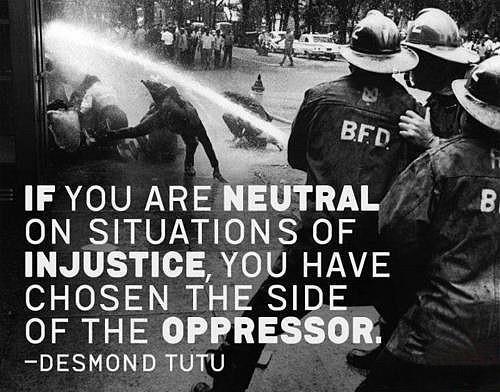
injustice engraved

Worse, the dearth of a justice framework has allowed some to reduce biblical justice issues as “social justice” or “economic justice” to mere politics. Both fit within the Bible’s call for justice, but neither sociology nor economy completely wrap their arms around biblical justice.

Calls to help the poor and disadvantaged are sometimes derided as left-wing distractions from the church’s primary role of evangelism. However, even a cursory search of scriptures reveals more than 130 uses of justice. It is used of God’s character, as a basis for asking for His intervention, as commands to His children, as expectations and examples. Justice is used in the context of helping the poor, taking care of business affairs, how orphans are treated, and judgments “in the gate,” ie, legal decisions. Consider this sampling:

Psalm 106:3-“Blessed are they who observe justice, who do righteousness at all times.”
Psalm 112:5– “It is well with the man who deals generously and lends; who conducts his affairs with justice.”
Proverbs 21:3-“To do righteousness and justice is more acceptable to the Lord than sacrifice.”
Proverbs 21:15-“When justice is done, it is a joy to the righteous but terror to evildoers.”
Isaiah 1:17-“Learn to do good; seek justice, correct oppression; bring justice to the fatherless, plead the widow’s cause.”
Isaiah 59:14, 15-“Justice is turned back, and righteousness stands far away; for truth has stumbled in the public squares, and uprightness cannot enter. Truth is lacking and he who departs from evil makes himself a prey. The Lord saw it, and it displeased him, that there was no justice.”
Hosea 12:6-“So you, by the help of your God, return, hold fast to love and justice, and wait continually for your God.”
Amos 5:24-“But let justice roll down like waters, and righteousness like an ever-flowing stream.”
Micah 6:8-“He has told you, O man, what is good; and what does the Lord require of you but to do justice, and to love kindness, and to walk humbly with your God?”
Hebrews 11:32, 33-“And what more shall I say? For time would fail me to tell of Gideon, Barak, Samson, Jephthah, of David and Samuel and the prophets–who…enforced justice,” (all ESV)

In scripture justice does not supplant the character of God, it flows from it. Calls for justice do not obscure the gospel, they bear witness to it. If justice is a left-wing, commie pinko plot the only alternative is to call the Bible a left-wing, commie pinko book.

It is to the discredit of American Christians that we have so readily and uncritically embraced our political system. We join the rancor of the powerful and gorge ourselves on the rewards of an earthly throne. We are reticent to “speak truth to power” because our team may be back in power after the next election. We have swallowed worldly systems hook, line, sinker, rod, reel and boat. Thus, care for the poor, to use a single example, with its clear biblical imperative, is bounced about as a Democrat-Republican debate.

God forbid.


Surely the prophet Nathan scratches his head at what passes for prophetic these days. Preaching against abortion to a TV audience is not prophetic. Mother Teresa speaking against abortion before the president of the United States is.

The Holy Spirit is yet quenched if we create a ranking system for justice based merely on what tugs on our heart strings, rather than what offends God’s character. And it is this–offending God’s character–that reveals injustice.

A few months ago I mused on a broad expression of injustice:

Injustice is the deprivation of basic human rights, dignity or freedoms by those in authority through oppressive or unfair laws, customs or mores that allow the physical, sexual, or economic exploitation of men, women or children who lack power, position or voice, affecting individuals and groups, whether unique or systemic, hidden or known, all of which grows from contempt toward or ignorance of God’s standard of righteousness.

If this is a fair enough description, what follows is what it would mean to “do justice” or “enforce justice.”

Doing justice is using all righteous means to restore basic human rights, dignity and freedom to men, women or children everywhere, becoming their voice to address, rebuke or replace those abusing power so God’s standard of righteousness is recognized and reflected as much as it is possible within the fallen systems of this world until Christ brings the kingdom of God in its fulness.

To “do” or “enforce” justice is a clear call to God’s people. The extensive Old Testament groundwork is affirmed in the New. Where power is abused, and when the established authority, ie, government, is either complicit or ignorant, justice must be pursued.

We are not given the option to pick and choose between preferable justice issues. Doing justice is shining light in the darkness. It is being a city on a hill. It is the kingdom of God displayed on earth. And only a full framework of biblical justice prepares us to do justice when and where the righteousness of God should most be on display.

Some of my other articles on justice and injustice:
Our Comfortable Injustice-Part 1 and Part 2.
The gospel to the poor
When injustice is enough justice: Parsing theology into nothingness

A prayer from St. Patrick

I arise today
Through a mighty strength, the invocation of the Trinity,
Through the belief in the threeness,
Through confession of the oneness
Of the Creator of Creation.

I arise today
Through the strength of Christ’s birth with his baptism,
Through the strength of his crucifixion with his burial,
Through the strength of his resurrection with his ascension,
Through the strength of his descent for the judgment of Doom.
20130317-061630.jpg
I arise today
Through the strength of the love of Cherubim,
In obedience of angels,
In the service of archangels,
In hope of resurrection to meet with reward,
In prayers of patriarchs,
In predictions of prophets,
In preaching of apostles,
In faith of confessors,
In innocence of holy virgins,
In deeds of righteous men.

I arise today
Through the strength of heaven:
Light of sun,
Radiance of moon,
Splendor of fire,
Speed of lightning,
Swiftness of wind,
Depth of sea,
Stability of earth,
Firmness of rock.

I arise today
Through God’s strength to pilot me:
God’s might to uphold me,
God’s wisdom to guide me,
God’s eye to look before me,
God’s ear to hear me,
God’s word to speak for me,
God’s hand to guard me,
God’s way to lie before me,
God’s shield to protect me,
God’s host to save me
From snares of devils,
From temptations of vices,
From everyone who shall wish me ill,
Afar and anear,
Alone and in multitude.

I summon today all these powers between me and those evils,
Against every cruel merciless power that may oppose my body and soul,
Against incantations of false prophets,
Against black laws of pagandom
Against false laws of heretics,
Against craft of idolatry,
Against spells of witches and smiths and wizards,
Against every knowledge that corrupts man’s body and soul.

Christ to shield me today
Against poison, against burning,
Against drowning, against wounding,
So that there may come to me abundance of reward.
Christ with me, Christ before me, Christ behind me,
Christ in me, Christ beneath me, Christ above me,
Christ on my right, Christ on my left,
Christ when I lie down, Christ when I sit down, Christ when I arise,
Christ in the heart of every man who thinks of me,
Christ in the mouth of everyone who speaks of me,
Christ in every eye that sees me,
Christ in every ear that hears me.

I arise today
Through a mighty strength, the invocation of the Trinity,
Through belief in the threeness,
Through confession of the oneness,
Of the Creator of Creation.

(HT: Klampert)