Tag Archives: food stamps

Adventures in food stamps: a personal story

I have never been on food stamps. Sonya, my wife, was raised in a family that has never been on food stamps.

A while back I was underemployed for a period of almost two years. My income was drastically reduced. Twice during that time we strongly considered at least applying for food stamps (now called SNAP–Supplemental Nutrition Assistance Program). The second time I had already found the office address for making the trip to apply. Both times we decided not to apply. We do not have the experience of being looked at with disdain by other shoppers who wonder if we are lazy, criminal, or “just poor.” Or those other shoppers who examine the groceries of such folks for any non-generic items.
We did enough research to know the stamps have been traded for reloadable cards. Rather than a book of tear off sheets, recipients pay just like using a debit card. Folks around the check-out line who are not paying attention may not even realize the difference.

Which brings me to a story of Sonya yesterday at our local Aldi grocery store (a story she did not want to to relate, but here we are).

The lady in front of Sonya, whose groceries were being scanned, was old enough to be in the social security range. Sonya watched as they removed item after item from her order, rerunning her card to no avail. Soon it became clear the woman did not have any money on her card.

It was about this time Sonya realized she was trying to pay with her SNAP card. She heard the customer and cashier discussing what day of the month and that the card should already have been refilled for use. It dawned on the lady trying to buy the groceries that no matter how many groceries were removed she could not pay for what was left.

As Sonya watched these events unfold the Holy Spirit prompted her to include the lady’s purchase in our own. So she said to the cashier, “I’ll get hers. Just include it with my groceries.”

After the expected quizzical looks from customer and cashier, the customer expressed her profound appreciation. After the transaction was completed she and Sonya hugged several times, near tears. Sonya said, “God will meet your needs and He’ll meet ours.” About then the cashier let loose with “That’s right! Amen!” and a small revival was had in the grocery story.

As they were getting ready to leave the lady then asked, “Where do you go to church?” After Sonya told her, she said, “Well, I was about to invite you to mine.”

I relate this story primarily to highlight generosity and the blessing of following God. But there is another component.

When talking about the poor we often hear the argument, “It is not the responsibility of the government to help the poor. It is the responsibility of the church.” It sounds good, right? It sounds right, right?

But is not the church (or churches) made up of people? Of we who claim the name of Jesus? How much helping of the poor do we really do? If all income taxes were to fall away overnight, would Christ followers increase their offerings or increase their possessions? Would we buy pants, shirts, gloves, and food for those in need, or empty our own closets of perfectly good threads to make room for armloads from our favorite clothier?
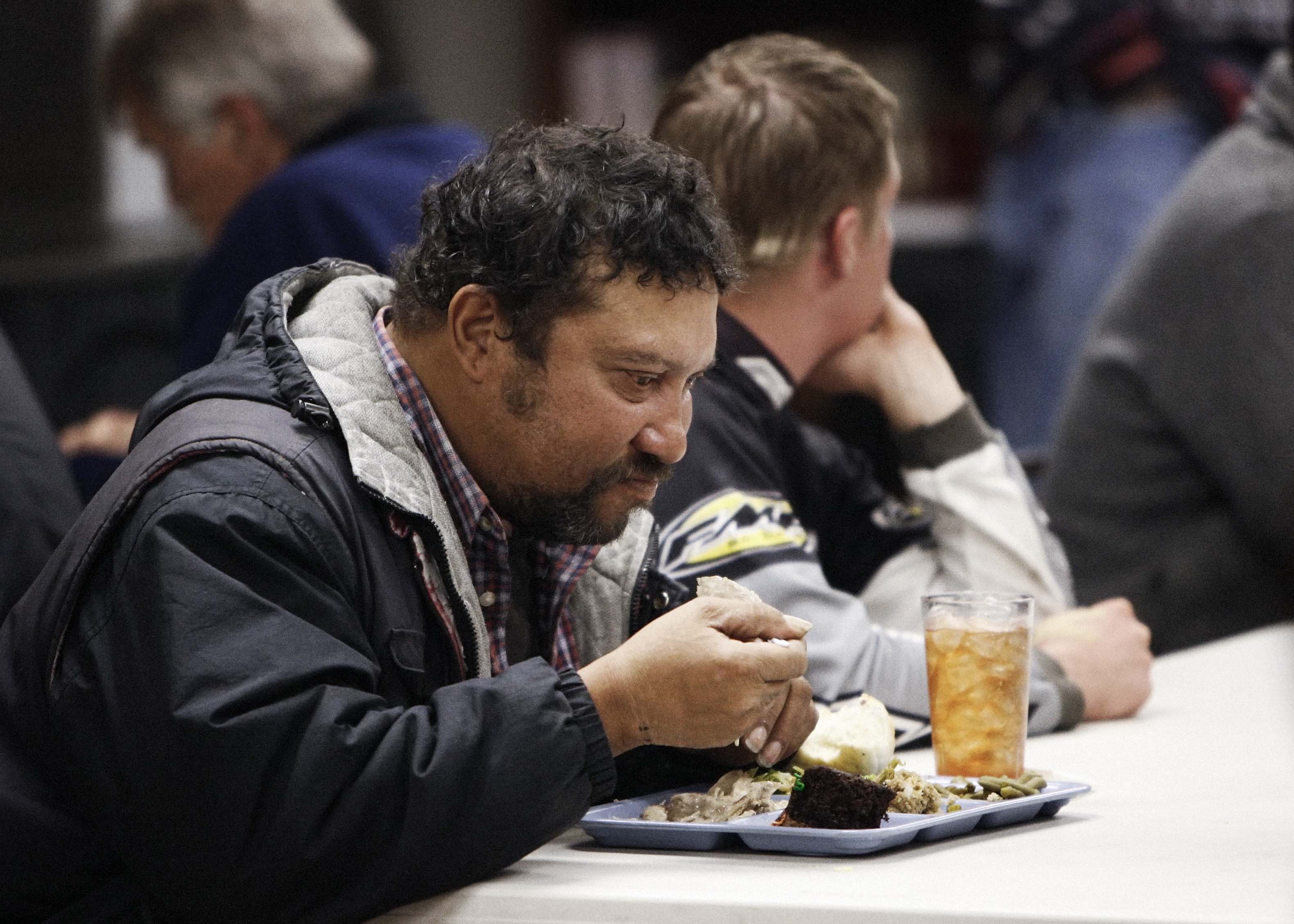
feeding the hungry and homeless

Would we feed the hungry and homeless? [Image credit]

In a conversation with a homeless person yesterday, Sonya found out his greatest need is for thermal underwear (as he stands in the cold selling newspapers). If we fill that need it may mean that one of us does without something we would like to have. Just how long would we live like that?

Would churches reallocate their budgetary funds away from buildings and property that house the faithful once or twice a week to construct, fund, and staff shelters for the long-term and transitional homeless? Organize and provide job training or job opportunities? You know, the stuff some say the government should be doing?

If churches were suddenly awash in cash from generous members would they join together with other churches to supplement the food needs in their community, or just hire additional staff to do the ministry the members should already be doing?

In short, would we “do justice,” or merely do business as usual?

Support this blog! Even $1 is helpful. No PayPal account necessary.


Food stamps and voting: What do the maps show?

Before the election much hubbub was made about the numbers of people being added as recipients to the SNAP (food stamp) program. Some wondered at the possibility of those being bought votes. In the form of a question, did the Obama administration recruit people to the assistance program to ensure a re-election victory? In the mean time, people wondered, were we being bled dry be a bunch of lazy, shiftless, good for nothings who are just taking advantage of the governmental teat?

According to the Wall Street Journal the average food stamp family in 2010 had $731 per month in gross income. They received just $287 per month from SNAP. The Journal also reported

Nearly 21% of households on food stamps also received Supplemental Security Income, assistance for the aged and blind. Some 21.4% received Social Security benefits. Just 8% of households also received Temporary Assistance for Needy Families, the cash welfare program.

But some 20% of households had no cash income of any kind last year, up from 15% in 2007, the year the recession began, and up from 7% in 1990.

That’s partly because most household heads who were receiving food stamps were also out of work. Just 21.8% of them had jobs in 2010, while 19.8% were jobless and looking for work.

More than half of household heads who received food stamps, 51.1%, weren’t in the labor force and weren’t searching for work. Labor-force dropouts have been a particular concern for economists, who worry their lost potential damages economic output. Those who drop out of the work force often turn to other government programs, such as Social Security disability, which is costly.

[…]

Just 6.7% of households who received food stamps were getting jobless benefits.

Nearly half of all food-stamp recipients, 47%, were children under the age of 18. Another 8% of recipients were age 60 or older.

Whites made up the largest share of food stamp households, 35.7%. Some 22% of households receiving food stamps were counted as African American and 10% were Hispanic.

U.S. born citizens made up the majority, 94%, of food stamp households.

While it is true SNAP users have increased dramatically under the Obama administration a substantial increase had already begun under the Bush 43 administration. The extent of the economic downturn between the fall of 2007 and 2011 would likely have seen a continued increase if there had been a third Bush term. (Only Clinton at -8.2% and Reagan at -2.4% have overseen declines in the last eight presidencies.)

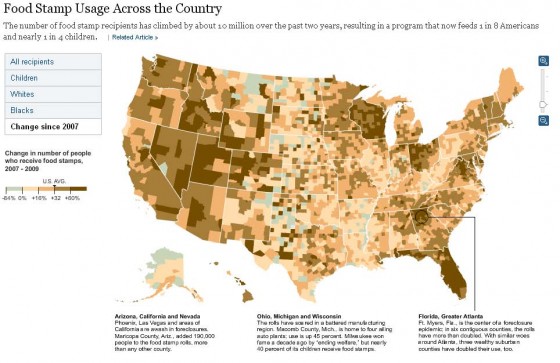
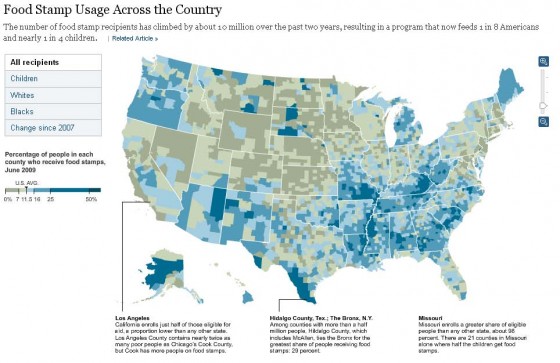
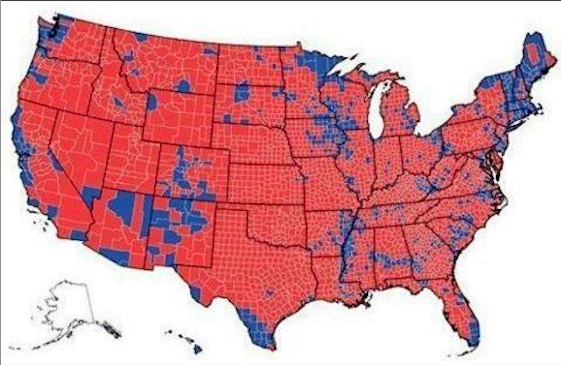
So what about the votes? Below are four national county maps. The first is voting by county for the 2008 election. Then the amount of county-by-county increase in food stamps recipients between 2007-2009. Beneath that is the percentage of residents on food stamps in each county nationally in 2009. Finally, a county-by-county voting map of the 2012 election.

I am neither a cartographer, a politician nor the son of either. However, it looks like an awful lot of counties with high concentrations of food stamp recipients voted Red (ie, GOP). It is true that the highest numbers of recipients are in Blue (Dem) areas, but I think it is too strong a suggestion to say all food stamp recipients voted Democratic. It is also too strong to say Obama carried the day because of that vote. Since 18M people been added since Obama took office and he won by less than 3M votes, and since he garnered 9M more votes in 2008, it seems hard to argue that SNAP recipients contributed meaningfully to his victory.
2008 election map

u.s. county map food stamp growth

2009 u.s. county map food stamps

2012 election u.s. county map

Thoughts?