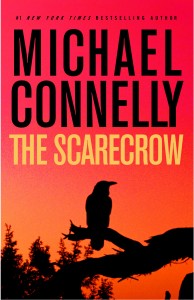
 The Scarecrow was Michael Connelly’s first release of 2009, being followed by the recently released 9 Dragons. Two major hardback releases in a single year is unusual for many writers (a notable exception is James Patterson) and Connelly, if not suffering from a lack of productivity seems to be suffering from a lack of creativity.
Scarecrow features one of Connelly’s four main protagonists, L.A. Times reporter Jack McEvoy (the others being LAPD detective Harry Bosch, FBI agent Terry McCaleb and attorney Mickey Haller ) and begins with McEvoy’s investigation into the arrest of a young man, Alonzo Winslow, who is found driving around with a body in the trunk of his stolen car. A call from the accused’s grandmother/mother gives the soon-to-be unemployed (due to corporate downsizing) reporter a final big story, which he hopes to turn into a Pulitzer as a means of payback to the paper which no longer needs him. The “big story” is that Winslow has been wrongfully charged for the crime; a charge from which McEvoy’s investigative skills will extricate him.
At this point of the narrative I had high hopes. The book is quite thick, so I was prepared for many chapters of L. A. culture, racial apprehension and tension, legal maneuvering and a bang up finish.
Maybe next time.
Instead, the story takes a turn into serial killer land and only returns to its start as Alonzo is paraded out unceremoniously for a TV appearance. McEvoy ultimately is teamed with a recurring Connelly character, FBI agent Rachel Walling, who is also a former love-interest of McEvoy’s (and Bosch’s) hearkening back to Connelly’s earlier effort, The Poet. Other than background information on the ease by which one’s entire life can be pieced together via public information on the Internet, this book simply does not work. There is too little character development, the action is predictable and the ending unsatisfying. Rather than being a story that draws one into a vortex, it ends up more as a sermon about the dangers of the Internet.
Having read virtually all of Connelly’s novels, McEvoy has always seemed his weakest character and The Scarecrow does nothing to dissuade me of that thinking. If Bosch was not to appear this time around, I was hoping to see another full length Haller story since Connelly’s turn at the legal genre was quite satisfying. (Haller does return in 9 Dragons along with Bosch.)
The Scarecrow will, quite likely, please some, perhaps many, die-hard Connelly fans, but new readers wanting to absorb his finest work should look earlier to Trunk Music or The Concrete Blonde or later to The Lincoln Lawyer, each of which may be purchased below.