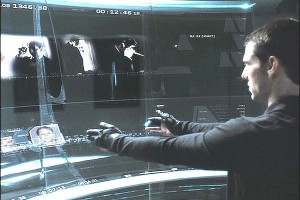
Image: Twentieth Century-Fox
Can humans develop a “sixth sense” for accessing information databases? Do humans need a sixth sense? What kinds of abuse could being online 24/7/365 bring?
If you have seen the Tom Cruise/Steven Spielberg film, Minority Report, you may have been forced into thinking about the extent of government intrusion that may take place in a country at any given time. Libertarians and constitutionalists warned that The Patriot Act opened the door to a regular abuse of civil liberties under the guise of fighting a “war of terror,” to use Borat’s jumbled description.
If you remember Haley Joel Osment’s haunting turn as the literally haunted Cole “I see dead people” Sear in The Sixth Sense, then you know his “sixth sense” was his ability to see and communicate with the dead, ultimately with the challenge to help them in slightly more serious ways than Ricky Gervais similar effort in Ghost Town as he was also able to communicate and help the dead through a sixth sense developed during his own near death experience.
Several months ago, MIT prof, Pattie Maes, gave a lecture at TED regarding a new sixth sense available to humans. Not exactly communicating with the dead, this gizmo, developed by her student, Prinav Mistry, gives the user the ability to access the information of the internet instantly to assist with decision making and has the capacity to replace clock, watch, camera and your subscription to Consumer Reports. Imagine going to a car lot, new or used, and asking the salesman for information and, while hearing a skewed sales pitch, having the accurate info beamed right onto the hood of the car (or in a future iteration the inside of your sunglasses). Think of meeting a new coworker who sees emblazoned on your white blouse:
Ordered room service for two at the Ritz-Carlton in Atlanta last night; husband ordered room service for one at the Holiday Inn, San Francisco airport.
Watch the video and see what you think; leave a comment if you desire. Is this “Big Brother” or are we big brothering ourselves? Is this government intrusion or Google instrusion? Can she be serious when she talks about a “sixth sense chip” being implanted in one’s brain? Would you get one?
(HT: Brett Compton)
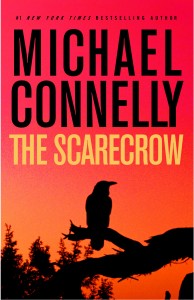 The Scarecrow was Michael Connelly’s first release of 2009, being followed by the recently released 9 Dragons. Two major hardback releases in a single year is unusual for many writers (a notable exception is James Patterson) and Connelly, if not suffering from a lack of productivity seems to be suffering from a lack of creativity.