Here it is, sure as shooting.
Author Archives: Don Duckston
Another test post for email alerts
Test again for another email post.
Testing, testing, 1, 2, 3
This is a test post for mailchimp.
Three reasons we are eating organic food
Like most people raised in the suburbs of a metropolitan area, nearly all of our food growing up was a product of the industrialized food system. Neither my family’s nor my wife’s meals were dominated by McDonald’s or Burger King. But that really does not matter since most food in grocery stores is processed by the same companies in the same way.
Documentaries like Fresh and books by Joel Salatin convinced me we needed to begin the shift to organic food (although we still currently enjoy lots of processed sweets and desserts).
I’m using the word “organic” not in the same way the USDA uses it, which can be sketchy. In my use consider locally grown, as little chemical fertilizer as possible, as little insecticide as possible, as little transport as possible, as little processing as possible. Give me eggs from chickens walking around the pasture, beef from grass-fed cows rather than corn and carrion fed cows, pork from oinkers in the field rather than from a cage shot-up with anti-biotics from birth.
The first time we had organic chicken from a local butcher, Sonya had prepared a dish we had frequently eaten. After one bite of the chicken we are all looking at each other asking, “If this is chicken, what in the world have we been eating?”
It is the same with farm direct, organic eggs. First you notice how much harder the shell is than a store-bought, industrialized egg. Then a bright orange yolk is staring up at you instead of a pale-yellow something and you wonder, “If this is a real egg, what are those other things and what has been laying them?” You may not want to know.
So we are shifting toward organic. Here are three reasons to consider it.
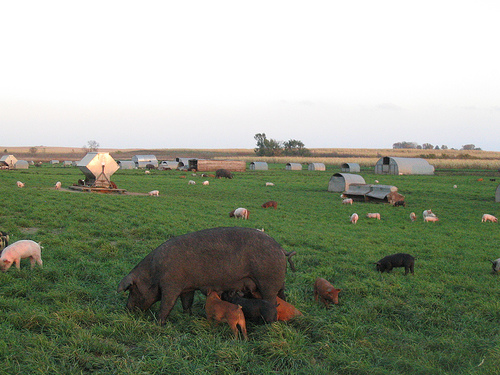
(Compare the above “free range sow” to the sow in the video below.)
1. Organic food tastes better and is better for you.
Undertand the process of industrializing the food chain requires many rounds of anti-biotics to prevent diseases in the confined spaces. The medicine, stress, and often toxic-environment all contribute to the shrink-wrapped package cooly displayed at the local grocery store.
There are reasons E-coli originates in the industrial food system.
Then there is the taste. Unless your taste buds are on a permanent vacation the taste difference will be immediate. It will also be for the better.
2. Buying local supports local, small farms.
If the food tasted exactly the same–and it does not–buying local is still a better option, when the option exists. CSAs and farmer’s markets remain great locations to get locally grown produce and meat. It also allows you to meet the local farmer and possibly even visit the farm.
The industrialized food system has no interest at all in your health, unless your loss of it can be directly attributable to their product. As with all things capitalist the bottom line is the bottom line. Profit margins will trump health concerns every time. Agribusiness needs my dollars a lot less than Shady Farms.
3. Choosing organic is a means of honoring God’s covenant with the earth.
After the flood of Noah God promised never to destroy the earth and its inhabitants by water. Often overlooked is that God’s covenant is not only with humanity, but with the animals as well.
Then God said to Noah and his sons with him, “Understand that I am confirming My covenant with you and your descendants after you, and with every living creature that is with you–birds, livestock and all the wildlife of the earth that are with you–all the animals of the earth that came out of the ark. (Genesis 9:8-10, HCSB)
The verses immediately preceding affirm these animals are provided for food.
Proverbs says “The righteous care for the needs of their animals” (12:10, NIV). This does not only refer to dogs and cats (ie, pets) since pets were not the order of the Old Testament day. The reference is to productive animals like animals used in farming. If a mistreated dog is offensive to you, then mistreated pigs, chickens and cows should be offensive as well. Compassion should exist even if the heart strings are not strummed in the same way.
The following video shows the industrial food system as it works in one Asian country eventually reaching the fast food chains. The sublimity of the soundtrack is a vivid contrast to the processing taking place on screen.
Foodies, share and share some more through my social media buttons! (HT: Kottke)
Support Kingdom in the Midst when you purchase from Amazon. You get the same low price and I get a small commission.
The Backyard Homestead is on my wish list, hint, hint…
Comedian Russell Brand on addiction
In a recent piece for The Guardian British comedian Russell Brand pulled back the curtain on his struggle with drug and alcohol addiction. It is an troubling read, or I anticipate it will be to many. If my post yesterday was revealing to those for whom depression is not an issue, this will likewise be for those of us who have no struggle with addiction.
Brand’s piece is also surprisingly eloquent. He seems to write less to gain sympathy for himself than to gain empathy for those walking his path in his shoes.
Here are some excerpts:
The last time I thought about taking heroin was yesterday. I had received ‘an inconvenient truth’ from a beautiful woman. It wasn’t about climate change (I’m not that ecologically switched on). She told me she was pregnant and it wasn’t mine.
I had to take immediate action. I put Morrissey on in my car and as I wound my way through the neurotic Hollywood hills my misery burgeoned. Soon I could no longer see where I ended and the pain began. So now I had a choice.
Russell Brand [Image Credit]
I cannot accurately convey to you the efficiency of heroin in neutralising pain. It transforms a tight white fist into a gentle brown wave, and from my first inhalation 15 years ago it fumigated my private hell. A bathroom floor in Hackney embraced me like a womb, and now whenever I am dislodged from comfort my focus falls there.It is ten years since I used drugs or drank alcohol and my life has immeasurably improved. I have a job, a house, a cat, good friendships and generally a bright outlook.
But the price of this is constant vigilance, because the disease of addiction is not rational. Recently, for the purposes of a documentary on this subject, I reviewed some footage of myself smoking heroin. I sit wasted and slumped with an unacceptable haircut against a wall in another Hackney flat (Hackney is starting to seem like part of the problem), inhaling fizzy black snakes of smack off a scrap of crumpled foil. When I saw the tape a month or so ago, what was surprising was that my reaction was not one of gratitude for the positive changes I’ve experienced. Instead I felt envious of this earlier version of myself, unencumbered by the burden of abstinence. I sat in a suite at the Savoy hotel, in privilege, resenting the woeful ratbag I once was who, for all his problems, had drugs.
[…]
Drugs and alcohol are not my problem — reality is my problem. Drugs and alcohol are my solution.
If this seems odd to you, it is because you are not an alcoholic or a drug addict. You are likely one of the 90 per cent of people who can drink and use drugs safely. I have friends who can smoke weed, swill gin, even do crack, and then merrily get on with their lives. For me this is not an option. I will relinquish all else to ride that buzz to oblivion. Even if it began as a timid glass of chardonnay on a ponce’s yacht, it would end with me necking the bottle, swimming to shore and sprinting to Bethnal Green in search of a crack house.
I looked to drugs and booze to fill up a hole in me. Unchecked, the call of the wild is too strong. I still survey streets for signs of the subterranean escapes that used to provide my sanctuary. I still eye the shuffling subclass of junkies and dealers, invisibly gliding between doorways through the gutters. I see the abundantly wealthy with destitution in their stare. I have a friend so beautiful, so haunted by talent that you can barely look away from her, whose smile is such a treasure that I have often squandered my sanity for a moment in its glow. Her story is so galling that no one would condemn her for her dependency on illegal anaesthesia, but now, even though her life is trying to turn around despite her, even though she has genuine opportunities for a new start, the gutter will not release its prey. The gutter is within.
It is frustrating to love someone with this disease. A friend of mine’s brother cannot stop drinking. He gets a few months of sobriety and his family bask, relieved, in the joy of their returned loved one. His life gathers momentum, but then he somehow forgets the price of this freedom, returns to his old way of thinking, picks up a drink and Mr Hyde is back in the saddle. Once more his face is gaunt and hopeless. His family blame themselves and wonder what they could have done differently, racking their minds for a perfect sentiment wrapped up in the perfect sentence, a magic bullet. The fact is, though, that the sufferer must be a willing participant in their own recovery. They must not pick up a drink or drug. Just don’t pick it up — that’s all.
[…]
Even as I spin this web I am reaching for my phone. I call someone, not a doctor or a sage, not a mystic or a physician, just a bloke like me — another alcoholic, who I know knows how I feel. The phone rings and I half hope he’ll just let it ring out. It’s 4a.m. in London. He’s asleep, he can’t hear the phone, he won’t pick up. I indicate left, heading to Santa Monica. The ringing stops, then the dry-mouthed nocturnal mumble:
‘Hello. You alright, mate?’
He picked up. And for another day, thank God, I don’t have to.

Much of Brand’s writing is surprisingly biblical. “The gutter is within”? Whether Brand knows it or not, this is a paraphrase of Jesus. “Reality is my problem”? That is absolutely true; he simply does not seem to know how God defines that particular reality. “I see the abundantly wealthy with destitution in their stare.” Because we are not redeemed with silver or gold, but by the precious blood of Christ as a lamb without spot or blemish.
Both Brand and Craig Ferguson (below) allude to “self-medication,” to the use of drugs and/or alcohol to numb the realities of life. Sometimes I wonder if the church has not anesthetized herself against people like Brand and Ferguson. It is easier to rail against the evils of “demon liquor” than to be the person who will receive a phone call at 4:00am. It is self-medicating to my pride to keep a Russell Brand at arm’s length. We will not be the person who gets the call until we are the person who is the friend.
Several years ago late-night TV host Craig Ferguson opened up about his own addiction. This is incredibly open and personal. If you do not have time to watch the entire piece, skip ahead to about 3:30. (Two or three swear words.)
Depression: When the black dog howls
A version of this was first posted as a Facebook note in 2009. Nothing in this post should be construed as medical or medicinal advice.
The term “black dog” was used by Winston Churchill to describe depression and, though it predates the British prime minister, is the sum total of familiarity most seem have with it. Regardless of who coined it, “black dog” is as apt a descriptor of the frustrating experience of depression as there is. Ask anyone who deals with it regularly.
At this point in my life I cannot even remember when I started dealing with depressive episodes. (I do not use the phrase “suffering from depression”; it just does not seem to fit me.) I’m pretty certain that it has not always been a part of my life, though it may have been unrecognized earlier on. For the last few years, however, there are three or four times each year that it hits.
It is funny when you start talking about being depressed and experience the reactions of those around. The responses can range from the spiritual (“Pray more.”), to the physical (“Are you getting outside enough?”) to the ludicrous (“Just pull out of it.”)
One can no more “just pull out of” a depressive episode than they can “just pull” the moon out of its orbit.
This note is the result of my own observations and experiences over the last couple of years.
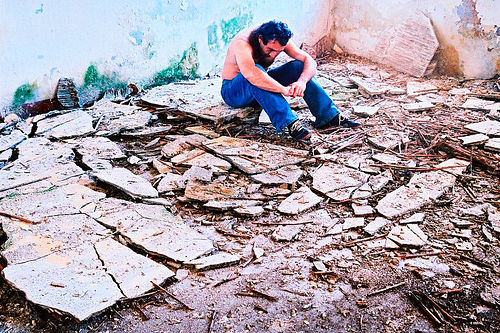
1. No one wants to be depressed. Nobody would choose it. It is not to get attention. There are easier and far more fun ways of getting attention.
2. Anything or nothing can trigger it. It can be turmoil on the job. Or not. It can be the kids growing older. Or not. It can be you growing older. Or not. It can be feeling inadequate on the job. Or not. All of the above, or none of it. Or anything else that you can put your finger on. It just shows up howling its blooming head off.
3. Sometimes you can be in it before you realize it. This is especially true with me. Sonya usually recognizes it before I do. I usually do not realize how depressed I am until I do not know if I can work another day, and that is even when things are good.
4. There are no easy steps out. Sometimes you just cannot tell if or when it will go away. I’ve awakened in the morning feeling pretty good only to have it return in half an hour leading to an entire day of “down” feelings.
5. Things may not be the same for every person with depression. It might be easier to relate to people in depressive episodes if they were all the same, but they are not.
What not to say to a depressed and why:
1. “Pray.” (Or these variants, “Pray more,” “Are you praying enough?” “Have you prayed about it?”) Depression is always a matter of prayer. If prayer was the solution there would not be any depressed Christians, since we all pray about it. Yes, I wish that God would always take it away for just the asking, but since Moses, Elijah and Paul dealt with it periodically, I don’t see that God will take it away just because He’s asked. It does bear remembering that prayer can actually make you more depressed since the tendency is to focus on the depression. This can be a tricky proposition.
2. “Cheer up.” Depression by nature is an emotional “out of whackedness.” A depressed person cannot simply get happy because they decide to do so any more than you can get from Nashville to Los Angeles by clicking your heels together. Although depression might be caused by various factors, in the end it is a feeling of sadness that usually seems impenetrable and, while you are in the midst of it, permanent. I’ve never been suicidal (or homicidal) during a depression, but I understand how some people can get that way. Just imagine the most sad you have ever been and then being convinced that it will never go away. The feeling of potential “lifelong sadness” is more than some can bear.
3. “Just trust God.” To do what, exactly? I do trust God and try to trust Him with every aspect of my life and depression still strikes. I trust Him to see me through it each time, but it does not make it go away immediately, though it always does with time.
4. “Don’t isolate yourself.” This one is actually true and helpful, but sometimes really hard to do. When depressed, there are few if any feelings of desire to socialize with ten or with one. Of course this exacerbates the situation but remains an issue. Depression can result from and cause a desire for isolation. It is not so much not wanting to be a wet blanket as it is not wanting to have to expend the emotional energy to carry on conversation. Any expenditure of emotion worsens the lack of emotional balance symptomatic of the depression itself. I have experienced great times of fun and laughter while depressed, then turned away and felt just as sad or “blue” as before. Laughter may be the best medicine, but it is not always the cure.
5. “Get some meds.” Some people are offended by the idea, since it is sometimes mentioned flippantly. I have not yet gotten a prescription, but I’m considering it. (Is it the purple pill, the blue pill or the hexagonal pill?) The thing that I am most working through is whether medication is necessary for something that happens three or four times a year.
What do to for a friend who is depressed:
1. If you deal with it, be open about it. Depression may be a black dog, but it should not be a dirty secret. Some men view it as weakness and thus it retains a hold on them. Bite the dog; don’t let it continue to gnaw on you. Be sensitive when you recognize that a friend is depressed, and be open when that friend is just realizing it for themselves. Sometimes depression makes you feel crazy; hearing from a friend who struggles through it and retains most of their sanity is an encouragement for others not to give up.
2. Don’t think that going to a ball game or a movie is “just what they need.” It may or may not be; depression is a tricky thing and when I am depressed, I often do not know what in the world I want to do. I do find that being in the company of another person, whether Sonya or a friend, who does not demand that I talk or interact can be helpful. Just hanging out. It takes a lot of energy to carry on conversation or “just be yourself” when there is no inner drive at all to do anything.
And on this note, don’t give a book, website, sermon, podcast, or other thing you think “might help.” The person typically feels broken already. Offers to “fix them” can serve to reinforce their feelings of inadequacy. Be friend enough to long time care without immediate repair.
3. Do pray because often your depressed friend finds little comfort in praying themselves. In addition prayer while depressed can be tricky. It is very easy for prayer itself to become depressing when depressed. I am not sure why.
4. Don’t judge the whys and wherefores, especially if you’ve never dealt with it. It’s very, very hard to explain; heck, it’s very, very hard to deal with emotionally, physically and spiritually. Depression may or not be spiritual and if it is not, then it is very frustrating to be given a simplistic answer revolving around a book, dvd or sermon series.
5. If the person begins to talk suicide or act suicidal to any degree, intervene; obviously, sadly some depressive episodes end in suicide. I knew a fellow many years ago who seemed for all the world to be ok. He woke up one morning to leave for vacation and saw that it was raining. Despondent over that particular situation, he went back into his house and killed himself. It was almost unbelievable to hear. At the time I thought, “How in the world…”
When writing this post originally I received a great amount of encouragement. I was steered to a natural product called St. John’s Wort available at almost any grocery store or drug store. It has proven to be very effective for me at both preventing and helping lift depression. I now take it only as needed which is infrequently.
All-in-all I see depression a result of the fall, not a part of God’s creation. As such Jesus died so that we might have ultimate deliverance from it. That may or may not happen in this life for me, but it gives me yet another reason to long for That Day.
Exactly how much will some people lie? Jimmy Kimmel knows
Jimmy Kimmel has a segment on his show called “Lie Witness News.” It is similar to other person-on-the-street interviews with this caveat: the interviewer is asking completely bogus questions. Nothing about the questions is true because nothing about them can be true. “What did you think about the debate?” when the debate has not taken place. “Who are you voting for?” when no such office exists.

Image credit: Disney
As Kimmel wryly notes, “We found people who had strong opinions about these imaginary events.”
One thing this demonstrates is people will lie and sometimes continuously if it makes them looks smart. Or if they think it makes them look smart. While this is likely true everywhere, it is doubtless true on Hollywood Boulevard.
“Did you vote in today’s vice-presidential election?”
And then there is this one where one of the liars shows up on the studio audience. He does not escape Kimmel’s attention.
“Who Won Last Night’s First-lady Debate?”
Check out shade-grown, direct-trade Highlands Coffee
Russ Rankin has been a good friend for nearly a decade. He’s also a food and coffee aficionado of the first order. An attentive magazine or newspaper editor would have him write a periodic food critic column.
Conversations on justice led to the idea of him “reviewing” coffees for Kingdom in the Midst. For these posts Russ will only be reviewing coffees that reflect fairness toward growers and roasters. All coffees may not be “Fair Trade,” but they will be fairly traded. This is the first in an ongoing, occasional series. Follow Russ on Twitter or on Instagram (where he posts numerous photos of coffee and food).
 Flor de Jinotega by Highlands Coffee (more about the organization below) is a classic high-mountain, shade-grown Central American coffee grown at elevations of 3,200-4,600 feet above sea level.
Whatʼs the big deal about shade grown? Coffee fruit growing under shade — like under jungle foliage or forestation — takes a longer time to ripen and mature. If picked and dried well and not over-roasted, shade-grown coffee will yield a very nice complex palette of flavor. This is truly the best way to grow coffee, but the practice is omitted by commercial growers because coffee shrubs kept in direct sunlight will grow their fruit faster. Itʼs more about the volume.
If your go-to morning coffee is a bold blend from the worldʼs largest coffee chain, or if you regularly pound black espressos (raising my hand here), your first inclination will be to say Flor de Jinotega coffee is weak. But donʼt dismiss it. Flor de Jinotega has a hint of sweet, nutty cacao and I found the flavor actually pleasantly grows as it lingers. It doesnʼt deliver an intense deep flavor, but has a smooth, wide, clean note. Thereʼs no bitter aftertaste; it is flavorful with an earthy, almost fruity nuttiness.
I probably would not choose Flor de Jinotega as my morning kickstart (see the pounding espressos reference above), but I would definitely love a French press of this bean after lunch. Followed by another one. Or three.
The Cause:
This coffee is sold by Highlands Mission Cooperative (HMC). Driven by a compassion to serve others and love as Christ, HMC and its partners are working together to improve the quality of life and to share Christʼs story of redemption and hope. By assisting and providing the “basics of living” — clean water, sanitation, health education, and nutrition, HMC helps the rural villages improve their quality of life. In sharing the love and joy found in Christ, HMC is able to nuture “community” and bring new hope and purpose to living.
HMC partners with The Society of Small Producers for Coffee Export (SOPPEXCCA) — a coffee cooperative comprised of 650 producers from the province of Jinotega in northern Nicaragua. Despite the severe challenges of natural and economic disasters, the self-sustaining co-op has become one of the highest quality coffee cooperatives in the country and produces, processes and markets its own coffee. SOPPEXCCAʼs 65 percent female membership and gender-equality blends makes this a truly exemplary cooperative. SOPPEXCCA became Fair Trade certified by Fairtrade Labeling Organizations International (FLO) in 1998.
FROM MARTY: Sonya and I have been drinking Highlands Coffee for about a week and love it. We have become coffee snobs anyway, but the opportunity to support this local co-op really excites us. I recommend it compared to any medium-roast I have tried.
To order Highlands Mission Coffee (ground or whole bean), which sells for $12.00/lb + shipping, click here. To read more about Marty’s mission trip this summer with Highlands Mission Cooperative, click here.
Russ Rankin has been called a coffee snob, but really heʼs just a guy who appreciates quality and the adventure found in a good cup of coffee. He has drank coffee in the jungles of Sumatra that was pounded in mortar and pestle and roasted in front of him; heʼs enraged a man in Cyprus by accidentally complimenting him on his Turkish coffee (the two countries hate each other); and heʼs brought a French press and bag of Italian Roast along with him backpacking in the Himalayan Plateau so he wouldnʼt have to drink prepackaged powdered Nescafe. He loves the Americanos at a couple of great coffeeshops in Nashville, especially at one that he canʼt tell you about because itʼs a secret.
To kill Americans
Let’s make this short and sweet.

Kentucky Senator Rand Paul [Image credit]
While some may argue the necessity of drones in wartime, even considering the differences of the “War on Terror” (I do not), Paul’s argument with the administration was different. Currently, the Obama administration, via Attorney General Eric Holder, holds to the position of possible killing of American citizens on American soil without due process, without charge, without trial.
The 5th Amendment to the U.S. constitution reads:
In ALL criminal prosecutions, the accused shall enjoy the right to a speedy and public trial, by an impartial jury of the State and district wherein the crime shall have been committed, which district shall have been previously ascertained by law, and to BE INFORMED OF THE NATURE AND CAUSE OF THE ACCUSATION; to be confronted with the witnesses against him; to have compulsory process for obtaining witnesses in his favor, and to have the assistance of counsel for his defense. [EMPHASIS ADDED.]
All of these rights are set aside in each and every case of targeted killing. The nature of targeted killing is secrecy, not openness. It’s a secret list, a secret process, secret decision making, secret rules, secret records, and secret secrecy.
To put it another way: There is no due process when the charge is on the business end of a missile in your morning latte.
The Constitution must protect the worst of us if it is to protect the rest of us. No matter how strong the evidence against a person, a “day in court” is a constitutional guarantee. It is this guarantee that has historically separated the Republic from banana republics. Violation of this right by any president or administration is not only unconstitutional, it is uncivilized.
I take issue with Bush, Rice, Obama and Brennan that drone warfare is legitimate or the “collateral damage” acceptable. I also take issue with Holder that Americans may be killed by the government based on little more than circumstantial evidence. Murder by suspicion is not a comforting thought.
The years since 9/11 bear witness to the hurricane force erosion of the 4th Amendment. It appears the shores of the 5th will be the next to wash away.
Don’t throw “The Bible” under the bus

Jesus walks on water.
Tonight begins the showing of the highly anticipated mini-series The Bible. Produced by Mark Burnett (“Survivor,” “The Voice”) and Roma Downey (“Touched by an Angel”) I’m already seeing a tremendous amount of buzz on Facebook. Twitter also is seeing a lot of activity.
In fact, while I was looking at tweets more than 35 more dropped into the stream.
A few naysayers have popped up, primarily because they disapprove of some participants. This is to be expected, sad as it is, because there are always those who shoot first, aim second, and then determine whether they in fact had a reason to be firing at all.
Because this is an adaptation, I would expect some “storyteller’s license” though how much remains to be seen. Even if this is the case, it is still not a reason for concern. Here’s why:
There have been numerous adaptations of the Christmas Story, the Easter Story, indeed the entire Bible, over the years. None of them have halted the message of Christ. Even the scandalous Last Temptation of Christ did nothing to slow the spread, or diminish the power of the gospel.
If there are discrepancies in The Bible on HISTORY use those as further opportunities to point out the truth of the Bible. The Word has power and the Holy Spirit can use it to communicate the truth and convict of sin, righteousness and judgment.
So, even if there are a few minor issues, don’t throw The Bible under the bus.
To get a copy of the book A Story of God and All of Us, based on the mini-series, click here.